
Control Line: Aerobatics
Frank McMillan
12106 Gunter Grove San Antonio, TX 78231
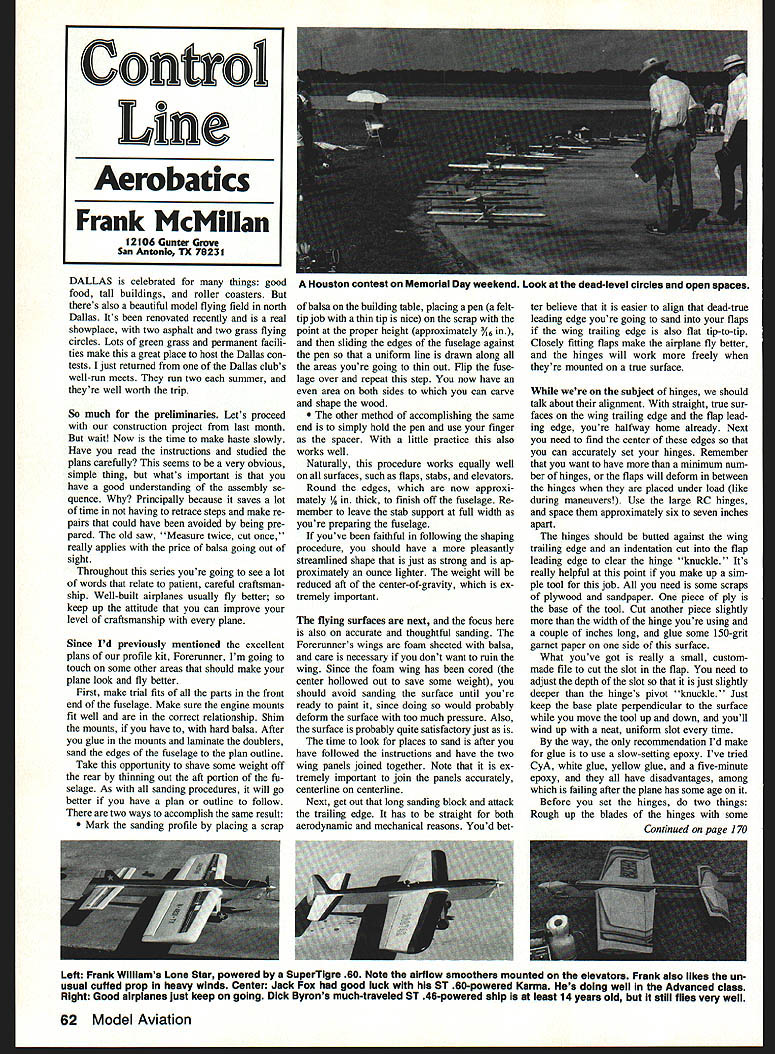
Dallas field
Dallas is celebrated for many things: good food, tall buildings, and roller coasters. But there's also a beautiful model flying field in north Dallas. It's been renovated recently and is a real showplace, with two asphalt and two grass flying circles. Lots of green grass and permanent facilities make this a great place to host the Dallas contests. I just returned from one of the Dallas club's well-run meets. They run two each summer, and they're well worth the trip.
Construction—general advice
So much for the preliminaries. Let's proceed with our construction project from last month. But wait! Now is the time to make haste slowly. Have you read the instructions and studied the plans carefully? This seems to be a very obvious, simple thing, but what's important is that you have a good understanding of the assembly sequence. Principally because it saves a lot of time in not having to retrace steps and make repairs that could have been avoided by being prepared. The old saw, "Measure twice, cut once," really applies with the price of balsa going out of sight.
Throughout this series you're going to see a lot of words that relate to patient, careful craftsmanship. Well-built airplanes usually fly better; so keep up the attitude that you can improve your level of craftsmanship with every plane.
Since I'd previously mentioned the excellent plans of our profile kit, Forerunner, I'm going to touch on some other areas that should make your plane look and fly better.
Front end assembly
First, make trial fits of all the parts in the front end of the fuselage. Make sure the engine mounts fit well and are in the correct relationship. Shim the mounts, if you have to, with hard balsa. After you glue in the mounts and laminate the doublers, sand the edges of the fuselage to the plan outline.
Thinning the aft fuselage
Take this opportunity to shave some weight off the rear by thinning out the aft portion of the fuselage. As with all sanding procedures, it will go better if you have a plan outline to follow. There are two ways to accomplish the same result:
- Mark the sanding profile by placing a scrap of balsa on the building table, placing a pen (a felt-tip with a thin tip is nice) on the scrap with the point at the proper height (approximately 3/16"), and then sliding the edges of the fuselage against the pen so that a uniform line is drawn along all the areas you're going to thin out. Flip the fuselage over and repeat this step. You now have an even area on both sides to which you can carve and shape the wood.
- The other method is to simply hold the pen and use your finger as the spacer. With a little practice this also works well.
Naturally, this procedure works equally well on all surfaces, such as flaps, stabs, and elevators. Round the edges, which are now approximately 1/8" thick, to finish off the fuselage. Remember to leave the stab support at full width as you're preparing the fuselage.
If you've been faithful in following the shaping procedure, you should have a more pleasantly streamlined shape that is just as strong and is approximately an ounce lighter. The weight will be reduced aft of the center of gravity, which is extremely important.
Flying surfaces—wings and sanding
The flying surfaces are next, and the focus here is also on accurate and thoughtful sanding. The Forerunner's wings are foam-sheeted with balsa, so care is necessary; you don't want to ruin the wing. Since the foam wing has a cored center (hollowed out to save some weight), you should avoid sanding the surface until you're ready to paint, since doing so would probably deform the surface with too much pressure.
Also, the surface is probably quite satisfactory; just take the time to look for places to sand after you have followed the instructions and have both panels joined together. Note that it is extremely important to join panels accurately, centerline to centerline.
Next, get out a long sanding block and attack the trailing edge. It has to be straight for both aerodynamic and mechanical reasons. You'll find it's easier to align that dead-true leading edge you're going to sand into your flaps if the wing trailing edge is also flat tip-to-tip. Closely fitting flaps make the airplane fly better, and the hinges will work more freely when they're mounted on a true surface.
Hinges—alignment and installation
While we're on the subject of hinges, we should talk about their alignment. With straight, true surfaces on the wing trailing edge and the flap leading edge, you're halfway home already. Next you need to find the center of the edges so that you can accurately set your hinges.
Remember that you want to have the minimum number of hinges; flaps will deform between hinges placed under load (like during maneuvers). Use large RC hinges spaced approximately six to seven inches apart. The hinges should be butted against the wing trailing edge, and an indentation cut in the flap leading edge to clear the hinge knuckle is really helpful.
At this point, make up a simple tool for the job. You need some scraps of plywood and a piece of sandpaper glued to a ply base. Cut another piece slightly wider than the hinge you're using, a couple of inches long; glue some 150-grit garnet paper to one side of this piece. What you've got is a really small custom-made file to cut the slot the flap needs. Adjust the depth of the slot so that it is just slightly deeper than the hinge's pivot "knuckle." Keep the base plate perpendicular to the surface and move the tool up and down; you'll wind up with a neat, uniform slot in no time.
Before you set the hinges, do two things: rough up the blades of the hinges with some coarse sandpaper (for better adhesion), and spread a thin coat of Vaseline on the hinge barrels so that the epoxy won't get into them.
By the way, the only recommendation I'd make for glue is to use a slow-setting epoxy. I've tried CYA (cyanoacrylate), white glue, and a five-minute epoxy, and they all have disadvantages, among which is failing after the plane has some air time on it.
Lubrication—tech tip
Lubricating the control system is a point you cannot overlook. The requirement is somewhat hidden unless you think about it a little. Lubricating is only part of the picture. You're asking the lubricant to penetrate your bellcrank's bearing points, form a coating, and basically stay put and perform its function for the life of the plane (which for us is several years!). Now, that's a tall order.
Ordinarily, oils will work for short periods of time, but then they dry out. There are a couple of other choices that I know will work:
- Use Vaseline with some Teflon powder mixed in. The touch of a warm soldering iron will flow the Vaseline into the bearing, and when it cools down, it will stay put and do its job. It will remain in a solid form at the normal temperatures one uses and be effective for as long as you can fly the plane. I've got planes with over 2,000 flights to their credit where the control rods are still free and the bearings are tight.
- Use motorcycle chain lube. This product comes out of its aerosol can as a foam and slowly changes state to become gel-like. You have to work the lube into the bearing, but once there it will stay put.
Transcribed from original scans by AI. Minor OCR errors may remain.

