
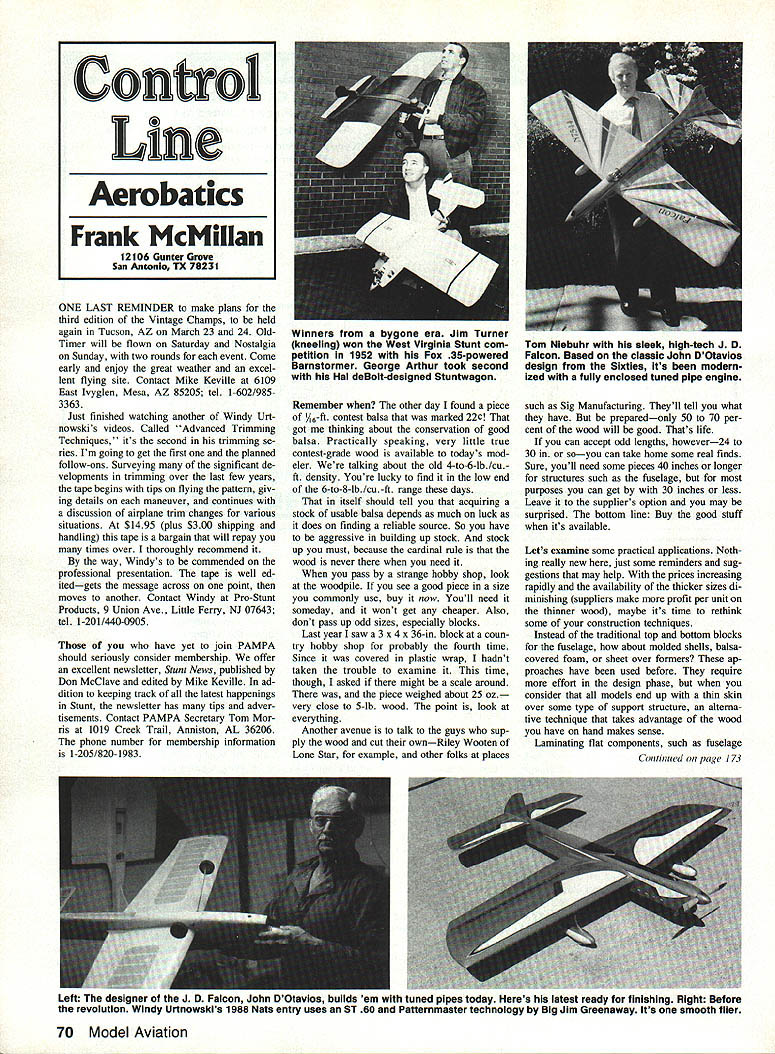
Control Line: Aerobatics
Frank McMillan
12106 Gunter Grove San Antonio, TX 78231
Vintage Champs — Tucson, AZ
One last reminder to make plans for the third edition of the Vintage Champs, to be held again in Tucson, AZ on March 23–24. Old-Timer will be flown on Saturday and Nostalgia on Sunday, with two rounds for each event. Come early and enjoy the great weather and an excellent flying site.
- Contact: Mike Keville
- Address: 6109 East Ivyglen, Mesa, AZ 85205
- Tel: 1-602-985-3363
Video recommendation: Advanced Trimming Techniques
I just finished watching another of Windy Urtnowski's videos, called "Advanced Trimming Techniques." It's the second in his trimming series; I plan to get the first and the planned follow-ons. The tape surveys many of the significant developments in trimming over the last few years. It begins with tips on flying the pattern, gives details on each maneuver, and continues with a discussion of airplane trim changes for various situations.
- Price: $14.95 (plus $3.00 shipping and handling) — a bargain that will repay you many times over. I thoroughly recommend it.
- Contact: Windy at Pro-Stunt Products, 9 Union Ave., Little Ferry, NJ 07643; tel. 1-201-440-0905.
Windy is to be commended for the professional presentation. The tape is well-edited—focuses on one point, then moves to another.
PAMPA membership
Those of you who have yet to join PAMPA should seriously consider membership. We offer an excellent newsletter, Stunt News, published by Don McClave and edited by Mike Keville. In addition to keeping track of all the latest happenings in stunt, the newsletter contains many tips and advertisements.
- Contact: PAMPA Secretary Tom Morris, 1019 Creek Trail, Anniston, AL 36206
- Phone for membership information: 1-205-820-1983
Balsa wood: sourcing and conservation
Practically speaking, very little true contest-grade balsa is available to today's modeler — by that I mean the old 4–6 lb/cu ft density. You're lucky to find the low end of the 6–8 lb/cu ft range these days. Acquiring usable stock depends as much on luck as on finding a reliable source. Be aggressive in building up stock: buy good stuff when it's available. The cardinal rule is that wood never gets cheaper. Don't pass up odd sizes, especially blocks.
Example: Last year I saw a 3 x 4 x 36-in. block in a country hobby shop. Since it was covered in plastic wrap I hadn't examined it closely. This time I asked the owner and the piece weighed about 25 oz — very close to 5-lb wood. The point is, look at everything.
Another avenue is to talk to the guys who supply the wood and cut their own — Riley Wooten of Lone Star, for example, and other folks at places such as Sig Manufacturing. They'll tell you what they have, but be prepared: only 50–70% of the wood will be good. You can accept odd lengths, however — 24 to 30 in. — so you can take home some real finds. Sure you'll need some pieces 40 in. or longer for structures such as fuselages, but for most purposes you can get by with 30 in. or less. Leave the supplier's option open and you may be surprised. The bottom line: buy the good stuff when it's available.
Practical construction techniques
Nothing really new here — just reminders and suggestions that may help as prices increase and thicker sizes diminish.
Consider alternative construction approaches that use thinner wood more efficiently:
- Molded shells
- Balsa-covered foam
- Sheet over formers
These require more effort in the design phase, but most models end up with a thin skin over some type of support structure, so an approach that takes advantage of the wood you have on hand makes sense.
Other techniques:
- Laminate flat components (for example, fuselage formers).
- Thin balsa sandwiches, especially when centers are cut out, provide excellent strength with little weight. Layers of 5/32-in. or 1/4-in. ply do equally well.
- When installing fuselage formers, glue a 1/16 x 1/4-in. piece across the fuse and perpendicular to the former. This creates an I-beam that strengthens the piece at virtually no weight increase.
When building, kit the pieces beforehand — at least the major components. This gets you thinking about the best method for each piece and allows you to use smaller bits of wood more efficiently. Big chunks of time seem to be just as hard to come by as good wood these days.
Grain orientation, triangulation, and layout
I still recommend triangulating everything.
A layout I saw recently for balsa wing skins for foam covering showed the grain running parallel to the trailing-edge hinge line. Though this saves some balsa (a sheet per wing half), I do not recommend it. Run the grain parallel to the leading edge. This gives greater torsional stiffness and makes the wing easier to sand; you end up with a more torsionally stable panel.
- Use triangulation on elevators and flaps as well.
- I like to cover stabilizers in a single piece per surface, so I use quarter-grain wood to achieve the desired stiffness.
- On solid surfaces, run the grain parallel to the trailing edge for the same effect.
When planning part layout, analyze how to orient the grain for each application. Each piece is unique; kit and plan ahead to conserve wood and achieve the desired strength and stiffness.
Balsa movement and correction techniques
Balsa is alive — it will move if you sand, paint, or wet it. You can look at it as stress relief. Cut one edge of a sheet to true it up, and your edge won't necessarily be true. Wet one side of a piece, and it may bow. Much depends on what you do and on the grain. My maxim: whatever you do, do it to both sides of the wood. This holds true through the very last coat of paint.
If a wing bows, don't give up — it happens to all of us. The El Diablo I just finished building had a major bow (over an inch) set into the trailing edge. There are limits, but here is a method I used to correct the problem:
- Mix ammonia with water to loosen the chemical bonding in the balsa and allow the bow to be molded.
- Saturate the bowed part with the ammonia-water mixture (do not use this on painted surfaces).
- Pin the wing to your building board with the tips braced opposite the bow. Because springback is usually about 50%, apply an amount of opposite deflection roughly equal to half the original bow (you may need to experiment).
- Keep the part pinned and let it dry completely; adjust and repeat if necessary.
This technique works with any raw balsa part. You can use it on twisted fuselages, but pressure must be applied opposite the existing twist until the part is completely dry.
Transcribed from original scans by AI. Minor OCR errors may remain.

