
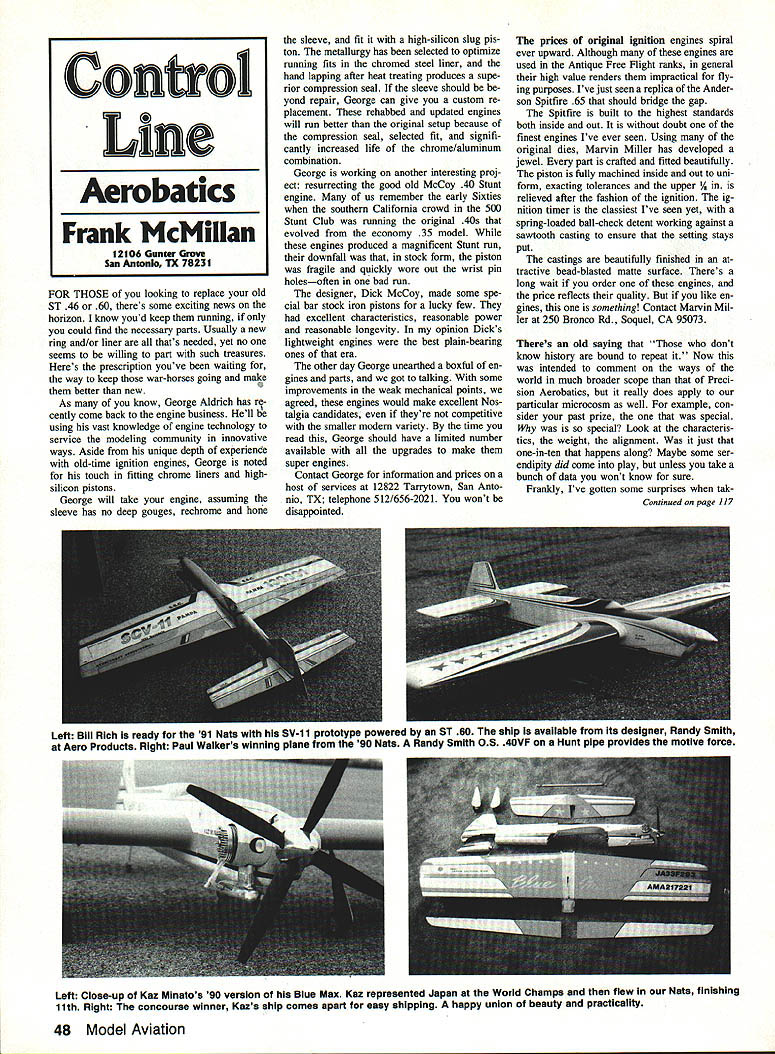
Control Line: Aerobatics
Frank McMillan 12106 Gunter Grove San Antonio, TX 78231
Engine rebuilding and upgrades
For those of you looking to replace your old .46 or .60 engines, there's some exciting news. Many of these warhorses only need a new ring and/or liner, yet parts are hard to find. Here's a prescription to keep them running — and make them better than new.
As many of you know, George Aldrich has recently returned to the engine business. Using his vast knowledge of engine technology, he services the modeling community in innovative ways. Besides his experience with old-time ignition engines, George is noted for fitting chrome liners and high-silicon pistons.
George will take your engine (assuming the sleeve has no deep gouges), rechrome and hone the sleeve, and fit it with a high-silicon piston. The metallurgy is selected to optimize running fits in the chromed steel liner, and the hand lapping after heat treating produces a superior compression seal. If the sleeve is beyond repair, George can make a custom replacement. These rehabbed and updated engines will often run better than the original setup because of the improved compression seal, selected fit, and the increased life of the chrome/aluminum combination.
George is working on another project: resurrecting the old McCoy .40 Stunt engine. Many remember the early Sixties when the southern California crowd in the 500 Stunt Club ran the original .40s that evolved from the economy .35 model. While these engines produced magnificent stunt runs, their downfall in stock form was fragile pistons that quickly wore out the wrist-pin holes — often in one bad run.
The designer, Dick McCoy, made some special bar-stock iron pistons for a lucky few. They had excellent characteristics, reasonable power, and reasonable longevity. In my opinion Dick's lightweight engines were the best plain-bearing ones of that era.
The other day George unearthed a box of engines and parts, and we got to talking. With some improvements to the weak mechanical points, we agreed these engines would make excellent nostalgia candidates, even if they're not competitive with smaller modern engines. By the time you read this, George should have a limited number available with all the upgrades to make them super engines.
Contact George for information and prices at: 12822 Tarrytown, San Antonio, TX — telephone 512/656-2021.
Antique ignition engines and replicas
The prices of original ignition engines keep spiraling upward. Although many are used in the Antique Free Flight ranks, their high value often makes them impractical for flying. I recently saw a replica of the Anderson Spitfire .65 that should bridge that gap.
The Spitfire replica is built to the highest standards, inside and out. It is without doubt one of the finest engines I've ever seen. Using many of the original dies, Marvin Miller has developed a jewel. Every part is crafted and fitted beautifully. The piston is fully machined inside and out to uniform, exacting tolerances, and the upper skirt is relieved after the fashion of the original. The ignition timer is the classiest I've seen yet, with a spring-loaded ball-check detent working against a sawtooth casting to ensure the setting stays put.
The castings are beautifully finished in an attractive bead-blasted matte surface. There's a long wait if you order one, and the price reflects the quality. But if you like engines, this one is something. Contact Marvin Miller at: 250 Bronco Rd., Soquel, CA 95073.
Lessons in building, trim, and construction
There's an old saying, "If you don't know history, you're bound to repeat it." While intended more broadly, it applies to precision aerobatics as well. Consider a past prize model that was special — why was it special? Look at its characteristics: weight, alignment, proportions. Was it just a lucky one-in-ten? Maybe serendipity played a part, but unless you collect data, you won't know for sure.
Frankly, I've had surprises when taking measurements on surfaces I've completed. Although I think I'm a reasonably accurate builder, I've found flaps with dimensions I never intended. Apparently, in final shaping the straight trailing edge or hinge line, the sanding block was just a little heavy.
The point is to check one last time before applying paint to make sure everything is the way you think it is. On my new Caudron, a final check showed the inboard flap had over 1/16 in. more chord at the root than the outboard one — a discrepancy that could have caused real trim problems if left uncorrected. Believe me, trying to find out what's inducing a roll can drive you up the wall.
Construction details and cowling attachment
My cardinal rule is that I have to be comfortable with what I do. After observing and evaluating many methods over the years, I've evolved my own way of attaching cowlings — one that I like and that works for me.
My best recommendation for arriving at a good approach to any construction problem is to review your experience, then study the best planes you can, both new and old. Why? You want to design and build for durability; you want the model to be well crafted and to hold together.
Look at how seams are fitted. Ask questions: are the edges faired? Do the sides fair nicely, or have they shrunk or expanded? The method of attaching the cowl may have forced its side out over time.
For the most part, I've found it best to avoid applying pressure at a single point against the seams — align them instead. I use four screws threaded into hardwood points, set up so that pressure is applied only to those points rather than being transmitted across the cowl area.
Design evolution and structural analysis
Good designs are evolutionary. The best fliers carefully examine their models and critique technique and structure. Good designs are made to fly, not to crash; so if a particular structure isn't absolutely essential, get out your Dremel. I've seen Al Raget take a Dremel tool to spars after he'd planked the wing and grind them down to nothing outboard of the gear points.
You can eliminate parts and mass by doing a meticulous structural analysis:
- Identify stress points.
- Determine which components absorb strain.
- Decide where you can remove material without compromising integrity.
Once that's done, pick your next structure-whittling step — and go for it.
Transcribed from original scans by AI. Minor OCR errors may remain.

