
Control Line: Aerobatics
Frank McMillan 12106 Gunter Grove San Antonio, TX 78231
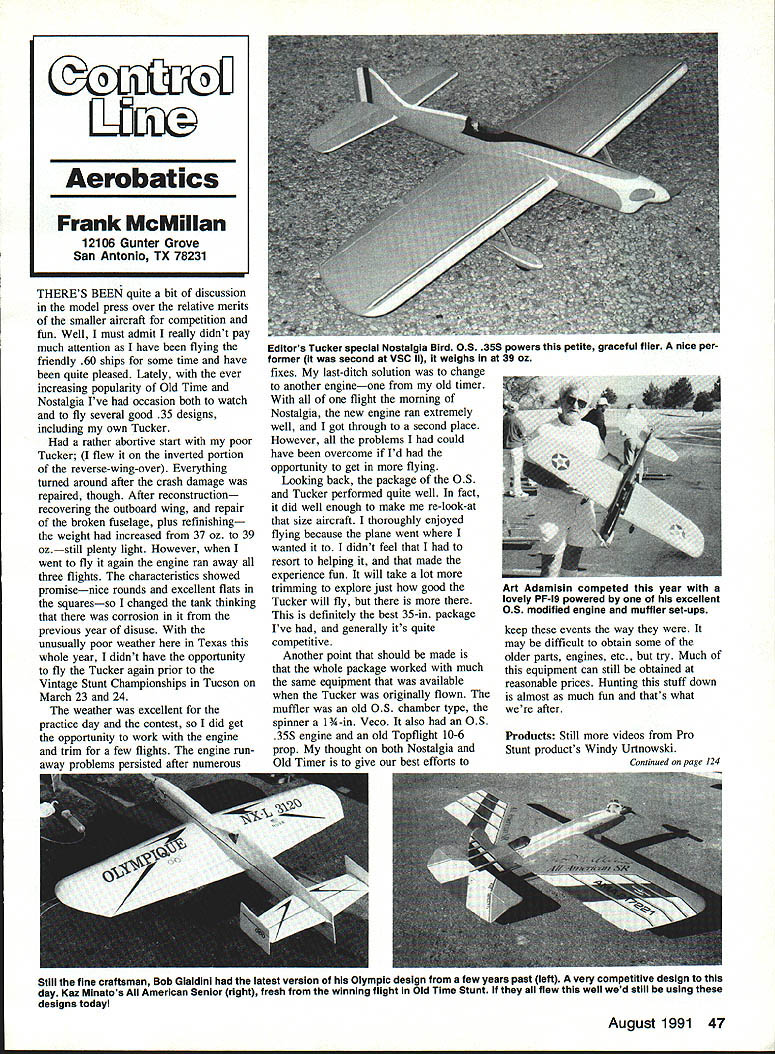
Tucker and .35 Designs
There's been quite a bit of discussion in the model press over the relative merits of smaller aircraft for competition and fun. I must admit I didn't pay much attention until I began flying smaller ships and found them very satisfying. Lately, with the growing popularity of Old Time and Nostalgia events, I've had the chance to watch and fly several good 35-inch designs, including my own Tucker.
I had an abortive start with the Tucker—it flew inverted for a portion of a reverse wing-over and was damaged. After reconstruction (recovering the outboard wing, repairing the broken fuselage, and refinishing), the weight increased from 37 oz. to 39 oz.—still plenty light. When I flew it again the engine ran away on all three flights. The airframe's characteristics showed promise—nice rounds and excellent flats in the squares—so I changed the tank thinking there was corrosion from previous disuse.
Vintage Stunt Championships — Tucson
Because of unusually poor weather in Texas I didn't get much more flying before the Vintage Stunt Championships in Tucson (March 23–24). Fortunately the weather was excellent on the practice day and contest day, so I had more opportunity to work on engine trim. The run-away problems persisted after numerous fixes. As a last-ditch solution I installed another engine—one from an old timer—and on that flight the engine ran extremely well. I finished in second place in Nostalgia. I feel the problems could have been overcome with more practice flights.
Looking back, the O.S./Tucker package performed well and made me reconsider this size of aircraft. I thoroughly enjoyed flying it because the plane went where I wanted it to; I didn't feel I had to "help" it. There's more trimming to do to explore the Tucker's full potential, but it is definitely the best 35-inch package I've had and is generally quite competitive.
Equipment and Nostalgia
An important point: the whole package worked with much the same equipment that was available when the Tucker was originally flown. The setup included:
- An old O.S. chamber-type muffler
- A 1 3/4-inch Veco spinner
- An O.S. .35S engine
- An old Topflite 10×6 prop
My thought on both Nostalgia and Old Timer events is to give our best efforts to keep these events true to their roots. It may be difficult to obtain some older parts and engines, but try—much of this equipment can still be found at reasonable prices. Hunting down these items is almost as much fun as flying, and that's part of the appeal.
Products and Resources
Windy Urtnowski — Videos and Tapes
Windy's product catalog video is an excellent way to see what services and items are available. As on all his tapes, there are many valuable tips on a variety of subjects, plus a series of patterns at the end to study.
One tape in particular covers basic finishing techniques and is full of hard-core information necessary to achieve consistent high-quality results. Windy details a solid approach to dope finishing that starts with surface prep and goes through to the final product. If you're a front-row Nats competitor you may not need it, but for everyone else this tape and some hard work can get you there. I recommend this product highly.
Contact: Windy at PSP, 9 Union Avenue, Little Ferry, New Jersey 07643; 201/440-0905.
Randy Smith / Aero Products
Another supplier who is extremely helpful is Randy Smith. He offers an extensive range of kits, engines, and accessories and stays on the leading edge of the latest technologies. Look for his new kit releases of two Bill Werwage designs, Juno and Janar—get in line early.
Contact: Randy at Aero Products, 1880 Scenic Highway, Snellville, GA 30278; 404/979-2035.
Recommended Publications
- Strictly I.C. — Focused on model internal combustion engines with testing and technical design articles, plus multi-part construction pieces. One notable article covered machining modern piston rings, including fixtures and heat treating. Covers are in color and well produced. Strictly I.C., 24920 43rd Ave. S., Kent, WA 98032 (6 issues for $24.25).
- The Home Shop Machinist — Focuses on hobbyist metalworking with many how-to articles useful for expanding your metalworking knowledge. Available in many bookstores or by subscription: The Home Shop Machinist, P.O. Box 1810, Traverse City, MI 49685 (1 year subscription for $21.00).
Finishing Tip — Avoid Magic Filler at the Canopy
On my cauldron I used Magic filler to feather the canopy area for a smooth transition. It looked great until I papered the fuselage and then built up clear. One section pulled loose as the clear built up; after repairs and more filler the surface softened and released the paper, leaving a bubble. I had to cut out that panel and redo it.
Lesson learned: don't feather the canopy area with Magic filler—use dope and sanding filler instead. Also be careful when papering near the canopy.
Aerobatics
Competitors and Designs
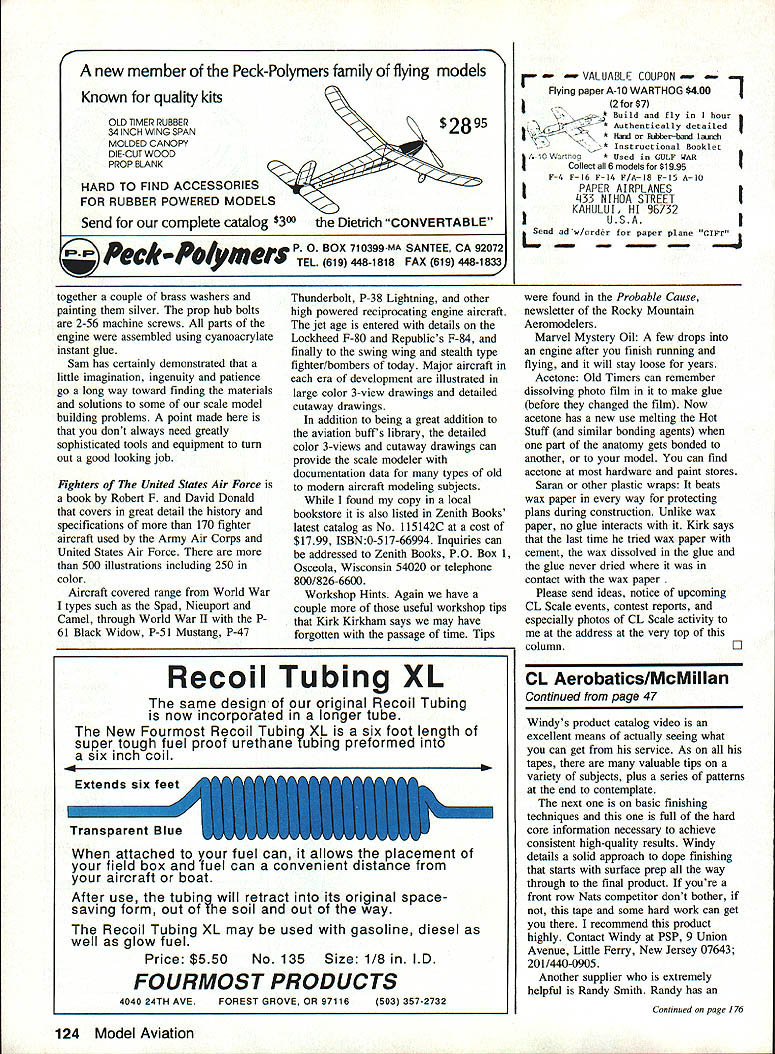
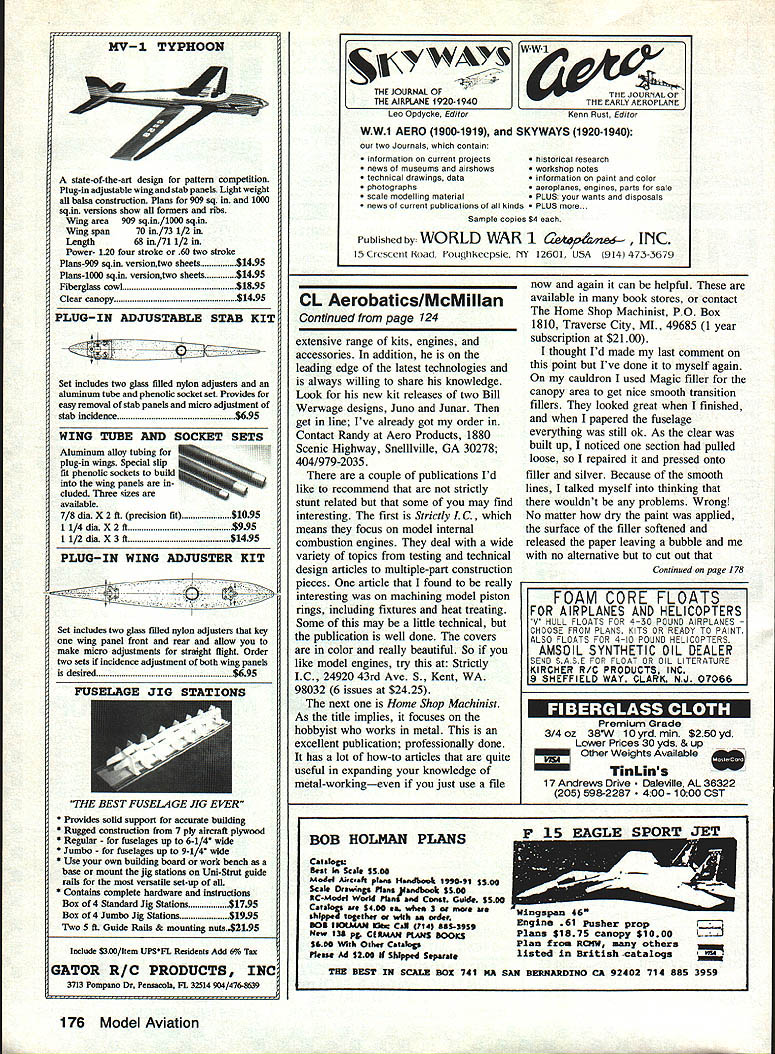
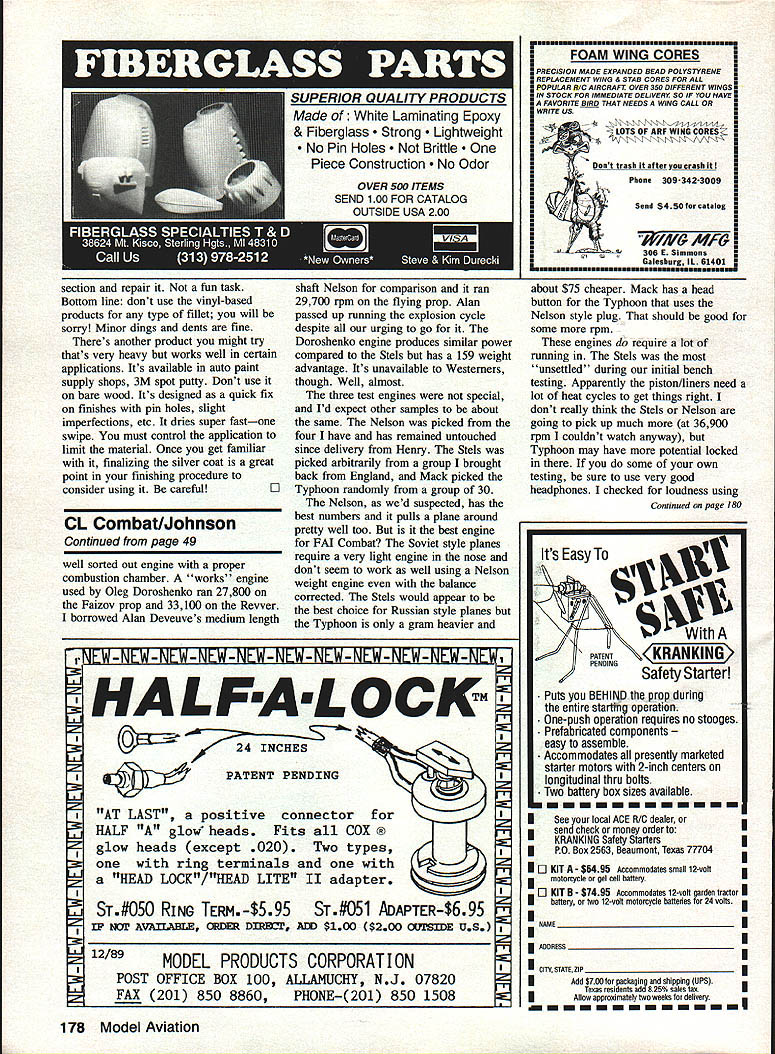
Art Adamisin competed this year with a lovely PF-19–powered ship and an excellent .05-modified engine/muffler setup. Bob Glaidini, still a fine craftsman, brought a latest-version Olympic design that was very competitive. Kaz Minato's American Senior, fresh from a winning flight, performed well in Old Time Stunt.
Building Tips and Ingenuity
We still use simple materials and a little ingenuity to solve scale model building problems: a couple of brass washers, painting silver prop-hub bolts, 2-56 machine screws, and assembling parts and engines using cyanoacrylate (instant) glue. Sam (one of our builders) has demonstrated that imagination, ingenuity, and patience go a long way. You don't always need highly sophisticated tools or equipment to produce a good-looking, well-performing model.
Transcribed from original scans by AI. Minor OCR errors may remain.

