
Control Line: Aerobatics
By Frank McMillan
12106 Gunter Grove San Antonio, TX 78231
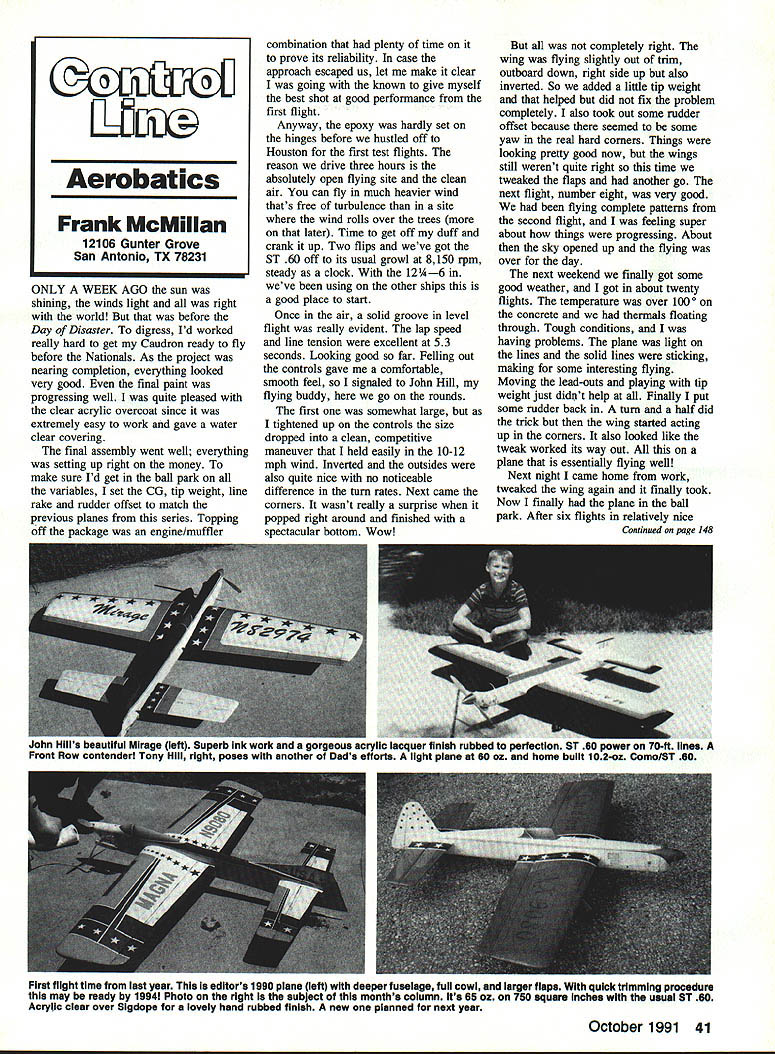
Only a week ago the sun was shining, the winds were light and all was right with the world. That was before the Day of Disaster. I'd worked hard to get my Caudron ready to fly before the Nationals. As the project neared completion everything looked very good. Final paint was progressing well; I was pleased with the clear acrylic overcoat — it was easy to work and gave a water‑clear finish.
Final assembly went smoothly; everything was setting up right on the money. To be sure I was in the ballpark on the variables, I set the CG, tip weight, line rake and rudder offset to match previous planes from this series. Topping off the package was an engine/muffler combination that had plenty of time on it to prove its reliability. I was going with known components to give myself the best shot at good performance on the first flight.
First test flights
The epoxy was hardly set on the hinges before we hustled off to Houston for the first test flights. We drive three hours to that site because it’s absolutely open with very clean air — you can fly in much heavier wind that is free of turbulence than at a site where the wind rolls over the trees.
Time to get off my duff and crank it up. Two flips and we had the ST .60 off its usual growl at 8,150 rpm, steady as a clock. With the 12x4‑6 in. prop we've been using on the other ships this was a good place to start.
Once in the air a solid groove in level flight was evident. Lap speed and line tension were excellent at 5.3 seconds. Feeling out the controls gave a comfortable, smooth feel, so I signaled to John Hill, my flying buddy, and we went rounds.
The first lap was somewhat large, but as I tightened up the controls the size dropped into a clean, competitive maneuver that I held easily in the 10–12 mph wind. Inverted outsides were also quite nice; there was no noticeable difference in turn rates. Next came the corners — it wasn't a surprise when it popped right around and finished with a spectacular bottom. Wow!
The wing was flying slightly out of trim — outboard down on the right side, both upright and inverted. We added a little tip weight which helped but didn’t cure it completely. I also removed some rudder offset because there seemed to be some yaw in the very hard corners. Things were looking pretty good, but the wings still weren't quite right, so we tweaked the flaps and had another go. Flight number eight was very good. By the second flight we were flying complete patterns and I was feeling great about progress. About that time the sky opened up and flying was over for the day.
Continued tuning
The next weekend we finally got some good weather and I managed about twenty flights. The temperature was over 100°F on the concrete and thermals were floating through — tough conditions. I was having problems: the plane was light on the lines and the solid lines were sticking, making for some interesting flying. Moving the lead‑outs and playing with tip weight didn't help. Finally I put some rudder back in — a turn and a half did the trick.
The wing started acting up again in the corners; it looked like the tweak was working its way out. Still, the plane was essentially flying well. The next night I came home from work, tweaked the wing again, and it finally took. Now I had the plane in the ballpark. After six flights it was relatively nice. Under those conditions there was no question in my mind this was a great plane, destined to get better with more work on props and fine tuning. I was still basically flying on much the same preflight settings or very close to them.
Day of disaster
A couple of days later we had a flying session here in San Antonio. Again it was hot and windy, and the wind was coming over the trees bordering the ramp area where I fly. That produced occasional rolling balls of turbulence which made things “fun.”
We flew and flew, trying to see what worked in the wind. One thing we noticed was a slight difference in elevator alignment versus the flaps. I realigned the trim but that turned out to be a mistake. It helped to a point, but in trimming the alignment of flaps and elevators got out of whack. We chased that problem through flight after flight on a 100‑plus degree runway.
The final mistake was pushing the plane through the pattern when the wind had gotten beyond safe limits, combined with the turbulence, temperature and thermal activity. Coming out of a second hourglass I had the airplane inverted and pulled out an inch too low. The wings were gone as a result of the gear impacting the surface — basically it was a write‑off.
Lessons learned
Let me discuss the bad lesson first because it still hurts to lose the best plane I ever had my hands on. It was pilot error without doubt. Sure the circumstances contributed, but there wasn't anyone but me pushing it. The prolonged flying session in intense heat had my reactions and judgment off — I am certain of that. Also, because of the conditions I shouldn't have even taken the plane out of the car. Either point could have caused the crash; together it was certain.
Bottom line, guys: don't push too hard when the return isn't there, or you'll wind up like me, looking at the old plane for this Nationals.
Transcribed from original scans by AI. Minor OCR errors may remain.

