
Control Line: Aerobatics
Frank McMillan 12106 Gunter Grove San Antonio, TX 78231
Winter, names, and the Tucson Vintage Stunt Championships
Winter will be upon most of us by the time you read this, and many of us will be hibernating in our workshops, thinking about our next high‑tech "killer." Of course, even tougher than building is conjuring up names for our creations — for example, how can Paul Walker go beyond "Totally Bad"? And can he top that screaming fluorescent paint job?
Winter is also a good time to plan some fun in the sun. The Vintage Stunt Championships (fourth edition) in Tucson, Arizona, is coming up and it’s going to be bigger than ever.
- Date: March 21–22, 1992
- Saturday, March 21: Old Time Stunt (ignition and glow as separate events) and a banquet in the evening
- Sunday, March 22: Nostalgia
- Rules: Pampa rules as in previous years; winners selected based on the total of two rounds flown
- Note: Plan to arrive early — there’s lots of flying and touring during the week
This year commemorates the 40th anniversary of the renowned Ringmaster kit. I remember paying $2.95 for those kits — I must have gone through at least a dozen. There will be two special awards honoring the design: Most Authentic and High Point (appropriate for Old Time Stunt glow).
For more information contact: JoAnn Keville 6109 E. Ivyglen, Mesa, AZ 85205 602/985‑3363
Remember: this isn’t a design contest — we’re here to have fun and celebrate the way it was.
Tech Tips
Recent photo features of semi‑scale stunters prompted a thought about one familiar example: Al Rabe’s Sharks Teeth P‑51. Hard to believe it was first campaigned at the 1976 Nationals in Dayton, won the 1977 Nationals in Riverside, helped earn a place on the F2B team, and finished second in the 1978 Worlds — all after a major repair effort early in its life.
Al was practicing alone using a stooge when a rag flipped up into the prop and broke a blade. Vibration ripped the nose section off; the spinner and engine kept running and the remainder of the plane, leading edge back, stayed attached to the stooge. Undaunted, Al built a new nose section using the same molded‑shell construction and used a jig to reconstruct and realign the semi‑scale.
He cut off the wingtips, slid dual 3/8‑in. aluminum tubes through the wing to hold alignment, grafted the new nose and realigned the thrust line. Within a week the new nose was finished; the jig tubes were removed, the wingtips restored, Hobby Poxy and fiberglass were applied, a few panel lines and access panels added, plus the shark’s mouth — and the plane was ready to fly. Less than ten days’ work and only a half‑ounce weight increase produced a very competitive airplane. To date it has logged well over three thousand flights and remains flyable, awaiting Nostalgia eligibility.
Lessons from the tale:
- Good airplanes deserve to be saved.
- Accidents will happen if you fly a lot; treat post‑event cleanup seriously.
- Clean up oil and debris; collect all pieces for possible reuse and set them aside for a couple of days before deciding on reconstruction.
Repair and reconstruction approach
Before touching damaged remnants, plan the repair. Break the job into phases and think it through. Two areas can get away from you quickly: alignment and weight. This is not the time to rush.
- Do only what is absolutely necessary to remove structurally unsound wood.
- If fractures can be rejoined cleanly, that is usually best, but be careful not to disturb alignment angles.
Example (Tucker fuselage repair): I made trial fits and forced jagged edges together. When stabilizer alignment looked good I tacked the edges and checked again, then injected Hot Stuff into all mating parts so the joint was sound but still needed reinforcement.
Glass cloth reinforcement method:
- Clear a strip of bare wood about 1/8 in. on either side of the fracture.
- Cut several 1/4‑in. strips of 6/10 oz. glass cloth.
- Apply strips to the bare wood with instant‑set CA glue, building layers until roughly half filled.
- Sand the strip with a small sanding block to knock off stray fibers and smooth the joint.
- Repeat until the gap is bridged and smoothed.
The multiple layers of cloth will form a very hard, easily finished, and structurally strong surface. This method works best on supported structures (like fuselages); for wings or stabilizers, consider additional bridging framework to carry flight loads.
Refinishing tips:
- Refinish only what you must.
- Use small sanding blocks to minimize damage to adjacent paint.
- Apply a little filler by airbrush and sand it off for best blending.
- If possible, use the original paint colors you retained and restrict spray to the repaired area.
Resources
GRW (Glen Wells) produces some excellent combat‑oriented products and kits. Contact: GRW P.O. Box 1011 White Oak, TX 75693 Phone: 903/759‑3942
Glen’s Slow Combat kit of the East Texas Slow and his sturdy tanks and slotted motor mounts are well designed. One of his tanks helped earn sixth place at the 1991 Nationals. The bolt‑style elevator horn offers wide leverage variation and long life compared with aluminum horns.
Aerobatics in Nostalgia
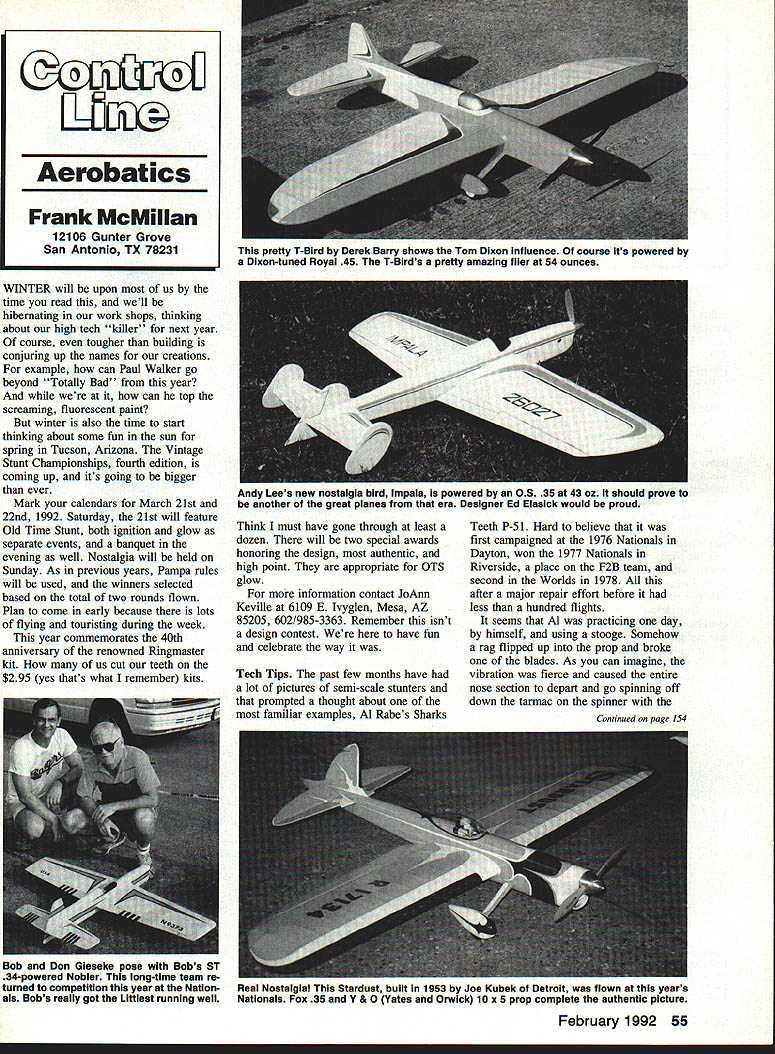
- Derek Barry’s T‑Bird (showing Tom Dixon influence) is powered by a Dixon‑tuned Royal 45. T‑Birds are impressive flyers at 54 ounces.
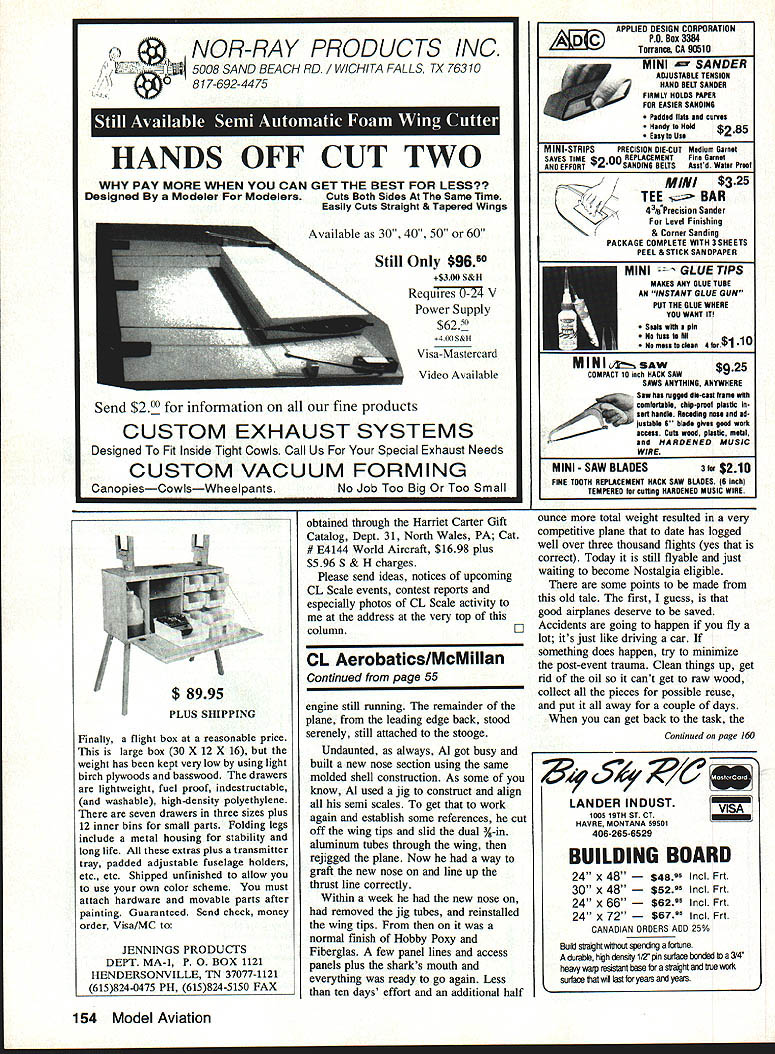
- Andy Lee’s new nostalgia plane, Impala, powered by an OS‑35 and weighing 43 oz., should be another great period model; designer Ed Elasick would be proud.
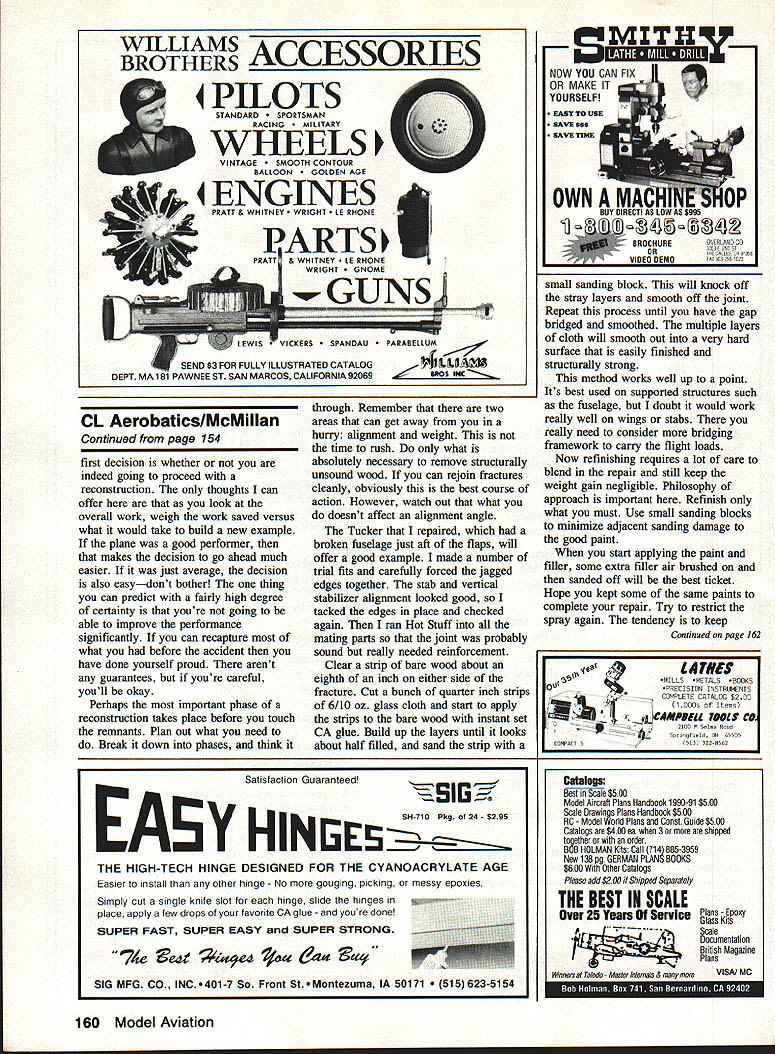
- Bob Don Gieseke’s ST‑34‑powered Nobler returned to competition at the Nationals last year; Bob’s Littlest is running well.
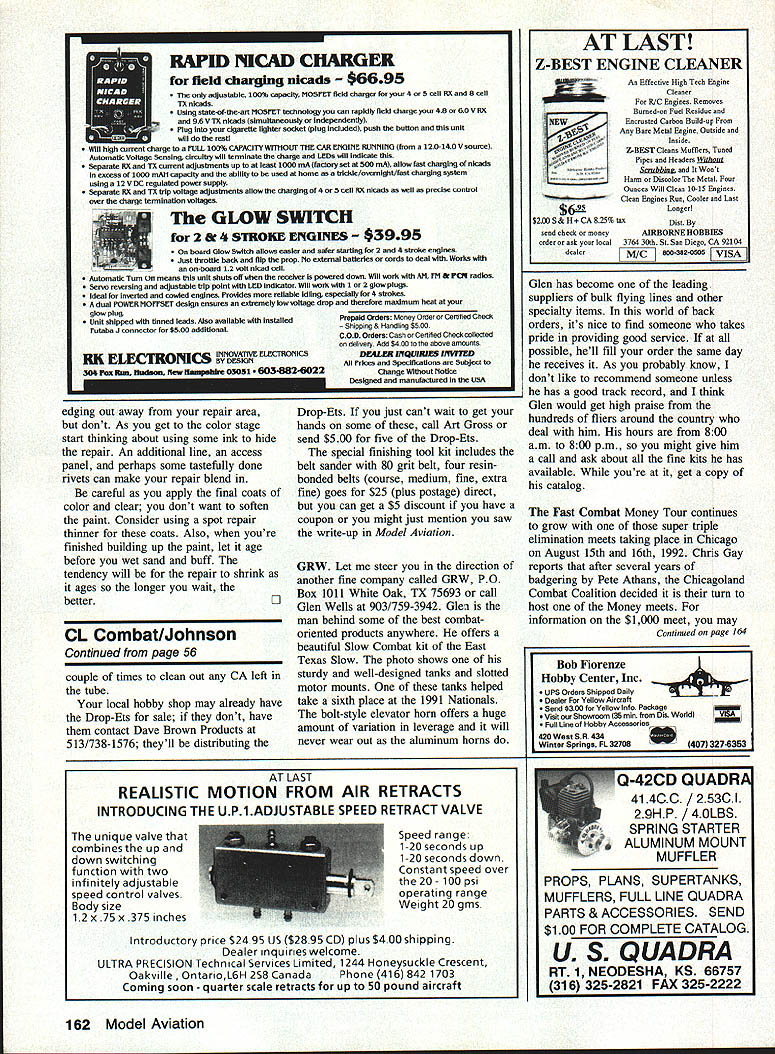
- A real Nostalgia Stardust, built in 1953 by Joe Kubek of Detroit and flown for years at Nationals with a Fox 35, provides an authentic picture of the era.
If you have ideas, notices of upcoming C/L scale events, contest reports — especially photos — please send them to the CL Aerobatics column address at the top of this column.
Transcribed from original scans by AI. Minor OCR errors may remain.

