
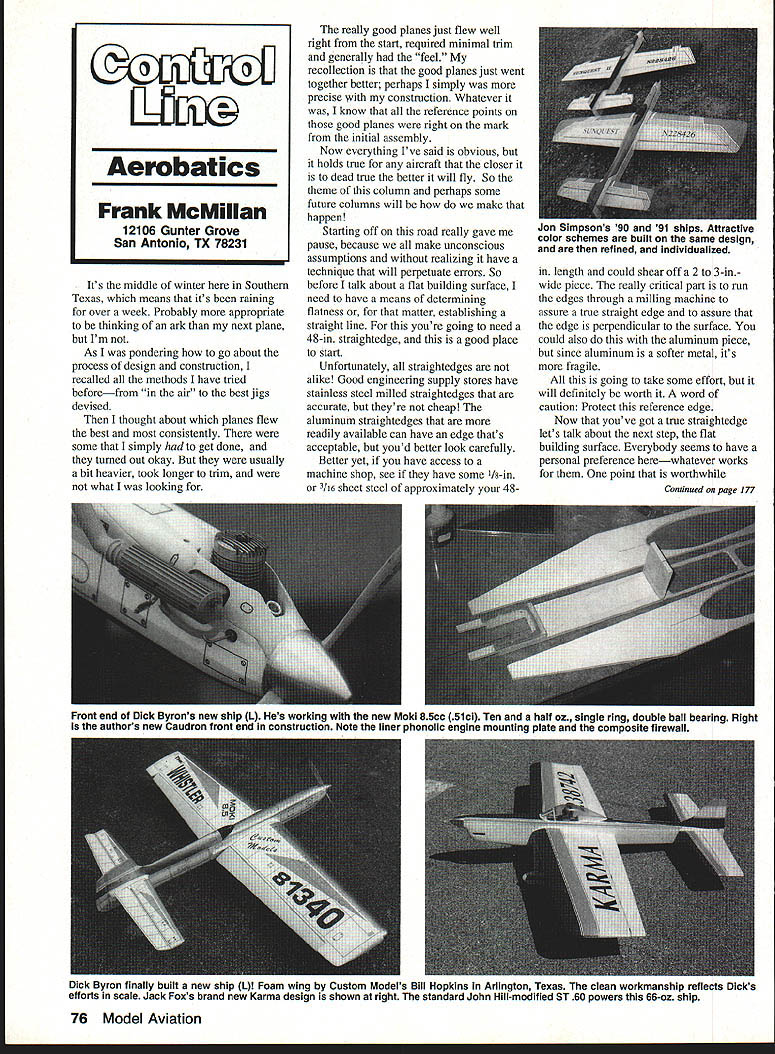
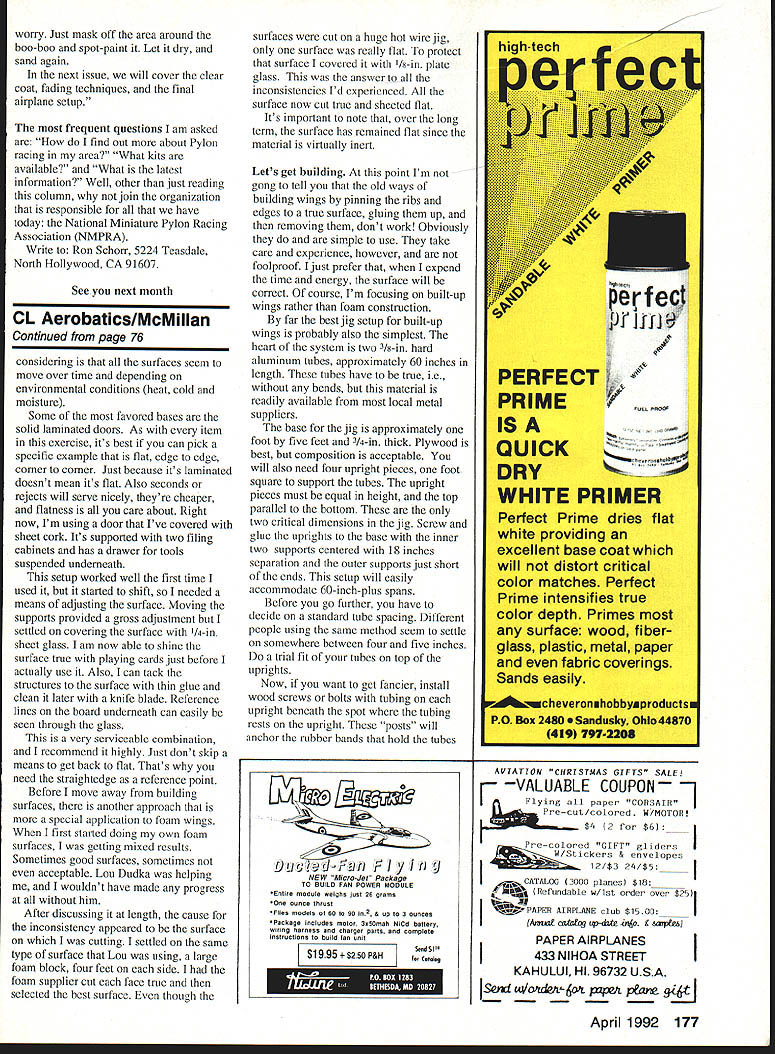
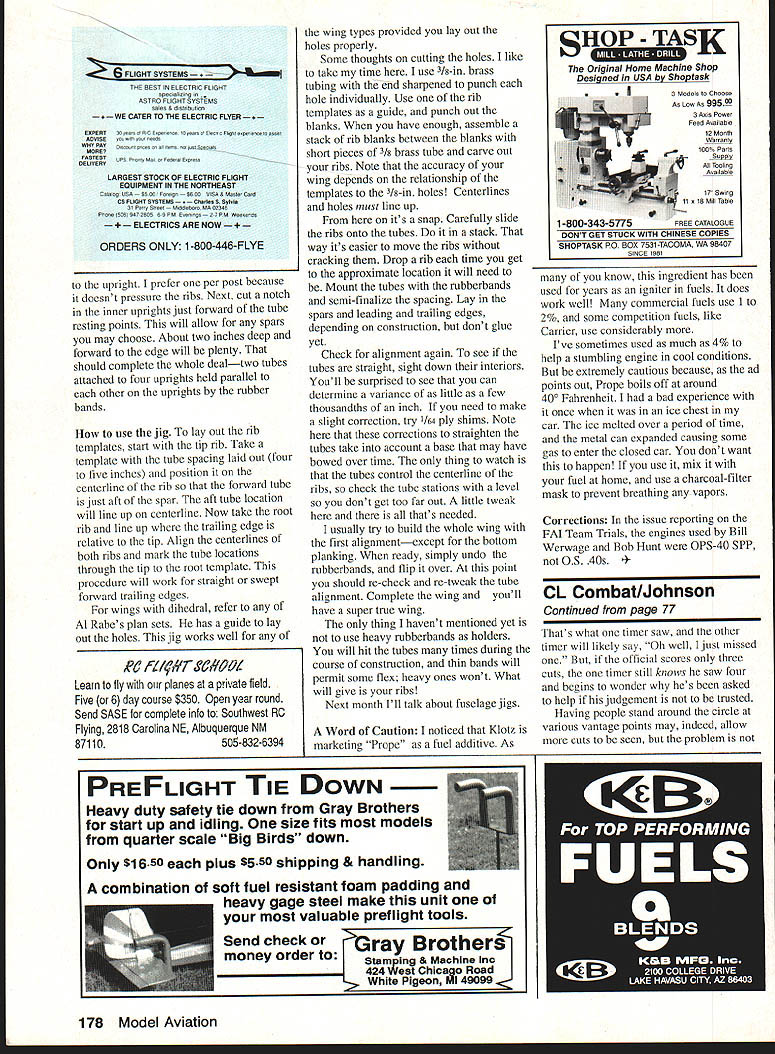
Control Line: Aerobatics
Frank McMillan 12106 Gunter Grove San Antonio, TX 78231
It's the middle of winter here in Southern Texas, which means that it's been raining for over a week. Probably more appropriate to be thinking of an ark than my next plane, but I'm not.
As I was pondering how to go about the process of design and construction, I recalled all the methods I have tried before — from "in the air" to the best jigs devised.
Then I thought about which planes flew the best and most consistently. There were some that I simply had to get done, and they turned out okay. But they were usually a bit heavier, took longer to trim, and were not what I was looking for.
The really good planes just flew well right from the start, required minimal trim and generally had the "feel." My recollection is that the good planes just went together better; perhaps I simply was more precise with my construction. Whatever it was, I know that all the reference points on those good planes were right on the mark from the initial assembly.
Now everything I've said is obvious, but it holds true for any aircraft: the closer it is to dead true the better it will fly. So the theme of this column — and perhaps some future columns — will be how do we make that happen!
Starting off on this road really gave me pause, because we all make unconscious assumptions and without realizing it have a technique that will perpetuate errors. So before I talk about a flat building surface, I need to have a means of determining flatness or, for that matter, establishing a straight line. For this you're going to need a 48-in. straightedge, and this is a good place to start.
Not all straightedges are alike. Good engineering supply stores have stainless steel milled straightedges that are accurate, but they're not cheap. The aluminum straightedges that are more readily available can have an edge that's acceptable, but you'd better look carefully.
Better yet, if you have access to a machine shop, see if they have some 1/8- or 3/16-inch sheet steel of approximately your 48-in. length and could shear off a 2- to 3-in.-wide piece. The really critical part is to run the edges through a milling machine to assure a true straight edge and to assure that the edge is perpendicular to the surface. You could also do this with the aluminum piece; since aluminum is a softer metal, it is more fragile. A word of caution: protect this reference edge.
Building Surfaces
Now that you've got a true straightedge, let's talk about the next step: the flat building surface. Everybody seems to have a personal preference here—whatever works for them. One point that is worthwhile considering is that surfaces seem to move over time depending on environmental conditions: heat, cold, moisture. Some favored bases are solid laminated doors.
As an item of exercise, pick a specific example—flat edge, corner. Just because it's laminated doesn't mean it's flat. Also, seconds or rejects will serve nicely; they're cheaper and flatness is what you care about. Right now I'm using a door I've covered with sheet cork. It's supported on two filing cabinets and has drawer tools suspended underneath. This setup worked well initially, but it started to shift and needed a way to adjust the surface. I adjusted the supports to provide gross correction; I then covered the surface with 1/4-in. plate glass and am now able to shine the surface true. Reference lines on the board underneath can easily be seen through the glass. It's a very serviceable combination—highly recommended. Just don't skip a means to get back to flat.
Foam Surfaces (for foam wings)
Before I move away from building surfaces, another approach for special application — foam wings — is worth describing. When I first started doing my own foam surfaces, I was getting mixed results. Sometimes good surfaces, sometimes not even acceptable. Lou Dudka was helping me, and I wouldn't have made any progress at all without him.
After discussing it at length, the cause for the inconsistency appeared to be the surface on which I was cutting. I settled on one type of surface that Lou was using: a large foam block, four feet on each side. I had the foam supplier cut each face true and then selected the best surface. Even though the surfaces were cut on a huge hot-wire jig, only one surface was really flat. To protect that surface I covered it with 1/4-in. plate glass. This was the answer to all the inconsistencies I'd experienced. All the surfaces now cut true and sheathed flat.
It's important to note that, over the long term, the surface has remained flat since the material is virtually inert.
Built-Up Wing Jigs
Let's get building. I'm not saying the old ways—building wings by pinning the ribs and edges to a true surface, gluing them up, and then removing them—don't work. Obviously they do and are simple to use. They take care and experience, however, and are not foolproof. I just prefer that, when I expend the time and energy, the surface will be correct. Of course, I'm focusing on built-up wings rather than foam construction.
By far the best jig setup for built-up wings is probably also the simplest. The heart of the system is two 3/8-in. hard aluminum tubes, approximately 60 inches in length. These tubes have to be true, i.e., without any bends, but this material is readily available from most local metal suppliers.
The base for the jig is approximately one foot by five feet and 3/4-in. thick. Plywood is best, but composition is acceptable. You will also need four upright pieces, one foot square, to support the tubes. The upright pieces must be equal in height, and the top parallel to the bottom. These are the only two critical dimensions in the jig. Screw and glue the uprights to the base with the inner two supports centered with 18 inches separation and the outer supports just short of the ends. This setup will easily accommodate 60-inch-plus spans.
Before you go further, you have to decide on a standard tube spacing. Different people using the same methods seem to settle on somewhere between four and five inches. Do a trial fit of your tubes on top of the uprights.
If you want to get fancier, install wood screws or bolts with tubing on each upright beneath the spot where the tubing rests on the upright. These "posts" will anchor the rubber bands that hold the tubes for most wing types, provided you lay out the holes properly.
Some thoughts on cutting the holes:
- Take your time. I use 3/8-in. brass tubing with the end sharpened to punch each hole individually.
- Use one of the rib templates as a guide and punch out the blanks.
- When you have enough, assemble a stack of rib blanks with short pieces of 3/8-in. brass tube between the blanks and carve out your ribs.
- Note that the accuracy of your wing depends on the relationship of the templates to the 3/8-in. holes — centerlines and holes must line up.
From here on it's a snap. Carefully slide the ribs onto the tubes, doing it in a stack. That way it's easier to move the ribs without cracking them. Drop a rib each time you get to the approximate location it will need to be. Mount the tubes with the rubber bands and semi-finalize the spacing. Lay in the spars and leading and trailing edges, depending on construction, but don't glue yet.
Check for alignment again. To see if the tubes are straight, sight down their interiors. You'll be surprised to see that you can determine a variance of as little as a few thousandths of an inch. If you need to make a slight correction, try 1/64-in. ply shims. These corrections to straighten the tubes take into account a base that may have bowed over time. The only thing to watch is that the tubes control the centerline of the ribs, so check the tube stations with a level so you don't get too far out. A little tweak here and there is all that's needed.
I usually try to build the whole wing with the first alignment—except for the bottom planking. When ready, simply undo the rubber bands and flip it over. At this point you should re-check and re-tweak the tube alignment. Complete the wing and you'll have a super-true wing.
The only thing I haven't mentioned yet is not to use heavy rubber bands as holders. You will hit the tubes many times during the course of construction, and thin bands will permit some flex; heavy ones won't. What will give is your ribs!
Next month I'll talk about fuselage jigs.
A Word of Caution
I noticed that Klotz is marketing "Prope" as a fuel additive. As many of you know, this ingredient has been used for years as an igniter in fuels. It does work well. Many commercial fuels use 1 to 1-1/2% and some competition fuels, like Carrier, use considerably more.
I've sometimes seen this reach as high as 4% to help a stumbling engine in cool conditions. But be extremely cautious because, as the ad points out, Prope boils off at around 40°F. I had a bad experience with it once when it was an ice chest in my car. The ice melted over a period of time, and the metal can expanded causing some gas to enter the closed car. You don't want this to happen. If you use it, mix it with fuel at home, and use a charcoal-filter mask to prevent breathing any vapors.
Corrections
In the issue reporting on the FAI Team Trials, the engines used by Bill Wrevig and Bob Hunt were OPS-40 SPR, not O.S. .40s.
Transcribed from original scans by AI. Minor OCR errors may remain.

