
Control Line: Aerobatics
Frank McMillan 12106 Gunter Grove San Antonio, TX 78231
Another Vintage Stunt Championships has come and gone. Every year the character of the event changes: more new and old faces appear, and the number of contestants increases. Marvelous new airplanes and older resurrected ones magically appeared from all manner of vehicles as the weekend approached.
With the really bad storms in the East, many took advantage of the good weather in Tucson and came early to fly and sightsee. In general, conditions remained excellent throughout the week, as they usually are this time of year in Tucson.
Many newcomers attended this year. Among them was Walt Pyron, one of the major designers and fliers from the fifties and sixties. This year Walt brought a 25-year-old Conquistador, designed by Thornton Hoffman. Seeing it really brought back memories, as I'd flown against "Thorny" and his original. With its thin, elliptical wing and K&B green-head engine, Thorny's model was fast and absolutely gorgeous.
Finished in a colorful blue-and-orange scheme, Walt's example was certainly as beautiful as Thorny's original. What surprised me was the quality of the plane — the finish was old Aerogloss and hand-rubbed to perfection. There's no question in my mind that the Conquistador was and is a front-row plane. The craftsmanship in the woodwork was just as good as the paintwork. It's really nice to see that memories of the glory days weren't wrong.
Bob Hunt crafted an exceptional Tucker Special to compete in Nostalgia this year. As elegant as the original, it features a lovely red-and-blue sunburst pattern in the wings with gold "Tucker Special" lettering and AMA numbers. The incredible fact about this plane is that it weighs only 35 1/2 oz. ready to fly! Using a new technique for creating accurate wing ribs by slicing up a foam slab, Bob achieved a super-true wing.
What Bob does is use the customary root-and-tip rib template method to create a standard foam-core wing panel. He then draws the exact rib locations on the foam and slices that piece off the panel. This gives him an accurate rib template for use in constructing a built-up wing panel.
Bob also uses a different method for final assembly. Instead of building the wing in a jig or on a board, Bob assembles the basic wing up to the point of applying the planking, paints slow-set epoxy on the ribs and spars where the planking will be positioned, and sets the planking in the foam wing saddles. He then positions the basic wing and the remaining foam saddle.
From this point on the wing is treated like a sheeted foam wing. Bob places the saddles containing the planking and framework on a dead-flat surface, weights them lightly, adjusts as necessary, and finally weights them more heavily.
What emerges after the glue has cured is a wing that is absolutely true, because the amount of glue has been restricted, and extremely light. At 37 oz., my Tucker Special was an ounce and a half heavier than Bob's. (At least, that's the weight I started out with; repairing crash damage nudged it up to 39 oz.) Bob's technique is worth exploring, and I'll tell you more after I give it a try.
I've heard that Bob and Bill Werwage have built Bill's geodetic Geo Maxes using this method and have come out with a complete wing weighing only 4 1/2 oz. That's absolutely astounding.
VSC IV
But let's get back to VSC IV. Bob Baron joined us this year for the first time, and with good air blew us all away. He brought one of his many unusual designs from the Nostalgia era; this particular model having been built in 1966. Flying one of your own planes that you actually campaigned is a neat idea, and that's what Bob did.
His petite Humbug was designed by Bill Netzeband as an exercise in developing a plane that would turn a true five-foot-radius corner. We really don't worry about the perfectly radiused corner anymore, but Bob's little plane, powered by a Tom Dixon–prepared Magnum .28, really turned a sharp corner.
Even more surprising is the absence of flaps, unusual for a Stunter of that or later vintage. Suffice it to say that Bob was thrilled with the quick turns and the fun characteristics, but found the plane a bit touchy to fly. He's working on a .40-size Humbug. If it's ready, he'll fly it at this year's Nationals.
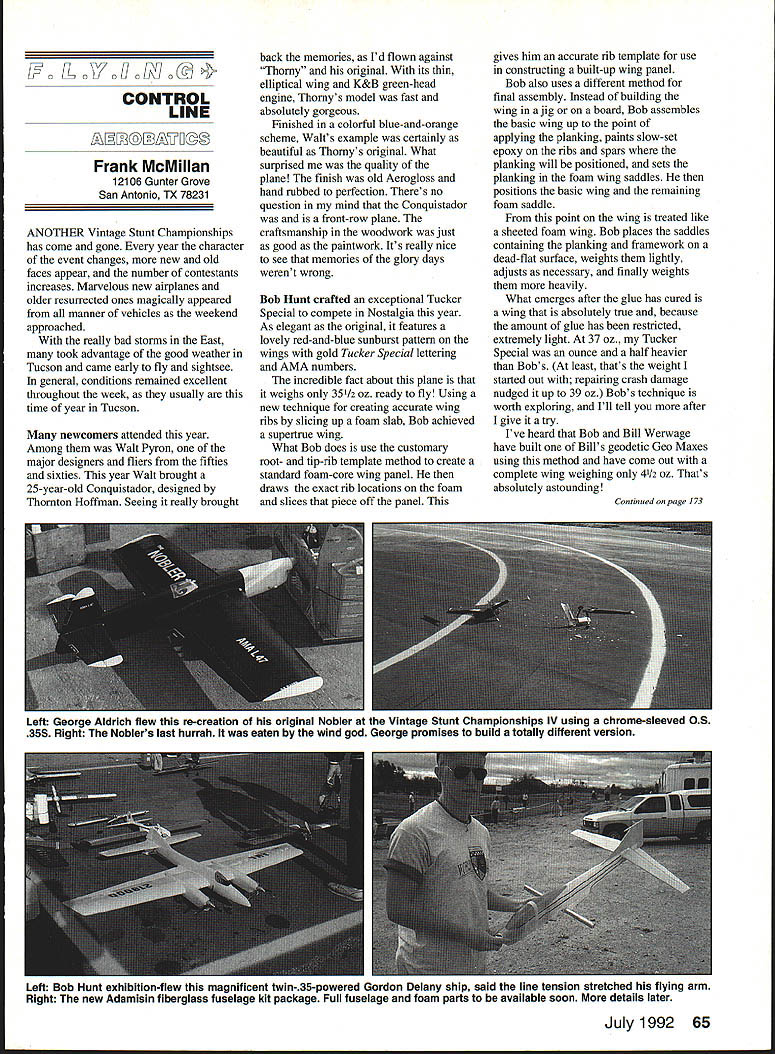
Many neat Nostalgia ships were in evidence this year, but at least one won't be seen again. As he has before, Bart Klapinski flew Gordon Delany's excellent twin-engine design from the early sixties. After another very credible performance, Bart decided it was time to retire the bird and clipped the leads-outs.
Likewise, the passing of George Aldrich's Nobler was a loss in Old-Time; an untimely wind caused its demise. George's airplane was painted like his original and flew slowly and well. He promises to build a totally new Nobler, probably one of the Magnum versions (not the Sig kit of the same name).
For those who haven't heard, there actually was a follow-on to the Nobler: a Super Nobler that embodied much of the original but was sleeker and more elegant. John Havel had a Folkerts Racer (a Folkerts "Jupiter" — a 1930s racing-style Stunter with an authentic paint scheme) in the early sixties that was essentially a Magnum, and it flew exceptionally well. Perhaps we can get George to make plans available now that I've returned them after 25 years?
Some months ago I mentioned in this column the Ringmaster anniversary feature to be held at VSC IV. At least a half dozen examples were on hand, many of them painted to replicate the color scheme on the original kit box. All the Ringmasters were flown successfully, but Ted Fancher's not only flew exceptionally well but was by far the most beautiful I've ever seen. Frankly, I can't recall ever having seen a Ringmaster fly that capably. Perhaps the secret is that it weighs all of 22 ounces! Guys, it takes a lot of attention to detail to push the weight that low. Obviously, it paid off in performance.
Ted used a vintage Torpedo .29 for power. The engine ran very well throughout the week—that is, until the last flight. Ted was putting in perhaps the highest flight of Old-Time when, right toward the end, the propeller and half the crankshaft departed the engine. That finished the flight with a DQ (Disqualified — Ed.).
I must applaud Ted's intent in using an engine from that era. The object of Old-Time and Nostalgia is to have fun and experience the way the planes and power plants flew in those days. What better way than to use the actual equipment and make it work again? Sometimes it's a little more difficult, but the personal satisfaction makes it well worthwhile.
The Vintage Stunt Championships is destined to continue in Tucson for many years. The number of entries grows steadily, and many of the perennial attendees build at least one new plane each year. An unofficial part of the meet, the exhibition flying on Sunday, has turned out to be as much fun as the actual contest for spectators and contestants alike.
This year Bob Hunt flew a sleek, modern twin-engine Gordon Delany ship and had his flying arm stretched three inches. Bart Klapinski put on an unbelievable pull, modern pattern, with a virtually scale Stearman PT-17. They both gave us a real thrill. I hope this sort of thing will happen again in the years to come. It got me thinking about bringing out the MB-5 for Bart to fly!
Let's start thinking about supporting the East Coast Old-Time/Nostalgia contest in Winston-Salem, North Carolina, this fall. The whole concept is fun-packed and takes us all away from serious competition. Check the May column for details.
Till next time
Transcribed from original scans by AI. Minor OCR errors may remain.

