
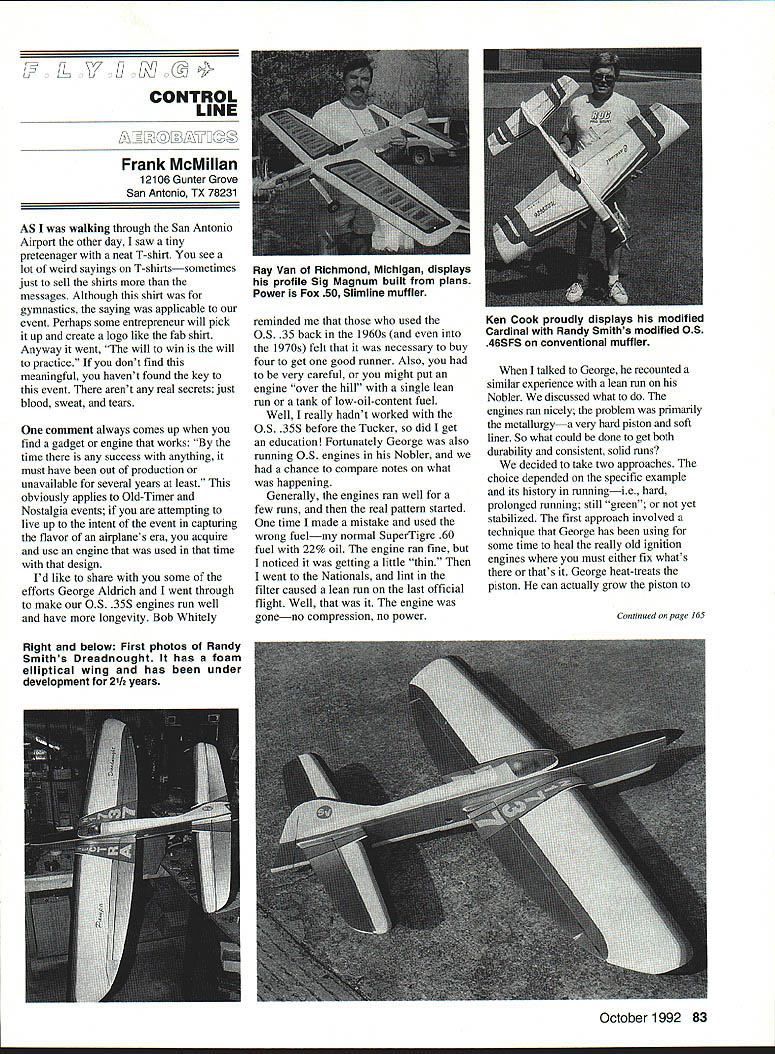
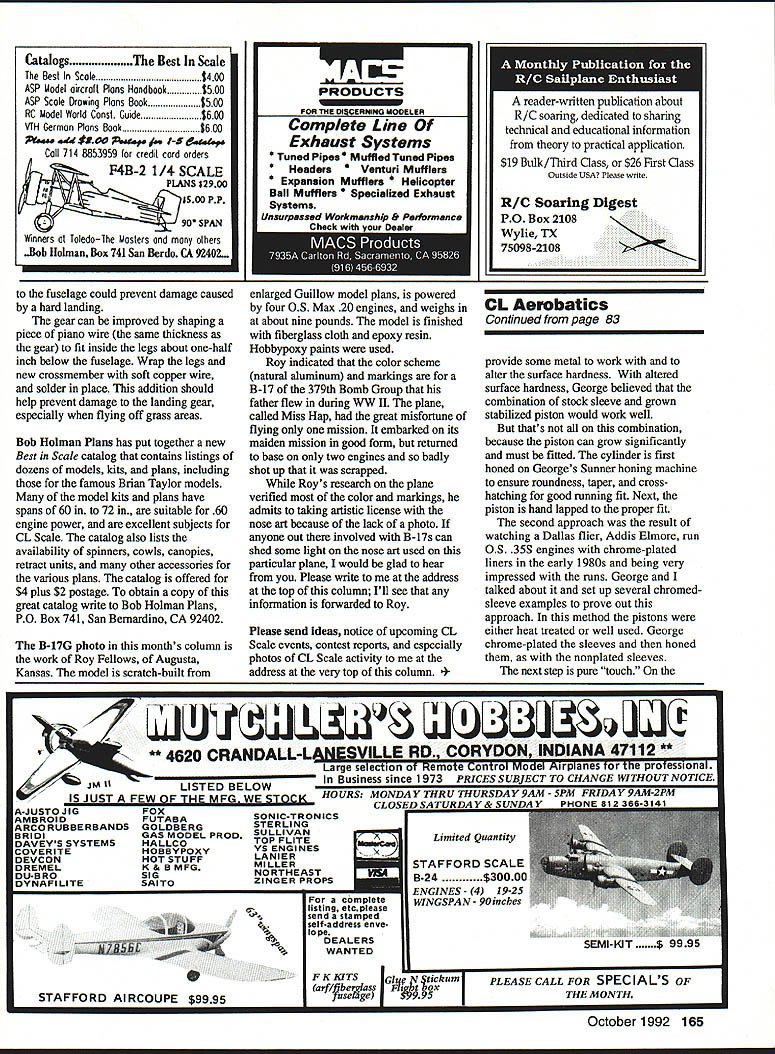
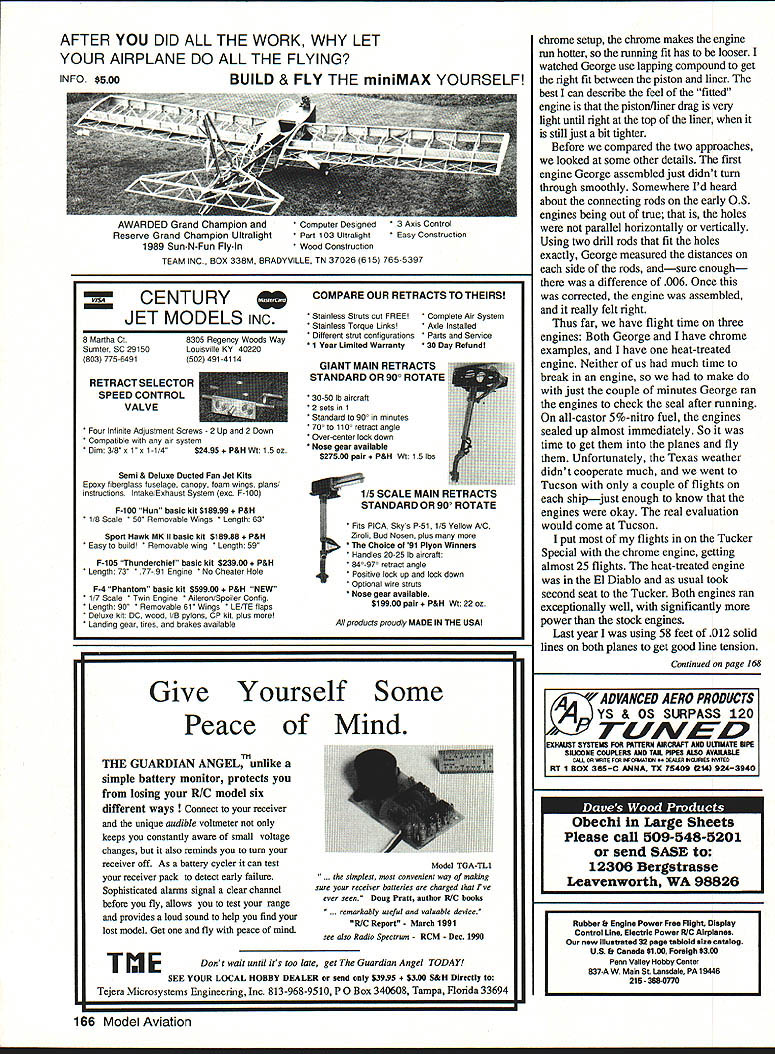
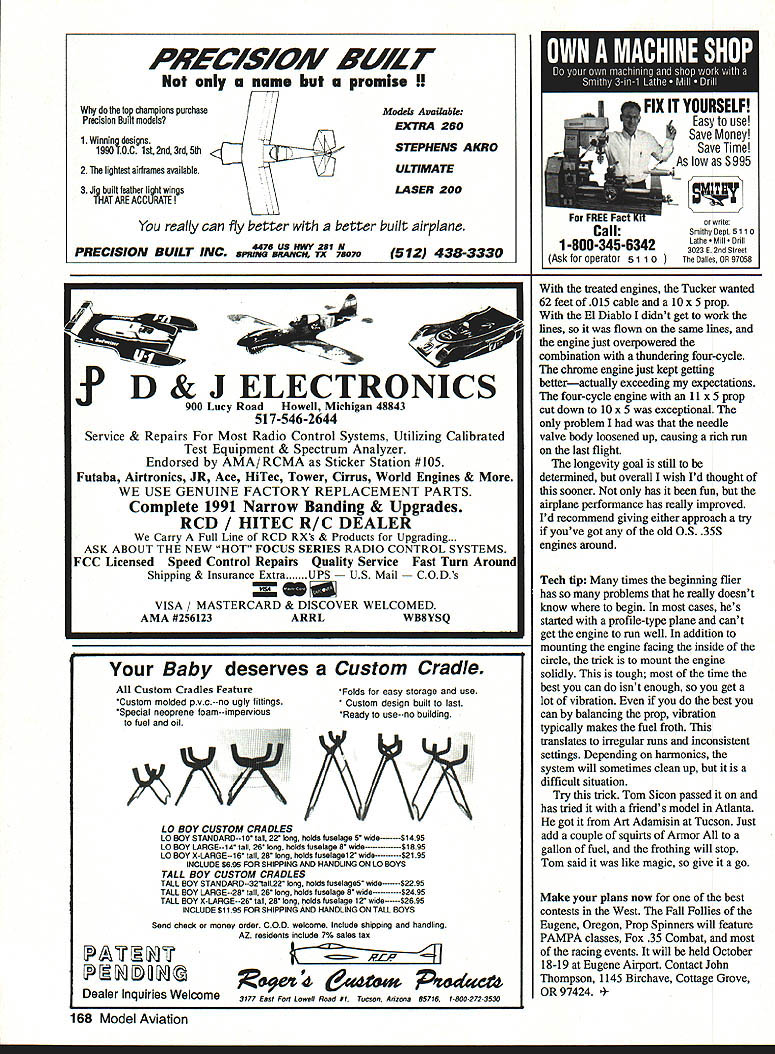
Control Line: Aerobatics
Frank McMillan 12106 Gunter Grove San Antonio, TX 78231
Introduction
As I was walking through the San Antonio airport the other day, I saw a tiny preteenager with a neat T-shirt. You see a lot of weird sayings on T-shirts—sometimes just to sell the shirts more than the messages. Although this shirt was for gymnastics, the saying was applicable to our event. Perhaps some entrepreneur will pick it up and create a logo like the fab shirt. Anyway it was: "There will be wins in the will to practice." If you don't find this meaningful, you haven't found the key to this event. There aren't any real secrets: just blood, sweat, and tears.
One comment always comes up when you find a gadget or engine that works: "By the time there is any success with anything, it must have been out of production or unavailable for several years at least." This obviously applies to Old-Timer/Nostalgic events; if you are attempting to live up to the intent of the event in capturing the flavor of an airplane's era, you acquire and use an engine that was used in that time with that design.
Problems with the O.S. .35S
I'd like to share some of the efforts George Aldrich and I went through to make our O.S. .35S engines run well and have more longevity. Bob Whitely reminded me that those who used the O.S. .35 back in the 1960s (and even into the 1970s) felt that it was necessary to buy four to get one good runner. Also, you had to be very careful, or you might put an engine "over the hill" with a single lean run or a tank of low-oil-content fuel. Well, I really hadn't worked with the O.S. .35S before the Tucker, so I did get an education! Fortunately George was also running O.S. engines in his Nobler, and we had a chance to compare notes on what was happening.
Generally, the engines ran well for a few runs, and then the real pattern started. One time I made a mistake and used the wrong fuel—my normal Super Tigre .60 fuel with 22% oil. The engine ran fine, but I noticed it was getting a little thin. Then I went to the Nationals, and lint in the fuel filter caused a lean run on the last official flight. Well, that was it. The engine was gone—no compression, no power.
George recounted a similar experience with a lean run on his Nobler. We discussed what to do. The engines ran nicely; the problem was primarily metallurgical—a very hard piston and soft liner. So what could be done to get both durability and consistent, solid runs?
Approaches to improving durability and consistency
We decided to take two approaches. The choice depended on the specific engine and its running history—i.e., hard, prolonged running; still "green"; or not yet stabilized.
- Heat-treat and fit the piston
- George heat-treats the piston. He can actually grow the piston to provide some metal to work with and to alter the surface hardness.
- With altered surface hardness, George believed that the combination of a stock sleeve and a grown, stabilized piston would work well.
- The piston can vary considerably and must be fitted. The cylinder is first honed on George's Sunnen honing machine to ensure roundness, taper, and cross-hatching for a good running fit. Next, the piston is hand-lapped to the proper fit.
- Chrome-plated sleeves
- This approach came from watching Addis Elmore run O.S. .35S engines with chrome-plated liners in the early 1980s and being impressed with the runs.
- Pistons were either heat-treated or well-used. George chrome-plated the sleeves and then honed them, as with the non-plated sleeves.
Break-in ("touch" procedure)
The next step is pure "touch." On the first run the pilot brings the engine up on a rich setting and runs it to operating temperature, then shuts it down to cool. On the next few runs he leans it up a bit and lets the engine come to temp then cool. This procedure is repeated until the engine seems satisfied. That may sound touchy-feely, but it works. Engines treated in this manner have run many flights without problems and retained compression.
Exhaust, tuning, and running fit
There are exhaust differences. Unmodified stock mufflers really don't do much for power. Tuned pipes give better power and smoother running, but they can be more fussy on adjustment. I've fallen back to using a tuned pipe or a well-designed muffler for most flying now, especially in contest work.
One final note: don't be too aggressive about tuning. If you push the mixture too lean to get the last few RPMs, you may burn a piston or damage the sleeve.
With the chrome setup, the chrome makes the engine run hotter, so the running fit has to be looser. I watched George use lapping compound to get the right fit between the piston and liner. The best I can describe the feel of the "fitted" engine is that the piston/liner drag is very light until right at the top of the liner, when it is still just a bit tighter.
Assembly details and rod alignment
Before we compared the two approaches, we looked at some other details. The first engine George assembled just didn't turn through smoothly. Somewhere I'd heard about the connecting rods on the early O.S. engines being out of true; that is, the holes were not parallel horizontally or vertically. Using two drill rods that fit the holes exactly, George measured the distances on each side of the rods, and—sure enough—there was a difference of .006. Once this was corrected, the engine was assembled, and it really felt right.
Flight experience and results
Thus far, we have flight time on three engines: both George and I have chrome examples, and I have one heat-treated engine. Neither of us had much time to break in an engine, so we had to make do with just the couple of minutes George ran the engines to check the seal after running. On all-castor 5% nitro fuel, the engines sealed up almost immediately. So it was time to get them into the planes and fly them. Unfortunately, the Texas weather didn't cooperate much, and we went to Tucson with only a couple of flights on each ship—just enough to know that the engines were okay. The real evaluation would come at Tucson.
I put most of my flights on the Tucker Special with the chrome engine, getting almost 25 flights. The heat-treated engine was in the El Diablo and, as usual, took second seat to the Tucker. Both engines ran exceptionally well, with significantly more power than the stock engines.
Last year I was using 58 feet of .012 solid lines on both planes to get good line tension. With the treated engines, the Tucker wanted 62 feet of .015 cable and a 10 x 5 prop. With the El Diablo I didn't get to work the lines, so it was flown on the same lines, and the engine just overpowered the combination with a thundering four-cycle. The chrome engine just kept getting better—actually exceeding my expectations. The four-cycle engine with an 11 x 5 prop cut down to 10 x 5 was exceptional. The only problem I had was that the needle valve body loosened up, causing a rich run on the last flight.
The longevity goal is still to be determined, but overall I wish I'd thought of this sooner. Not only has it been fun, but the airplane performance has really improved. I'd recommend giving either approach a try if you've got any of the old O.S. .35S engines around.
Tech tip
Many times the beginning flier has so many problems that he really doesn't know where to begin. In most cases, he's started with a profile-type plane and can't get the engine to run well. In addition to mounting the engine facing the inside of the circle, the trick is to mount the engine solidly. This is tough; most of the time the best you can do isn't enough, so you get a lot of vibration. Even if you do the best you can by balancing the prop, vibration typically makes the fuel froth. This translates to irregular runs and inconsistent settings. Depending on harmonics, the system will sometimes clean up, but it is a difficult situation.
Try this trick. Tom Sicon passed it on and has tried it with a friend's model in Atlanta. He got it from Art Adamisin at Tucson. Just add a couple of squirts of Armor All to a gallon of fuel, and the frothing will stop. Tom said it was like magic, so give it a try.
Events
Make your plans now for one of the best contests in the west. The Fall Follies of the Eugene, Oregon, Prop Spinners will feature PAMPA classes, Fox .35 Combat, and most of the classic events. It will be held October 18–19 at Eugene Airport. Contact John Thompson, 1145 Birch Ave., Cottage Grove, OR 97424.
Transcribed from original scans by AI. Minor OCR errors may remain.

