
Control Line: Aerobatics
Frank McMillan
12106 Gunter Grove, San Antonio, TX 78231
Intrepid — kit and construction
At the end of the last flying season I decided to convert to the tuned-pipe system and was in search of a new design. The number two Super Caudron was finally completed, with an OPS .40 SPP conversion finished too early in the year to give up after building just one plane, so I started looking around for another one.
The Caudron was on the outer edge for size that I thought the .40 would handle—perhaps beyond at 63 ounces and 740 square inches. Perhaps something more compact was in order. So I expressly set up for the tuned pipe.
About that time I was talking to Randy Smith of Aero Products and he commented about how well his Nationals ship Vector flew with the same power combination I was using. We talked about the characteristics, moments, areas, etc., and in the course of the conversation he mentioned that he would be producing a kit. I ordered one right then and received it shortly thereafter.
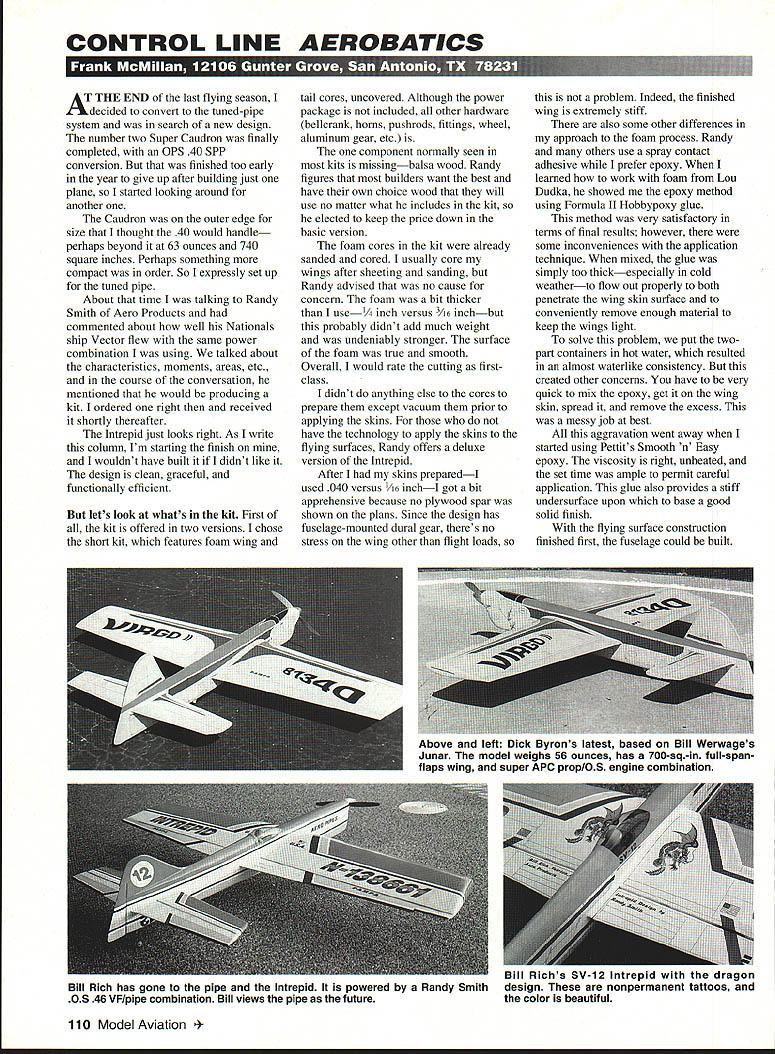
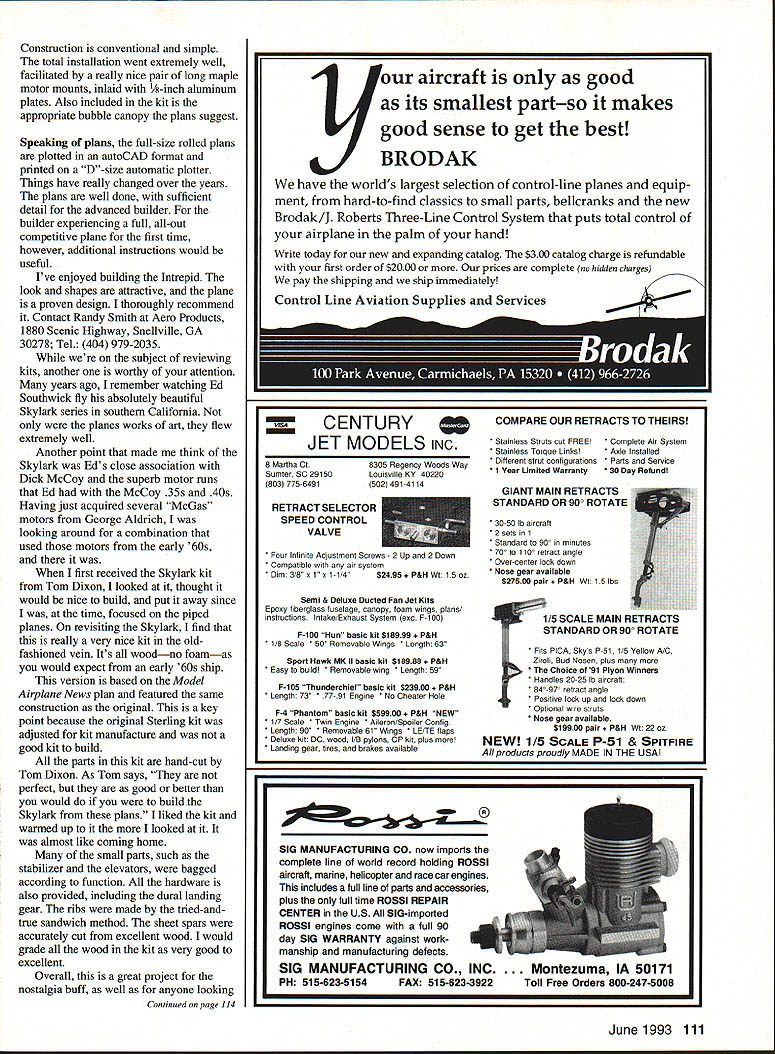
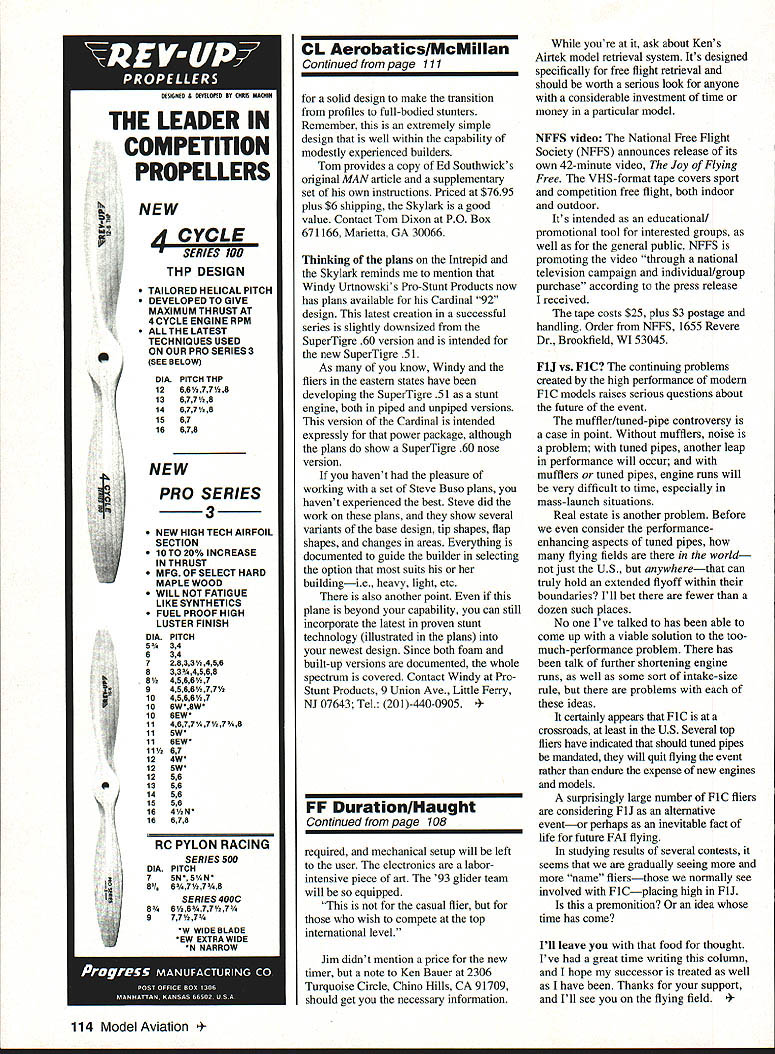
The Intrepid just looks right. As I write this column I'm starting the finish on mine, and I wouldn't have built it if I didn't like it. The design is clean, graceful, and functionally efficient.
What's in the kit
- The kit is offered in two versions. I chose the short kit, which features foam wing and tail cores, uncovered.
- The power package is not included, but all other hardware is: bellcrank, horns, pushrods, fittings, wheel, aluminum gear, etc.
- One component normally seen in most kits is missing—balsa wood. Randy assumes most builders prefer to select their own wood, so he omits it to keep the price down in the basic version.
- Foam cores were already sanded and cored; the foam was slightly thicker than I use (1/4 inch versus 3/16 inch), but this probably didn't add much weight and was undeniably stronger. Surface cutting was true and smooth—first-class overall.
- A deluxe version is available for builders who do not have the technology to apply skins to the flying surfaces.
I didn't do anything else to the cores to prepare them except vacuum them prior to applying the skins. After I had my skins prepared (I used .040 instead of 1/16 inch) I got a bit apprehensive because no plywood spar was shown on the plans. Since the design has fuselage-mounted dural gear, there's no stress on the wing other than flight loads, so this is not a problem. Indeed, the finished wing is extremely stiff.
There are also some differences in my approach to the foam process. Randy and many others use a spray contact adhesive, while I prefer epoxy. When I learned how to work with foam from Lou Dudka he showed me the epoxy method using Formula II Hobbypoxy. The glue method produced satisfactory final results; however, there were inconveniences with the application technique. When mixed, the glue was simply too thick—especially in cold weather—to flow out properly, both to penetrate the wing skin surface and to conveniently remove enough material to keep the wings light.
To solve this problem we put the two-part containers in hot water, which resulted in an almost waterlike consistency. But this created other concerns. You have to be very quick to mix the epoxy, get it on the wing skin, spread it, and remove the excess. This was a messy job at best.
All this aggravation went away when I started using Pettit's Smooth 'n Easy epoxy. The viscosity is right unheated, the set time was ample to permit careful application, and the glue provides a stiff undersurface upon which to base a good solid finish.
With the flying-surface construction finished first, the fuselage could be built. Construction was conventional and simple. The total installation went extremely well, facilitated by a really nice pair of long maple motor mounts inlaid into 1/8-inch aluminum plates. Also included in the kit was an appropriate bubble canopy, as the plans suggest.
The plans are full-size, rolled plans plotted in AutoCAD format and printed on a D-size automatic plotter. Things have really changed over the years. The plans are well done, with sufficient detail for an advanced builder or a builder experiencing an all-out competitive plane for the first time; however, additional instructions would be useful.
I've enjoyed building the Intrepid. The shapes are attractive, and the plane is a proven design. I thoroughly recommend it. Contact:
- Randy Smith, Aero Products, 1880 Scenic Highway, Snellville, GA 30278. Tel. 404-979-2035.
Skylark — nostalgia and kit
Years ago I remember watching Ed Southwick fly the absolutely beautiful Skylark series of Southern California planes. They were works of art and flew extremely well. Another point that made me think of the Skylark was Ed's close association with Dick McCoy and the superb motor runs that Ed had with the McCoy .35s and .40s. Having just acquired several "McGas" motors from George Aldrich, I was looking around for a combination that used those motors from the early '60s, and there it was.
When I first received the Skylark kit from Tom Dixon I looked at it, thought it would be nice to build, and put it away since I was, at the time, focused on the piped plane. On revisiting the Skylark, I find that this is really a very nice kit in the old-fashioned vein—it's all wood—no foam—as you would expect from an early '60s design.
This version is based on the Model Airplane News plan and features the same construction as the original. This is a key point because the original Sterling kit was adjusted for its manufacturer and was not a good kit to build.
All the parts in this kit are hand-cut by Tom Dixon. As Tom says, "They are not perfect, but they are as good or better than you'd get if you were to build the Skylark from these plans." I liked the kit and warmed up to it the more I looked at it. It was almost like coming home.
Many of the small parts, such as the stabilizer and the elevators, were bagged according to function. All the hardware is also provided, including the dural landing gear. The ribs were made by the tried-and-true sandwich method. The sheet spars were accurately cut from excellent wood. I would grade all the wood in the kit as very good to excellent.
Overall, this is a great project for the nostalgia buff, as well as for anyone looking for a solid design to make the transition from profile models to full-bodied stunters. Remember, this is an extremely simple design that is well within the capability of modestly experienced builders.
Tom provides a copy of Ed Southwick's original Model Airplane News article and a supplementary set of his own instructions. Priced at $76.95 plus $6 shipping, the Skylark is a good value. Contact:
- Tom Dixon, P.O. Box 671166, Marietta, GA 30066.
SuperTigre .51, Steve Buso plans, and Pro-Stunt Products
Thinking of the plans on the Intrepid and the Skylark reminds me to mention that Windy and the fliers in the eastern states have been developing the SuperTigre .51 as a stunt engine, both in piped and unpiped versions. This version of the Cardinal is intended expressly for that power package, although the plans do show a SuperTigre .60 nose version.
If you haven't had the pleasure of working with a set of Steve Buso plans, you haven't experienced the best. Steve did the work on these plans, and they show several variants of the base design, tip shapes, flap shapes, and changes in area. Everything is documented to guide the builder in selecting the option that most suits his or her building—i.e., heavy, light, etc.
There is also another point. Even if this plane is beyond your capability, you can still incorporate the latest in proven stunt technology (illustrated in the plans) into your newest design. Since both foam and built-up versions are documented, the whole spectrum is covered. Contact:
- Windy, Pro-Stunt Products, 9 Union Ave., Little Ferry, NJ 07643; Tel.: (201) 440-0905.
While you're at it, ask about Ken's Airtek model retrieval system. It's designed specifically for free flight retrieval and should be worth a serious look for anyone with a considerable investment of time or money in a particular model.
NFFS video
The National Free Flight Society (NFFS) announces release of its own 42-minute video, The Joy of Flying Free. The VHS-format tape covers sport and competition free flight, both indoor and outdoor. It's intended as an educational/promotional tool for interested groups, as well as for the general public. NFFS is promoting the video "through a national television campaign and individual/group purchase" according to the press release I received.
The tape costs $25, plus $3 postage and handling. Order from:
- NFFS, 1655 Revere Dr., Brookfield, WI 53045.
F1J vs. F1C?
The continuing problems created by the high performance of modern F1C models raises serious questions about the future of the event.
The muffler/tuned-pipe controversy is a case in point. Without mufflers, noise is a problem; with tuned pipes, another leap in performance will occur; and with mufflers or tuned pipes, engine runs will be very difficult to time, especially in mass-launch situations.
Real estate is another problem. Before we even consider the performance-enhancing aspects of tuned pipes, how many flying fields are there in the world—not just the U.S., but anywhere—that can truly hold an extended flyoff within their boundaries? I'll bet there are fewer than a dozen such places.
No one I've talked to has been able to come up with a viable solution to the too-much-performance problem. There has been talk of further shortening engine runs, as well as some sort of intake-size rule, but there are problems with each of those ideas.
It certainly appears that F1C is at a crossroads, at least in the U.S. Several top fliers have indicated that, should tuned pipes be mandated, they will quit flying the event rather than endure the expense of new engines and models.
A surprisingly large number of F1C fliers are considering F1J as an alternative event—or perhaps as an inevitable fact of life for future FAI flying.
In studying results of several contests, it seems that we are gradually seeing more and more "name" fliers—those who normally are involved with F1C—placing high in F1J.
Is this a premonition? Or an idea whose time has come?
Closing
I'll leave you with that food for thought. I've had a great time writing this column, and I hope my successor is treated as well as I have been. Thanks for your support, and I'll see you on the flying field.
Transcribed from original scans by AI. Minor OCR errors may remain.

