
CONTROL LINE AEROBATICS
Frank McMillan, 12106 Gunter Grove, San Antonio, TX 78231
Several months ago I received a letter from the "Ghost of Stunt Past." Enclosed was a photocopy of an entry blank announcing the ninth annual Mirror Model Flying Fair that was held May 15, 1954. To those of us who grew up on the East Coast, the Mirror Meet brings back a flood of memories.
The name was derived from the main sponsor and host, the then-famous New York City Daily Mirror newspaper. This fine newspaper, long since gone, sponsored many youth programs. This contest was a significant showcase in the paper's successful program, and it received a lot of space.
As I read the entry blank, some of the reasons why many of us thought the Mirror Meet was special came rushing back. Right at the top of the form it stated, "Limited to 1,000 Contestants!" In today's terms that number is staggering. Every event in the AMA rule book was run on that one day, starting at 6 a.m. promptly and terminating at about 3 p.m. The reason for the early closing time was that a super air show concluded the event.
The Blue Angels were always there. After all, the Mirror Meet was usually held on a Navy airfield or at an associated manufacturer. After starting out at Grumman in Bethpage, Long Island, the venue was later moved to Floyd Bennett Field in Brooklyn, New York. It was literally a subway contest!
With the proximity to New York City and the publicity, plus the major air show, crowds gathered early and stayed through the whole day. I've seen estimates of between 250,000 and 300,000! All told, I guess I attended six of these meets. It was an experience I'll never forget.
My dad took me to one of the early meets—1946 or 1947. We took the Long Island Railroad. We saw mostly free flight, some control line, and I'm not sure about radio. But I do remember the air show, because it featured some of the daredevil performances, such as traditional wing walkers, that are starting to reappear in modern air shows.
One maneuver I remember in particular was when a red-and-white checkerboard biplane, piloted by barnstormer Bevo Howard, did an inverted pass over the runway and, with the rudder, picked up a ribbon suspended from two poles.
In those days we weren't so concerned with crowd control. We were close enough to see the pilot, feel the sound of the motor, and smell the exhaust. Of course, the Blue Angels were there in Bearcats—wow!
But back to some of the memories of '54. The other momentous action was Red Reinhart flying the Mirror Meet pattern.
As with everything else about this contest, there was a special pattern. Three seven-minute flight attempts were allowed to complete the pattern once. At that time the AMA pattern was evolving, and the Mirror pattern was by far the more complex and challenging. Besides, there was also the holdover from the old days, where low and fast got the impression points.
This special pattern had a repetitive theme. A maneuver was first done upright and then repeated from an inverted position. This might not seem so difficult, but just think about repeating a sequence in which the control inputs are reversed. That gets the difficulty right up there.
Another mentally taxing—as well as performance-demanding—tactic was the double vertical eights. The maneuver consisted of two vertical eights, with the axes of the two eights inclined to each other at about 30°. The maneuver started with an entry from up top and was continuous from the first near-eight exit. After flying upright, the pilot came back around inverted and repeated it.
This pattern also contained the hourglass and—if I remember correctly—a four-leaf clover. The adventure concluded with a bob wingover that consisted of eight inside loops executed generally in a climbing flight path, four in each side of the circle. Finally, the landing was scored solely by proximity to a selected spot.
I first saw Red the morning of the '54 meet, preparing for his first flight. Helping were Larry Scarzinski and, I believe, Rey Dugan.
The plane was something else. It looked more like a big combat plane than a conventional stunt ship. Actually, the more I looked at it, the more I thought of a manta ray. This impression was reinforced by the all-black paint and the plane's characteristics in flight. It was fast, fast, fast, and the wingtips flexed visibly when it turned.
Red flew the Stunt Wing as though it were on rails on the deck. It seemed the single-wheel landing gear was never more than a foot above the runway, except in the maneuvers. Red's series of flights were some of the most impressive I've ever seen.
But the final flight was what really capped it off. As I mentioned, the landing was scored by the distance the plane landed from a spot the contestant had designated earlier.
When Red completed the flight portion of the final round, his helper positioned an empty wooden cable reel in the flight circle and put a rag in the center. This was a bit puzzling, because most contestants simply put a mark or rag outside the circle edge so they wouldn't run into it. Not Red. He had another way—his way!
When the engine stopped, he simply towed the Stunt Wing toward the reel, nosed the plane so the spinner was perfectly centered over the rag in the center hole of the reel. No bounce, perfect points! He won easily that day!
Well, the Mirror Meet has been gone for some time, as has the Daily Mirror. But it still remains a vivid memory to many who were fortunate enough to be a part of the spectacle. Just as with the Navy Nationals, we may never see its match ever again.
Tech tip:
This is probably the simplest piece of advice I can give. It was prompted by a comment made in a telephone call regarding engines last week.
The gist was that I got better engines from engine builders, and that they ran better because of extra attention. That got me thinking, and after I read George Aldrich's new catalog (Aldrich Models, 12822 Tarrytown, San Antonio, TX 78233; Tel.: (210) 656-2021), I thought I'd again offer one primary thought on customized engines.
I've had excellent results with engines built for me. But as I have mentioned before in this column, I believe in the builders I use and trust their work.
That means I do not take the engines apart to find out what they do. I break in the engines carefully, use the correct fuel (I use a lot of castor in my fuel), and I take great care not to get them dirty. If you take an engine apart, you will almost always change the characteristics when you put it together. It may or may not run as it did before.
I once found a bad set of shims and the engine was just flat in certain areas. After replacement it was like finding a better engine.
CL AEROBATICS — McMillan (continued)
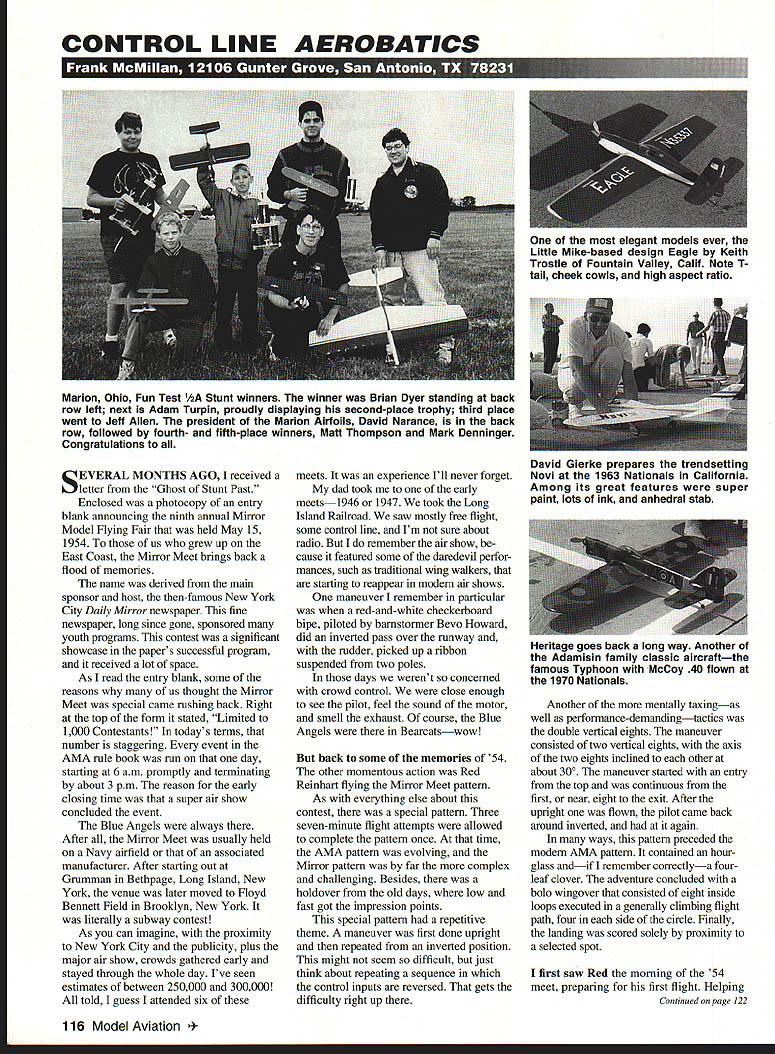
Just a closing word on what sounds like a great idea to promote youth participation. David Narance, president of the Marion, Ohio, Airfoils, writes of his club's third annual Father's Day Fly on June 20, 1993, at the Marion Municipal Airport. Youth is the focus, and the idea is to have fun and participate.
Features include:
- 1/2A Stunt
- Weirdo Stunt event, where unusual is good
Looks like a great way to enjoy Father's Day if you're in the area. Perhaps other clubs might consider similar ideas.
Next month I'll feature more about the work George Aldrich does on cylinder/piston fits, because the real secret on super engines is the correct running fits. +
Transcribed from original scans by AI. Minor OCR errors may remain.

