
CONTROL LINE AEROBATICS
Frank McMillan 12106 Gunter Grove, San Antonio, TX 78231
This is truly an exciting time in precision aerobatics. I've been sitting here in my pit (read: hobby room) reflecting on this column for the last hour. Many ideas come from letters, phone calls, special-interest publications, and catalogs. As I've said before, there are so many new items and services that our hobby has become easier and more enjoyable to pursue.
George Aldrich — engine projects and services
Last month I mentioned some of the services that one of the world's premier engine men offers. Before we let George Aldrich of Aldrich Models describe what he offers, several projects he is working on could be of great interest to us.
The first is a U.S.-made, limited-production tuned-pipe .40. The second is a motor that fills a real need — a plain-bearing, loop-scavenged .40 made in Russia.
Right now, a limited number of suitable motors are available for tuned-pipe stunt operation: the O.S. .46 VF, O.S. .40 SPP, and possibly the SuperTigre .51. That's not many, and as we are all well aware, manufacturers tend to either change or discontinue motors that are timed for stunt. Also, the motors that are currently the best are not U.S. motors, so availability can change quickly — witness the O.S. .40 VF.
George is now working with Willie Wylie to develop a rear-exhaust, front-intake, lightweight (possibly under nine ounces) ABC .40 that is timed for stunt. Castings are being produced, and a prototype should be flying by the time you read this. Don't expect actual production engines, however, until they have been tested and are correct. If you're interested, drop George a line for current information.
The other motor is in about the same stage but has broader application than a tuned-pipe motor. Since the demise of the O.S. .35S and the McCoy .40, we haven't had a good, powerful utility motor that would run well out of the box for our purposes. George has supplied the timing numbers and general arrangements. If the appropriate manufacturing agreements can be set up, we could see a really attractive, moderately priced motor that everyone can run.
George's philosophy and methods
George's story: "All work is done as though I were going to use the project myself. For this reason, I only work one way — the best that I can. I remain a fact that many of the engines I have reworked never realized their potential because, in their desire to find what secret tricks had been performed, the customer took them apart before running them. Then the customer thinks he's been cheated, or he can't put them back together properly.
"Let me make it clear: my forte is fitting an engine properly. You will never find a lot of polishing; I feel it is detrimental to engine performance. If anything, I rough up or bead-blast certain areas to form a wetted surface.
"The gases in our model two-cycles are moving so fast that a polished surface not only runs hotter, but lets the fuel charge slide by too fast.
"The piston is a two-cycle's valve, and it moves past the port so quickly that it is difficult to get the fuel charge into the cylinder. My theory has been to assist a stored charge, waiting to get into the port, when it opens. Chrome-plating parts and keeping the same tolerance will result in overheating and a loss of power."
It takes critical honing and lapping tolerance control to produce the same power that was there before chrome plating. What you get with a chrome-plated cylinder when it is done properly is renewed or longer engine life.
"It is most important to know the piston position in the cylinder at the top of the stroke (TDC). If the customer cannot measure this, it assures a better setup if the engine is sent out when chrome work is desired."
Chrome-plating and fitting steps
The steps are as follows:
- Lap piston perfectly round.
- Hone cylinder round and at least .003" oversize, to assure over .001" chrome on each wall.
- Chrome-plate cylinder .0005" undersize or piston .0002" oversize.
- Hone cylinder to a perfect fit or relap chromed piston to perfect roundness and then hone cylinder to a running fit.
"Regardless of how carefully a chromed-steel cylinder setup is done, it takes longer to reach full power than one that is not. With ABC setups the fit is much tighter because the brass cylinder expands more than the piston. Do not be alarmed at loud squeaks or squawks when turning an ABC/AAC engine through TDC. As it runs in, some of this noise will disappear.
"Do not try to run-in an ABC by keeping it slobbering rich. A tad on the rich side for five minutes is fine."
Heat treating, cast-iron pistons, and port modifications
In addition to full chrome and rechromed service is the special heat treating and fitting of cast-iron piston/steel cylinder engines. This is a broadening of a technique worked out on the Rossi .15 back in the '70s — and many of those engines are still running strong today.
George can restore worn cylinder assemblies with cast-iron pistons to at least as-good-as-new compression. Additional benefits include longer life due to piston hardening and salvaging some cylinders that had become unusable.
This process can be applied to production engines as well as new or used engines for everything from free flight to control line and radio control. In conjunction with this, cylinder-port modification will be offered to give a steadier engine run for aerobatics events, either unpiped or piped.
Many of today's Schnuerle-ported engines do not give the strong four-cycle, or four-two, break so desirable in a stunt engine. Most of these engines can easily be retuned to meet this criterion. Naturally, George has a keen interest in stunt engines and constantly checks various new engines to see if they meet the standards he requires.
Back in the late 1960s the basic fitting of the ABC setup was developed in his shop. These techniques have not been lost, and he has developed some new and better things along the way.
Critical to top performance is total stability of the aluminum piston in the ABC setup. His special heat treatment produces a setup that is totally stable, requiring no relapping or stoning after it has been run.
"The ABC and AAC cylinder assemblies for the SuperTigre .46 and .60 are being used all over the world now. I probably will just offer the ABC setup from now on as it is not so fragile."
Contact: Aldrich Models, 12822 Tarrytown, San Antonio, TX 78233. Tel.: (210) 656-2021.
Old engines, ignition conversions, and lubricants
These past few years George's modeling interests have centered on Old-Timer, Free Flight, and CL Stunt, with a pure ignition engine running on the old gas 'n' oil fuel. Over the years he's spent quite a bit of time testing, retrofitting, and retesting various ignition engines like Super Cyclone, Anderson Spitfire, Oswick, O&R, etc.
While leaving these engines in their original plan form, the increased performance from the retrofitting has been more than gratifying. Ohlsson & Rice engines, because the cylinder is permanently attached to the case, are the most difficult. Under development now is a method of restoring the rod, wrist pin, and piston so that many of these engines can be put into use.
Also under extensive test have been various lubricants for gasoline/ignition operation. George is now convinced that the reason so many old engines from the 1930s and '40s are still in really excellent condition is 70 S.A.E. oil.
He had always felt castor oil was king when it came to carburetor heavy load. In tests he has seen engines that would overheat on 25% castor oil after only 30 seconds, run out the whole tank at full power on 25% 70-weight oil. This is the old thick lube — not the new, thinner racing nitro 70.
Jim Hunt — specialty control line items
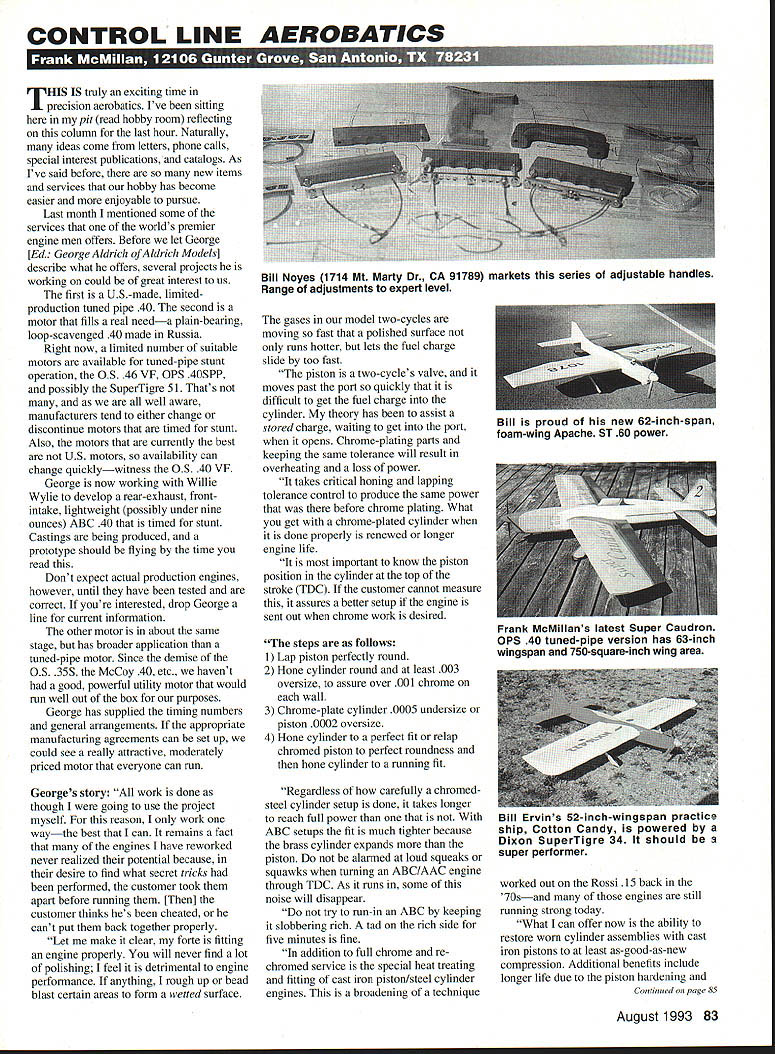
Another old friend, Jim Hunt, is once again producing specialty items for control line. Some years ago — when we were all much younger — Jim produced several items that were recognized strongly at the time. His son, Bob, used the adjustable handle to win the Nationals and World Championship.
In addition, Jim produced a simple, durable stooge that I have been using for 18 years. Jim has been working recently on a product line that includes these time-proven items and some new additions.
The Strong Arm control system includes horns of 1/8" or 3/32" wire with unique dural posts for secure bushing support and bellcrank configurations up to four inches. I like the bellcranks in particular, as they are made from 5/16" linen plywood and are provided with a 1/4" brass bushing for adequate support.
Other items include custom-made aluminum radial mounts for stunt applications and the well-known landing gear setups for foam-wing applications. These are well-engineered, proven, quality products.
Contact: Jim Hunt, 208 E. Center St., Box 86, Stockertown, PA 18083. Tel.: (215) 746-0106.
Windy Urtnowski — Pro-Stunt Products and construction tapes
Many times in past columns I've mentioned Windy Urtnowski's Pro-Stunt Products. Windy is continually giving of himself to improve our event. Some years ago he started producing construction videos in which he built various planes from the ground up.
These early tapes, which include a Nobler and an early piper ship, were very informative — including many tips on construction and painting. As he produced more tapes, the quality and the information improved and expanded significantly.
For the '93 season there is a new shop series that details the construction of Windy's Tweener ships. I'm hooked on these tapes. It is fun to watch a real craftsman (or craftsperson, to be politically correct) at work.
As a bonus, each tape includes many still photos from the past — in this series there are 14.
The series starts with basic foam wing techniques and details how Windy works through the assembly of the wing, including installing landing gear clips. The work on the wingtips that addresses the tip box and the leading edges contains solid, dependable information.
Of real interest is the running commentary by Windy, which contains an extensive flood of handy tips. The concepts of weight management, whereby the builder tracks component weight such as wing skins and uses the lightest parts for the inboard wing, are obvious but important. All this sounds simple on the surface, but many of these ideas put together result in a competitive plane.
This year Windy chose to use built-up flaps and tail surfaces. This construction is completely detailed on several tapes. As I had just constructed the same surfaces on my new plane, I was particularly interested in the comparison of techniques and weights. For one thing, Windy used a molded leading edge for the stab. That was interesting.
The discussion of wood selection for flaps and the construction geometry was also very interesting and informative. In many areas new and subtle changes incorporated from earlier tapes result in new technologies.
As most of you know, Windy has won the Concours. Watching the development of beautiful planes is both enjoyable and inspiring. In this series Windy shows how to do metal flanking numbers and candy colors. This is really a case of a picture being worth a thousand words. The effect is brilliant, and it really isn't as difficult as it seems.
Two tips passed on by Windy are really neat. The first is to use a degreaser product called Sikkens M-600 to wet-sand. This is not available everywhere, but PPG Acryl-Clean will also work. This enables the finest grades of wet-or-dry paper to cut without clogging. For example, where you usually would use 600-grit, you can now use 1,200, and still cut easily. Also, you can sand the silver coats with this easily, without destroying the base. Wait till you sand clear!
The next tip is too easy. For masking, try heavy-duty kitchen aluminum foil. Windy got this from Walt Frey, and I've just used it. It works extremely well; you won't believe it. Just tape the foil where you want it, and mold the excess around.
No matter how experienced you are, you will benefit from these tapes. Contact Windy for his new subscription service at Pro Stunt Products, 9 Union Ave., Little Ferry, NJ 07643. Tel.: (201) 440-0905.
Closing
It seems that the assorted E-writings along the way did present the correct picture: you just can't tell what you're getting until it's too late. As for me, I'm not a very happy modeler right now, and you can bet your last prop I won't be buying any more until this gets straightened out — if then!
Win some, lose some, I guess. Please address any correspondence directly to me (and not to MA), and please do enclose an SASE with any correspondence for which you'd like a reply. See ya at KRC!
Frank McMillan
Transcribed from original scans by AI. Minor OCR errors may remain.

