
CONTROL LINE AEROBATICS
Frank McMillan 12106 Gunter Grove, San Antonio, TX 78231
PAMPA and its newsletter
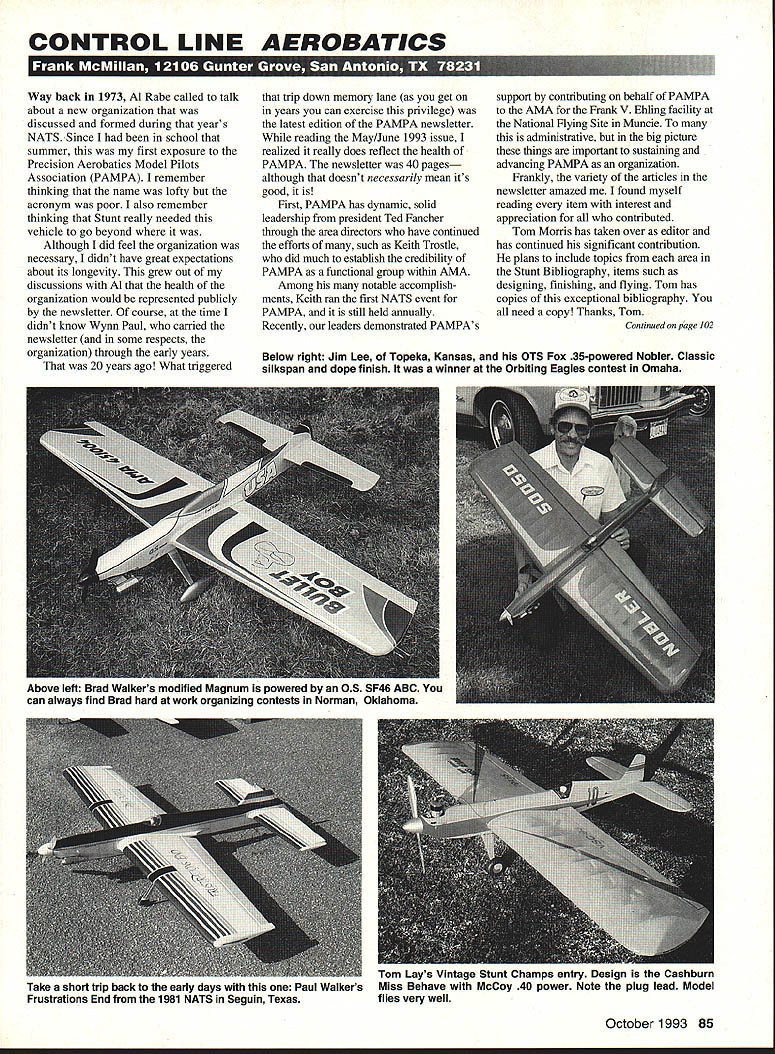
Way back in 1973, Al Rabe called to talk about a new organization that was discussed and formed during that year's NATS. Since I had been in school that summer, this was my first exposure to the Precision Aerobatics Model Pilots Association (PAMPA). I remember thinking that the name was lofty but the acronym was poor. I also remember thinking that Stunt really needed this vehicle to go beyond where it was.
Although I did feel the organization was necessary, I didn't have great expectations about its longevity. This grew out of my discussions with Al that the health of the organization would be represented publicly by the newsletter. Of course, at the time I didn't know Wynn Paul, who carried the newsletter (and in some respects, the organization) through the early years. That was 20 years ago! What triggered that trip down memory lane (as you get on in years you can exercise this privilege) was the latest edition of the PAMPA newsletter.
While reading the May/June 1993 issue, I realized it really does reflect the health of PAMPA. The newsletter was 40 pages — although that doesn't necessarily mean it's good, it is!
First, PAMPA has dynamic, solid leadership from president Ted Fancher through the area directors who have continued the efforts of many, such as Keith Trostle, who did much to establish the credibility of PAMPA as a functional group within AMA. Among his many notable accomplishments, Keith ran the first NATS event for PAMPA, and it is still held annually. Recently, our leaders demonstrated PAMPA's support by contributing on behalf of PAMPA to the Frank V. Ebling facility at the National Flying Site in Muncie. To many, this is administrative, but in the big picture these things are important to sustaining and advancing PAMPA as an organization.
Frankly, the variety of the articles in the newsletter amazed me. I found myself reading every item with interest and appreciation for all who contributed.
Tom Morris has taken over as editor and has continued his significant contribution. He plans to include topics from each area in the Stunt Bibliography, items such as designing, finishing, and flying. Tom has copies of this exceptional bibliography. You all need a copy! Thanks, Tom.
Contributors and regular features
Members familiar to all have committed to regular articles. In addition to his input as president, Ted Fancher lends his vast technical expertise, commenting on many facets of our event. Mike Keville has also volunteered to do a regular feature called the "Trailing Edge," which is a forum for the Vintage side of our event.
Noted authority on Stunt aerodynamics "Wild Bill" Netzeband documented his experiments with high-aspect-ratio non-flapped Stunt models, which led to the famous Humbug that Bob Baron flew, and about which Windy Urtnowski wrote several articles — "Tuned Pipes: My Opinion," and "What Should It Weigh?"
Louey Pyatt discussed coaching competitive fliers, and several of our expert fliers, such as world champion Paul Walker, responded to readers' technical questions. These are just a few items found in the newsletter.
Finally, the newsletter's advertisers are sources of the items we all need to fly Stunt. These are the good old days, with exceptional products, a wealth of information, and an exchange of helpful ideas. With PAMPA as the catalyst, we see a bright future.
If you have any interest in precision aerobatics—or in modeling in general—you need to join PAMPA. For your $15 membership fee you also get the great newsletter. Write to Tom Morris at 1019 Creek Trail, Anniston, AL 36206, or call (205) 820-1983.
Tech topics — shop tools
For some time, I've been meaning to comment on shop tools. Back in the early '60s Dremel came out with the Moto-Shop, a jigsaw/sander/flex-shaft drive unit and filled a real need. The unit was a convenient size, it had the flexibility to accomplish a variety of tasks, and — most important — it was affordable.
I purchased one when they first came on the market and used it for more than 25 years. When I decided to upgrade, I passed it on to a young modeler. Therein lies the tale of mixed results.
The type of building we do requires the ability to cut the obvious outside fine cuts and the inside cuts to lighten parts. This requires a jigsaw with a detachable blade that you can feed through a hole, make the cut, and repeat the procedure.
The Dremel saw did this conveniently. The blade on the Dremel has a pin at each end to tension the blade. As I searched for a scroll/jigsaw, there was a big price range and attendant quality. I considered a mid-range model — a Delta that cost approximately $600. Aside from the high price, the blade attached with a collar that had to be undone and then redone with each inside cut.
This didn't really seem practical, so I bought Sears' top-of-the-line unit. It is a sturdy machine with bushed pivot points on the saw arms. I've been using it for more than three years, and I would rate it satisfactory. I'd also have to say that a jigsaw doesn't cut any better than my original Dremel. Considering how infrequently I use a saw, I couldn't justify the top-of-the-line model.
I suggest watching the Sunday ads to find tools at the right price, although I recommend that you get the Dremel and stick with it.
One thing the jigsaw couldn't do was cut blocks well. You could cut the smaller blocks, but even though the throat capability of most jigsaws is 1 3/4 to 2 inches, they really won't cut that much — and the cuts are not clean. They don't handle the big blocks well at all. This makes doing a fuselage a mess.
This led me to think of a band saw that would do everything I wanted. Again I had to make some choices: did I want a quality piece? What size? At what price? I just couldn't justify $400 or $500 for a good 14-inch band saw, considering its annual use. (Sorry, it's a habit from too many years of cost/benefit analysis.)
Fortunately, about that time I was visiting with John Hill who had a small 10-inch band saw made by Ohio Forge. He explained that Ohio Forge was a house brand made in Taiwan and imported by Home Depot in the Texas area. I bet it's the same one many other companies are importing under their brand names! The big difference is price. I bought mine for just under $100, and it's still available at that price. Look around!
I've really liked it from the first time I used it. It cuts balsa and plywood like butter — and straight, too. Top blocks are a snap. Fitting cowls is also easy. In short, it does what it's supposed to do.
Of course, it has its drawbacks. It is an exceptional buy for the price; however, because it uses three wheels, the constant flexing of the blade increases the chance of breakage at the weld. This is especially true when use is prolonged and continuous. Setting it up properly also takes a little getting used to.
There is also a neat, new table-size unit by Delta that I would recommend. It's a 7-1/2-inch, two-wheel, tabletop band saw priced at approximately $180. If it had been available when I was looking, I would have bought one. It's about the same size and has the same cutting capacity as my 10-inch Ohio Forge band saw but, with two wheels instead of three, the blade breakage is less likely. Check one out.
Transcribed from original scans by AI. Minor OCR errors may remain.

