
CONTROL LINE AEROBATICS
Frank McMillan, 12106 Gunter Grove, San Antonio, TX 78231
Vintage Stunt Championships
The huge success of the continuing series of Vintage Stunt Championships has prompted its mentor, Mike Keville, to expand the format to three days for next year's contest. There were so many entries at the last contest that the trophies were awarded in the dark.
The '94 event is scheduled for March 25–27, so mark your calendar. The new format will have Old Time and Ignition Old Time on Friday, with one round of Classic (formerly called Nostalgia) on Saturday and one round on Sunday. Jo Ann Keville will be the contest director; Mike doesn't foresee being able to make time around the expanded format.
With the expanded format, there should be more time for other areas that are in keeping with the spirit of the Vintage format. For those of you who haven't attended the Tucson contests, there are several informal activities that, if promoted, could add to the fun and flavor of the entire event.
Demonstration Flying and Collectors' Show
One informal activity is demonstration flying of unusual or old original examples of aircraft not entered in the main contest. Past examples have been Bart Klapinski (a former NATS champ and the best strange-plane flier I've seen) flying Don Hutchinson's PT-17 near-scale biplane through the modern Stunt pattern; Bob Hunt and Bart flying Gordon Delany's Monster twin; and many more.
Another demonstration might be the old Mirror Meet pattern, which I've talked about before in this column. Bob Hunt and I have discussed this a lot, and I've finally got to work on the new Reinhart Stunt wing for next year. We will do this during one of the lunch breaks.
A second area would expand on what a few people are already doing informally. Some cottage-industry types have been showing their kits, tanks, etc., and offering them for sale. Others have brought older engines and parts for sale or trade. Why not expand this into a full-blown collectors' show such as the Model Engine Collectors Association (MECA) sponsors? We could focus on the engines, kits, plans, and pieces that support the Vintage era. Friday night at the hotel would be a reasonable time and place, but more has to be done. Jo Ann would probably need someone to run with this idea. More on these later. If you have any thoughts, drop me a line.
SV-12 Intrepid
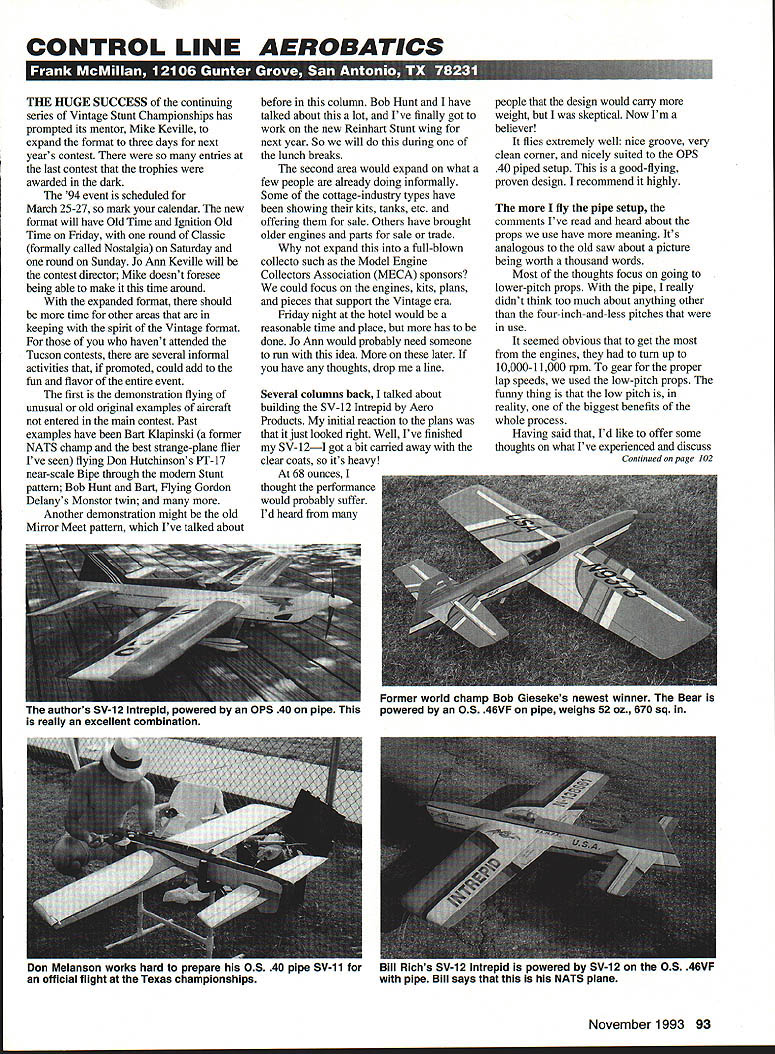
Several columns back I talked about building the SV-12 Intrepid by Aero Products. My initial reaction to the plans was that it just looked right. Well, I've finished my SV-12 — I got a bit carried away with the clear coats, so it's heavy! At 68 ounces, I thought the performance would probably suffer. I'd heard from many people that the design would carry weight, but I was skeptical. Now I'm a believer!
It flies extremely well: nice groove, very clean corner, and nicely suited to the OPS .40 piped setup. This is a good-flying, proven design. I recommend it highly.
Prop Pitch and Performance
As for the pipe setup, the comments I've read and heard about the props we use have more meaning. It's analogous to the old saw about a picture being worth a thousand words. Most of the thoughts focus on going to lower-pitch props. With the pipe, I really didn't think much about anything other than the four-inch-and-less pitches that were in use.
It seemed obvious that to get the most from the engines, they had to turn up to 10,000–11,000 rpm. To gear for the proper lap speeds, we used the low-pitch props. The funny thing is that the low pitch is, in reality, one of the biggest benefits of the whole process.
Many years ago, the only props any of us knew about were the 10 x 6 Top Flite or some other brand. As it turns out, many of the good fliers of the Classic era were using lower pitches, but because the information wasn't well disseminated, few knew it was happening. In addition, the older motors were timed for lower rpm, so sometimes the match to the motor wasn't there, and it was back to the higher pitches. George Aldrich mentioned running four-plus pitch, wide blades and the presswood Top Flite 10 x 5 that were actually under five pitch in his winning Noblers, but the consensus was that a Stunt plane ran a six pitch, as much because the sound was the classic run as because of performance.
The two-four break was there, but in the upper outside portions of the square eights and in the verticals the power, and thus the tension, faded. We lived with it that way because we didn't see anything better.
The low-pitch props do offer more performance. In the PAMPA newsletter, Ted Fancher stated that even with the pipe, the same props on the same engines produced a gain in performance. The question is: what is that gain? Sometimes that is difficult to quantify. I would guess that many a flier has not realized the gain simply because he didn't set up the plane correctly to experience it. Before working with different props you need to understand what the relationships are and what they do.
Bob Hunt explained the pitch relationship best when he compared props to the gears in a car. Many new cars come with tachometers, so if you visualize low gear and the tach, the rpm are naturally higher for the lower gears, and lower as the shifts are made. The same is true with low-pitch props: the rpm must be higher to maintain the same speed with a lower-pitch prop. At low gear the rpm must be more closely controlled to maintain the correct speed, even though the rpm can be varied in count. It's the torque curve and the speed/torque match that matter.
#### How to experiment with lower-pitch props
- Start with a standard setup. For example, a .60 model commonly will lap at a top speed of 5.2–5.4 seconds with a 5.5–6.0 x 12–12.5 prop.
- If you want to try a low-pitch prop, begin with a Rev-Up 13 x 5 (typically these pitch to 4.5–4.8) or try a 13 x 5 to start.
- Get the plane up to the speed where you now know it is comfortable. Do this by airspeed and throttle control—not by the sound of the motor.
- Change to the low-pitch prop.
- Increase the throttle to regain the same lap speed, then check the timing. In most cases the timing may need to be advanced slightly to bring the rpm up and make the torque curve flatter.
- Fine-tune fuel, plug, and timing to keep the rpm in the narrower range where the low-pitch prop performs best.
One point we've learned is that whereas a standard high-pitch prop may have a broad, forgiving power band, the low-pitch prop can be more sensitive to fuel, plug, and timing changes. It's not that the low-pitch prop is less tolerant; it's just that the rpm range where it performs is narrower, and you have to set the motor up to stay in that range.
To sum up, changing to a low-pitch prop can improve performance if you understand the interaction of prop pitch, rpm, throttle setting, and timing. Experimentation and careful tuning are required, but the rewards can be significant.
Runs up!
This will have a different feel; that is what the performance gain is. You may or may not get it the first time, but here is what you are looking for:
First, the heavy line tension below 45° with severe lessening above 45° will moderate. In general, the tension will be more evenly distributed, especially in the vertical maneuvers. The speed changes with the two-four cycle break will be less severe. You should notice a nicer characteristic overall.
The big feature will be the wind performance. You will be able to drive through the pattern without the heavy handle pressure that once made that task an agony no one looked forward to. Also, the wind-up in the loops will minimize to a reasonable amount.
If you have watched some of the top fliers in heavy conditions and wondered how it was possible, it is the prop/engine combination. The difference made by using the right prop is absolutely astounding.
#### Cautions and specifics
- I saw words in a western newsletter that the low pitches didn't work with a Fox .35, and I surmise that's true. That motor is a low-rpm setup and it won't turn up enough to be effective. You will need around 10,500 rpm.
- The old O.S. .35s will turn that rpm, as Bob Hunt showed me on the Tucker. He pitched an 11 x 5 Rev-Up to about 4¼ and that worked well.
- The S.T. .60s and .46s will turn up enough to run the 4¼–4½ pitch. While this pitch range will show measurable gains, it would be better to get down under 4-inch pitch to minimize wing-up in the wind.
To determine where you want to go to get the most beneficial effect, gear/pitch the motor to be unloaded just beyond the peak of the horsepower curve. When the rpm falls off under load, the horsepower kicks in, the rpm come back, and since you are on the back side of the curve, the plane settles back to the unloaded condition. That's what it's all about. If you can get in this range, you will be very happy!
On the props themselves: a pitch gauge is vital. Check the ads for Prather pitch gauges. Stock props can vary from blade to blade and prop to prop. The approach that I have found to be most consistent is a medium-to-wide blade set at constant pitch from the number-four station to the tip.
Many props will pitch lower at the tip; I've found this doesn't work well. If anything, a slight increase in pitch at the very tip will help in the verticals. On our test 13 x 5 Rev-Up, you might consider taking a sanding block and increasing the pitch for the last inch of the prop. But don't do this until after you have worked with the stock prop.
Try this approach. It'll take some time to get it right, but it does work!
Transcribed from original scans by AI. Minor OCR errors may remain.

