
CONTROL LINE AEROBATICS
Frank McMillan, 12106 Gunter Grove, San Antonio, TX 78231
During the 1993 Labor Day weekend, the F2B Control Line Precision Aerobatics Team was selected. Eight of the sixteen competitors who flew on Saturday were eliminated. The remaining eight flew a best-two-out-of-three-flight competition Sunday, with the top three earning the privilege of representing the United States at the international competition in Shanghai, China, in October 1994. As many readers already know, the U.S. is defending the team championship and the individual World Champion, Paul Walker, will compete as defending champion.
Volunteers and officials
The selection process was smooth and efficient thanks to many volunteers:
- Warren Tiahrt — event director (second time)
- Dave Cook — head judge
- Dave Winship — behind-the-scenes coordinator
- Judges headed by Gary McClellan
The Precision Aerobatics community expresses sincere thanks to all who helped.
The team selection and site
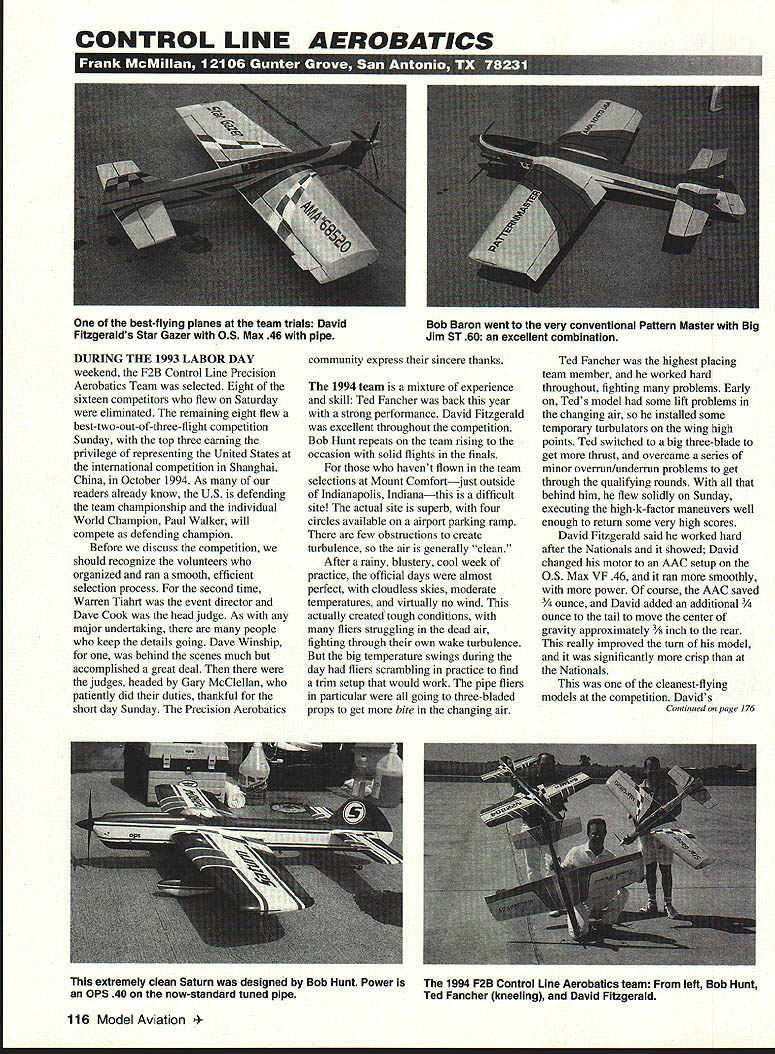
The 1994 team is a mixture of experience and skill. Ted Fancher returned with a strong performance, David Fitzgerald was excellent throughout the competition, and Bob Hunt repeats on the team with solid flights in the finals.
For those who haven't flown the team selections at Mount Comfort—just outside Indianapolis, Indiana—this is a difficult site. The actual location is superb, with four circles available on an airport parking ramp and few obstructions to create turbulence, so the air is generally "clean."
After a rainy, blustery, cool week of practice, the official days were almost perfect: cloudless skies, moderate temperatures, and virtually no wind. These conditions were actually tough, with many fliers struggling in dead air and fighting their own wake turbulence. The large temperature swings during the day forced fliers to scramble in practice to find a trim setup that would work. Pipe fliers in particular went to three-bladed props to get more bite in the changing air.
Results and notable finishes
- Ted Fancher — highest placing team member
- David Fitzgerald — excellent throughout; clean geometry
- Bob Hunt — repeats on the team
Alternates:
- First alternate: Bob Baron (missed by a little more than three points)
- Second alternate: Bill Rich (0.016 points behind Bob Baron)
Other top-eight finalists included Bill Werwage, Windy Urtnowski, and Bob Gieseke.
Competitor summaries
- Ted Fancher: Ted worked hard throughout the event, overcoming lift problems caused by changing air. He installed temporary turbulators on wing high points, switched to a large three-blade for more thrust, and solved a series of minor overrun/underrun problems to get through the qualifying rounds. He flew solidly on Sunday, executing high-k-factor maneuvers well enough to earn very high scores.
- David Fitzgerald: David made significant improvements after the Nationals. He changed his motor to an AAC setup on the O.S. Max VF .46, which ran more smoothly and with more power. The AAC saved 3/4 ounce, and David added 3/8 ounce to the tail to move the center of gravity approximately 3/8 inch rearward. This improved the turn of his model and made it significantly crisper than at the Nationals. David minimized obvious errors and combined excellent geometry to score well; his selection was well deserved.
- Bob Hunt: Known for consistently strong flights, Bob's Saturn/OPS .40 combination flew well throughout the competition. He delivered two of the superior flights of the weekend. His flying is clean and compact and scores well in international competition. Bob fought through some dead air on several flights to achieve high scores.
- Bob Baron (first alternate): Bob returned to a more conventional model with his comfortable ST .60 package. The engine run was superb and his flying was smooth and compact. Slight flaws and some low maneuvers cost him enough to miss the team by a few points.
- Bill Rich (second alternate): Bill flew the same SV-12 O.S. .46 VF combination he used at the Nationals, and it performed flawlessly. He lost out due to a chance dead-air spot on one square eight with the high-k-factor sequence. Bill has been a Nationals finalist multiple times and continued perseverance should pay off.
- Bill Werwage: Bill had some excellent flights but suffered pipe header problems that robbed him of the power edge needed in dead air. A vibration node apparently cracked the headers, diminishing power and the crispness that usually characterizes his flying.
- Windy Urtnowski: Windy "returned home" to his old Cardinal airframe and ST .60 setup, which ran well and produced a nice, solid, loud .60 bellow. His flying was smooth with good corners, though a bit large for the high-k-factor maneuvers to earn the biggest numbers.
- Bob Gieseke: Bob rounded out the top eight flying one of his classic models. He suffered engine troubles earlier in the year and arrived at the trials without an engine; Bill Werwage loaned him his best O.S. .46 VF and Bob persevered. He had rejoined his wing from the Nationals and it performed well.
Observations and outlook
In general, the flying was good with many excellent maneuvers. There was little to choose among the models, as most flew well. Piped setups were slightly better in dead air, especially in the difficult spots (above 45° at the edge of the square eight).
The new U.S. F2B team is excellent and has the potential to repeat as world champions. It will take hard work, but that dedication is how Ted, David, and Bob reached the team. Congratulations to the team.
Transcribed from original scans by AI. Minor OCR errors may remain.

