
Control Line: Aerobatics
Wynn Paul
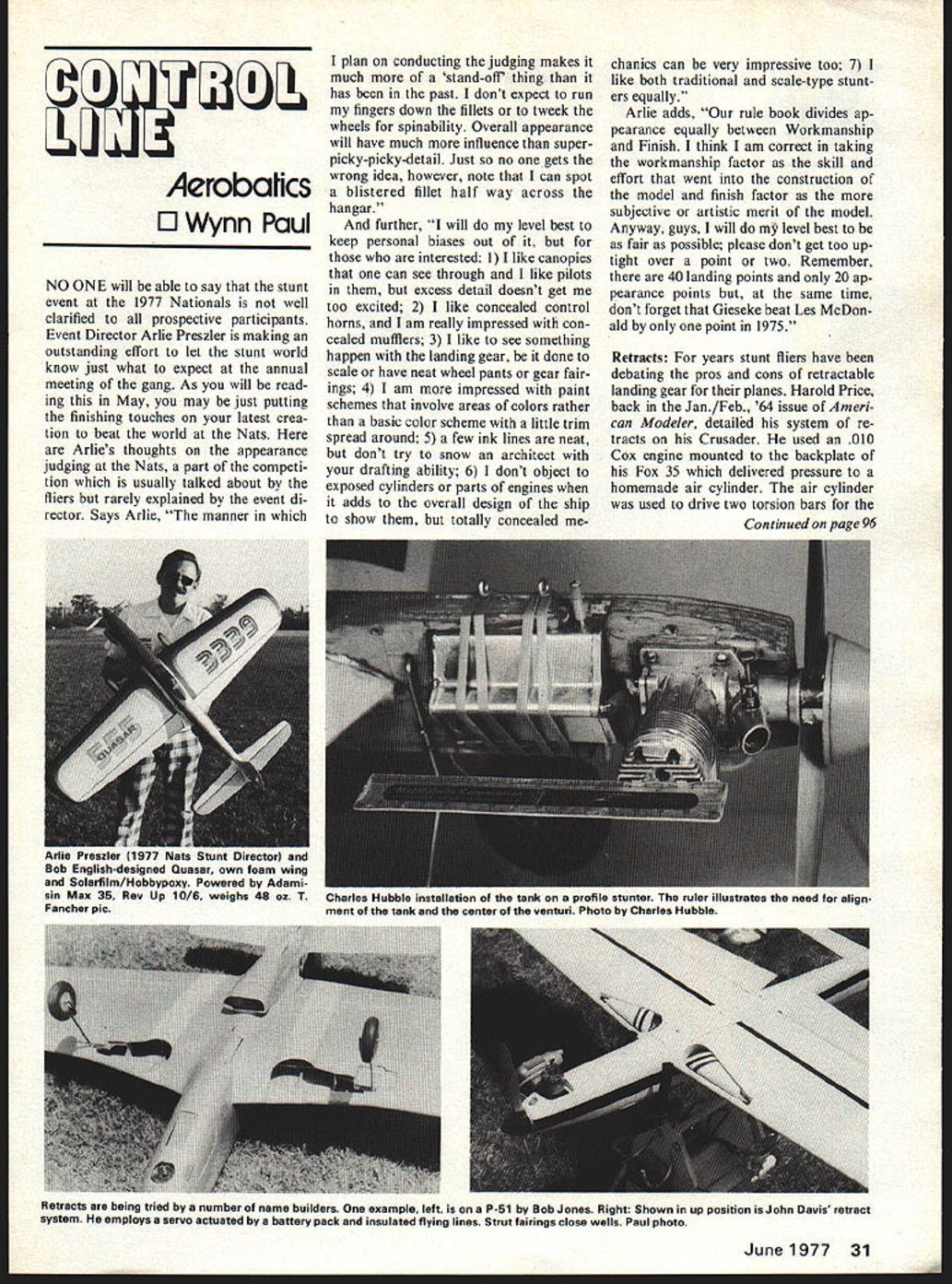
NO ONE will be able to say that the stunt event at the 1977 Nationals is not well clarified to all prospective participants. Event Director Arlie Preszler is making an outstanding effort to let the stunt world know just what to expect at the annual meeting of the gang. As you will be reading this in May, you may be just putting the finishing touches on your latest creation to beat the world at the Nats. Here are Arlie's thoughts on the appearance judging at the Nats, a part of the competition which is usually talked about by the fliers but rarely explained by the event director. Says Arlie, "The manner in which I plan on conducting the judging makes it much more of a 'stand-off' thing than it has been in the past. I don't expect to run my fingers down the fillets or to tweak the wheels for spinability. Overall appearance will have much more influence than super-picky-picky detail. Just so no one gets the wrong idea, however, note that I can spot a blistered fillet halfway across the hangar."
And further, "I will do my level best to keep personal biases out of it, but for those who are interested: 1) I like canopies that one can see through and I like pilots in them, but excess detail doesn't get me too excited; 2) I like concealed control horns, and I am really impressed with concealed mufflers; 3) I like to see something happen with the landing gear, be it done to scale or have neat wheel pants or gear fairings; 4) I am more impressed with paint schemes that involve areas of colors rather than a basic color scheme with a little trim spread around; 5) a few ink lines are neat, but don't try to snow an architect with your drafting ability; 6) I don't object to exposed cylinders or parts of engines when it adds to the overall design of the ship to show them, but totally concealed mechanics can be very impressive too; 7) I like both traditional and scale-type stunter s equally."
Arlie adds, "Our rule book divides appearance equally between Workmanship and Finish. I think I am correct in taking the workmanship factor as the skill and effort that went into the construction of the model and finish factor as the more subjective or artistic merit of the model. Anyway, guys, I will do my level best to be as fair as possible; please don't get too uptight over a point or two. Remember, there are 40 landing points and only 20 appearance points but, at the same time, don't forget that Gieseke beat Les McDonald by only one point in 1975."
Retracts: For years stunt fliers have been debating the pros and cons of retractable landing gear for their planes. Harold Price, back in the Jan./Feb., '64 issue of American Modeler, detailed his system of retracts on his Crusader. He used an .010 Cox engine mounted to the backplate of his Fox .35 which delivered pressure to a homemade air cylinder. The air cylinder was used to drive two torsion bars for the
CL Aerobatics/Paul
wing mounted gear. Actuation of the retractable gear is the most difficult part of a retract gear and Price used an air pressure switch set to work at an air speed of 30 mph. Mounted in the wing to get away from the prop blast, the pressure switch was used to bleed off pressure from the pump when the plane was on the ground and to close off the bleed hole when the plane reached flying speed. Price didn't state exactly how much the system weighed but it must have been from 2 to 4 ounces. He did state that the retracts made the square maneuvers much better and the reduced drag also helped the hourglass.
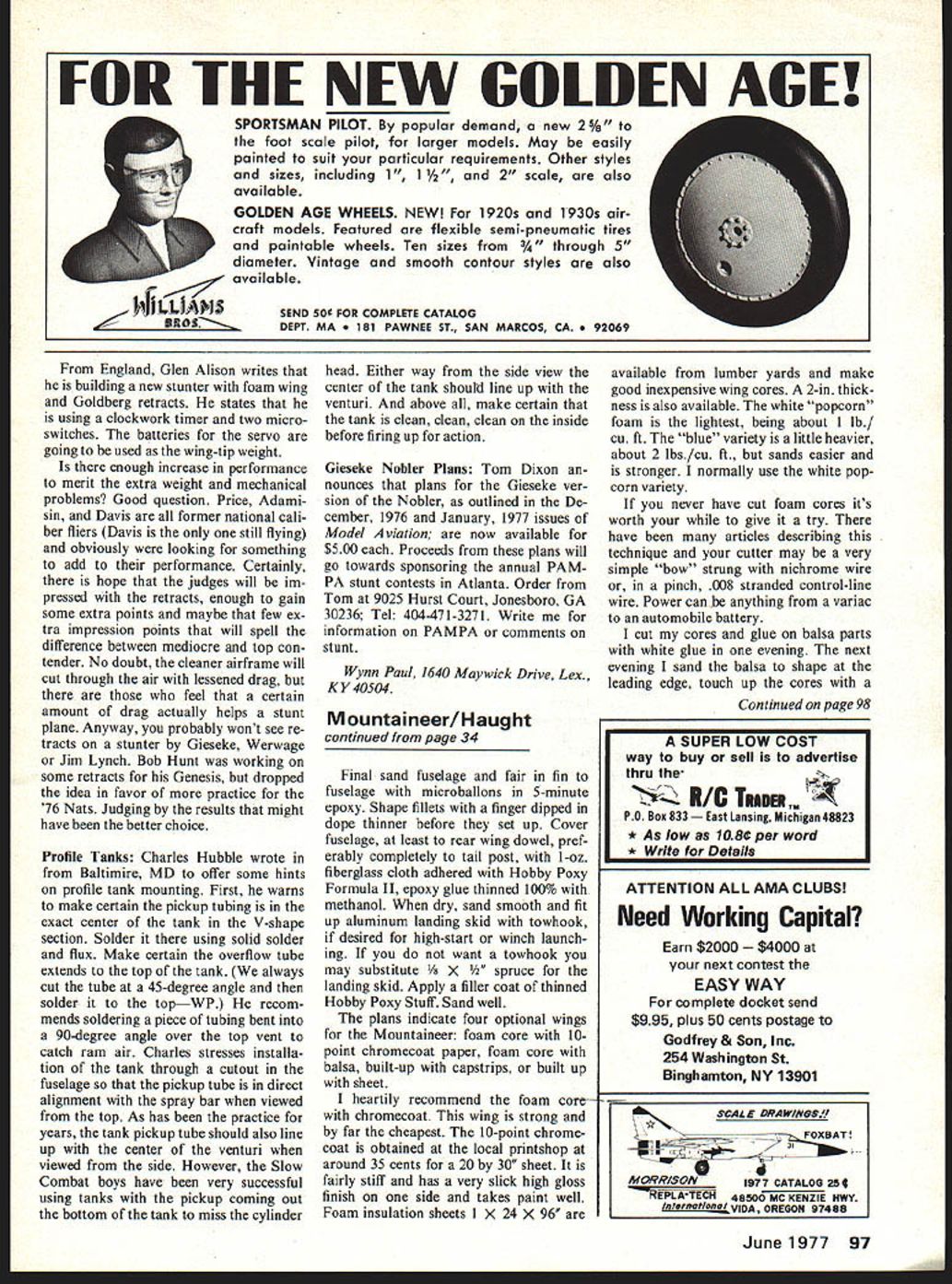
Since Price's experiment there have been other attempts to use retracts. At the 1973 Nationals Arch Adamish had a semi-scale Tony with Goldberg retracts operated by a servo and battery. They worked on the ground but Arch chose not to fly at windy Oshkosh, by gosh. John Davis had a set of retracts at the '76 Nats which did work in the air. Insulated lines carried current from a battery pack attached to the handle. The current operated the retracts which everybody saw at the qualifications in the morning at the Nats. In the afternoon John chose not to utilize the retracts because the wind was up and he evidently felt he needed the extra drag.
Bob Jones, Long Beach, Cal., sent in a picture of his P-51 semi-scale stunter with retracts. He has a hatch on the bottom of the fiberglass fuselage for access to the servos. The cockpit is removable for access to battery. He found a device to achieve a fail-safe-down in a 1958 Flying Models magazine!
Al Rabe has been working on his twin-engine stunter with retracts since 1974. The writer has seen how the retracts work, utilizing a wing-mounted battery to actuate a servo to raise the gear. A pressure takeoff from the back plate lowers the gear after the engine shuts down. A truly ingenious setup which seems to work well on the ground; however, Al has had a lot of trouble getting the right powerplants for his twin. Currently he has a proposal before the CLCB to increase the allowable engine displacement in stunt to .72 cu. in. to allow him to use two reliable .35-size engines in his twin. Incidentally, Al uses the up and down movement of his familiar shock landing gear to actuate a micro-switch when the gear leaves the ground which actuates the servo to raise the gear! From England, Glen Alison writes that he is building a new stunter with foam wing and Goldberg retracts. He states that he is using a clockwork timer and two micro-switches. The batteries for the servo are going to be used as the wing-tip weight.
Is there enough increase in performance to merit the extra weight and mechanical problems? Good question. Price, Adamson, and Davis are all former national caliber fliers (Davis is the only one still flying) and obviously were looking for something to add to their performance. Certainly, there is hope that the judges will be impressed with the retracts, enough to gain some extra points and maybe those few extra impression points that will spell the difference between mediocre and top contender. No doubt, the cleaner airframe will cut through the air with lessened drag, but there are those who feel that a certain amount of drag actually helps a stunt plane. Anyway, you probably won't see retracts on a stunter by Gieseke, Werwage or Jim Lynch. Bob Hunt was working on some retracts for his Genesis, but dropped the idea in favor of more practice for the '76 Nats. Judging by the results that might have been the better choice.
Profile Tanks:
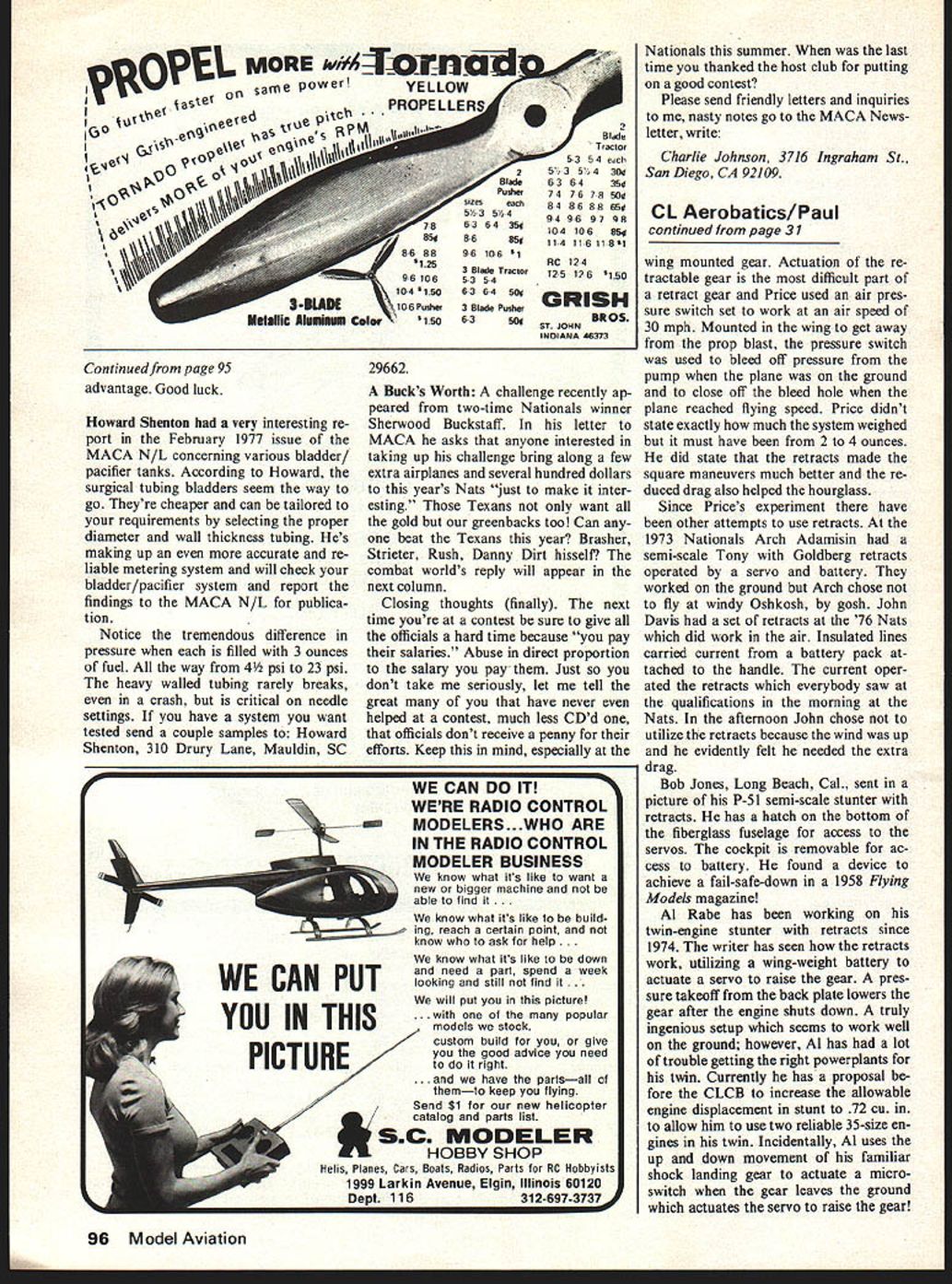
Charles Hubble wrote in from Baltimore, MD to offer some hints on profile tank mounting. First, he warns to make certain the pickup tubing is in the exact center of the tank in the V-shape section. Solder it there using solid solder and flux. Make certain the overflow tube extends to the top of the tank. (We always cut the tube at a 45-degree angle and then solder it to the top—WP.) He recommends soldering a piece of tubing bent into a 90-degree angle over the top vent to catch ram air. Charles stresses installation of the tank through a cutout in the fuselage so that the pickup tube is in direct alignment with the spray bar when viewed from the top. As has been the practice for years, the tank pickup tube should also line up with the center of the venturi when viewed from the side. However, the Slow Combat boys have been very successful using tanks with the pickup coming out the bottom of the tank to miss the cylinder head. Either way from the side view the center of the tank should line up with the venturi. And above all, make certain that the tank is clean, clean, clean on the inside before firing up for action.
Gieseke Nobler Plans:
Tom Dixon announces that plans for the Gieseke version of the Nobler, as outlined in the December, 1976 and January, 1977 issues of Model Aviation, are now available for $5.00 each. Proceeds from these plans will go towards sponsoring the annual PAMPA stunt contests in Atlanta. Order from Tom at 9025 Hurst Court, Jonesboro, GA 30236; Tel: 404-471-3271. Write for information on PAMPA or comments on stunt.
Wynn Paul, 1640 Maywick Drive, Lex., KY 40504.
Transcribed from original scans by AI. Minor OCR errors may remain.

