
Control Line Aerobatics
P.T. Granderson f2bmail@yahoo.com
An outstanding finishing system is detailed
My first column got many people thinking about the state of our sport. We are creatures of habit, and the most often asked questions are related to building and flying. The topic people ask the most about is finishing.
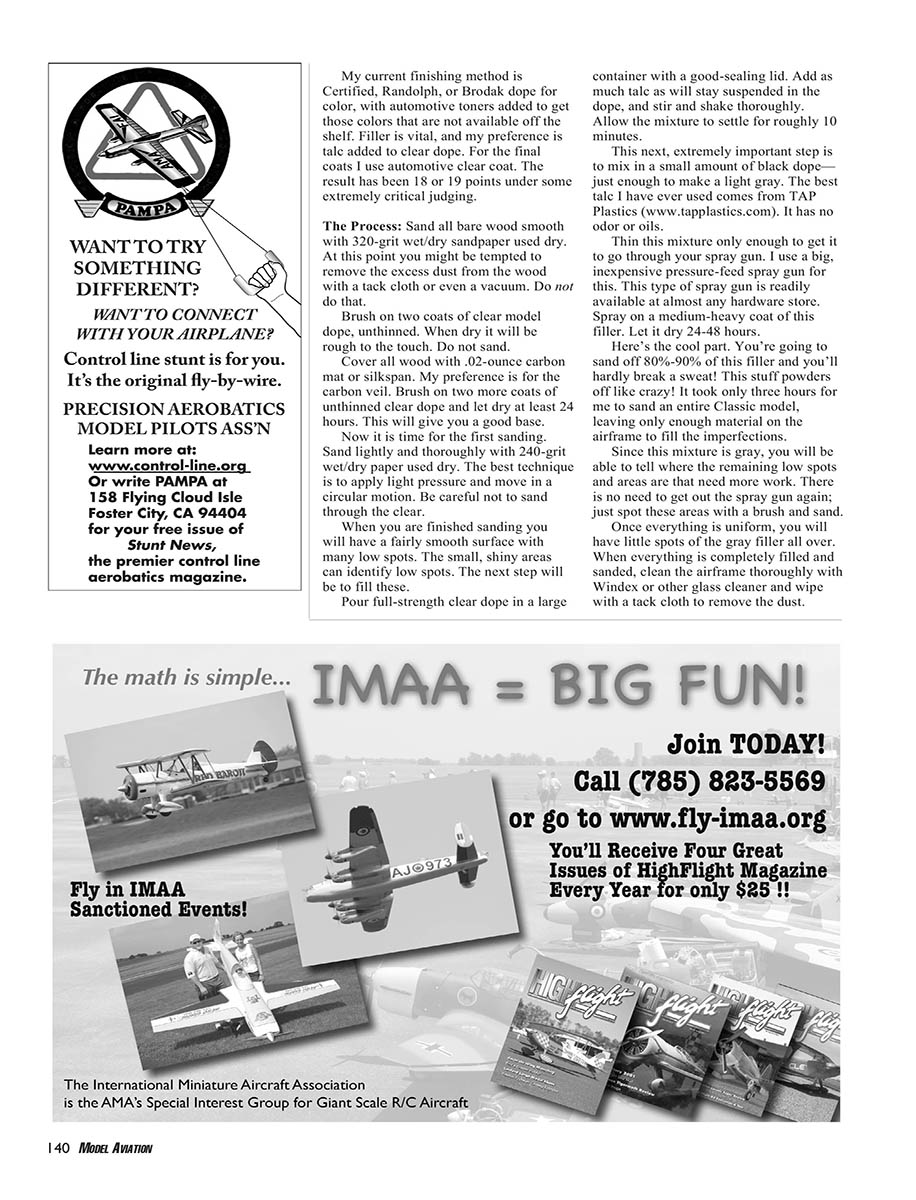
Much of the work I've done has been circulated, modified, and printed by others, with and without my knowledge. Because it is such a hot topic, I will present the unabridged, updated version of the finishing system created eight years ago. It has consistently received high marks from experienced judges.
With roughly 600 hours devoted solely to finishing in the past eight years, when it comes to finishing, for me there is "no fear."
The most important part of the finish is the preparation for color. The most important tool you will ever own is sandpaper. If you want a first-class finish, you will have to become good friends with a variety of types and grits of the stuff.
There is definitely an art to sanding, and the key is touch. Sandpaper is a tool; let the tool do the work. It sounds simple. Everyone knows what sandpaper is and we've used it for many years, so why is it such a big deal?
It took me 30 years to figure out how to use this basic tool and another 10 years to perfect my technique! I could have cut my learning time down to a few days were it not for stubbornness and trying to find some magic paint, spray equipment, or super polish. Today I can say with relative confidence that there is no such thing.
My current finishing method is Certified, Randolph, or Brodak dope for color, with automotive toners added to get those colors that are not available off the shelf. Filler is vital, and my preference is talc added to clear dope. For the final coats I use automotive clear coat. The result has been 18 or 19 points under some extremely critical judging.
The Process
- Prepare the bare wood
- Sand all bare wood smooth with 320-grit wet/dry sandpaper used dry.
- Do not remove the dust with a tack cloth or vacuum yet. Brush on two coats of clear model dope, unthinned. When dry it will be rough to the touch. Do not sand.
- Apply veil and build a base
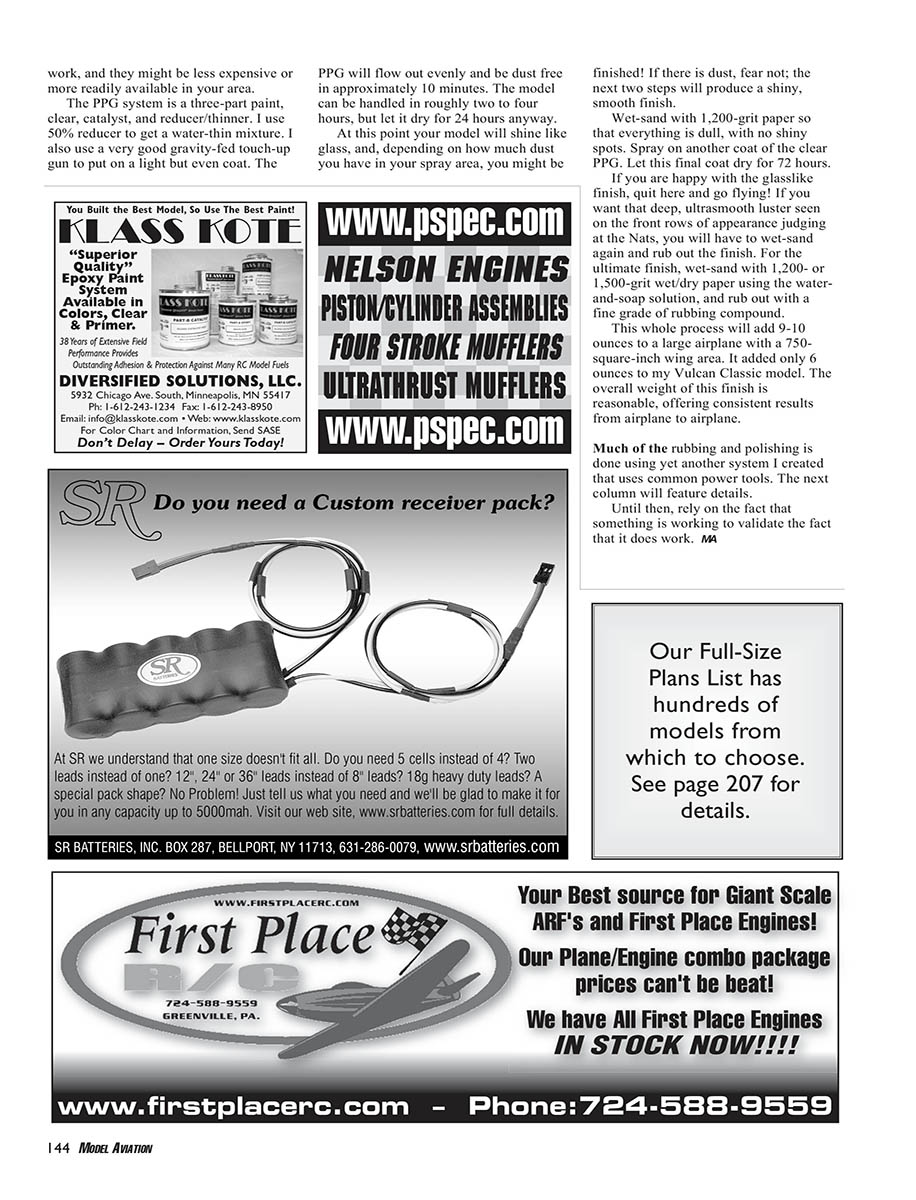
- Cover all wood with 0.02-ounce carbon mat or silkspan. My preference is the carbon veil.
- Brush on two more coats of unthinned clear dope and let dry at least 24 hours. This gives you a good base.
- First sanding and filling
- Sand lightly and thoroughly with 240-grit wet/dry paper used dry. Apply light pressure and move in a circular motion. Be careful not to sand through the clear. After sanding you will have a fairly smooth surface with many low spots; the small shiny areas identify low spots.
- Pour full-strength clear dope into a large container with a good-sealing lid. Add as much talc as will stay suspended, stir and shake thoroughly, and allow the mixture to settle for roughly 10 minutes.
- Mix in a small amount of black dope—just enough to make a light gray. (The best talc I have used comes from TAP Plastics, www.tapplastics.com; it has no odor or oils.)
- Thin this mixture only enough to get it to go through your spray gun. I use a big, inexpensive pressure-feed spray gun available at most hardware stores.
- Spray on a medium-heavy coat of this filler. Let it dry 24–48 hours.
- Sand off 80%–90% of this filler; it powders off easily and leaves just enough material to fill imperfections. Because the filler is gray, you can easily see remaining low spots. Spot-fill with a brush as needed and sand again.
- Clean and seal before color
- When everything is uniform and filled, clean the airframe thoroughly with Windex or other glass cleaner and wipe with a tack cloth to remove dust.
- Thin clear dope 80% (that's right—80%) and spray on a quick, wet coat. This extraordinarily important step helps prevent the base coat from coming off when you remove masking tape. Do not skip this thin coat.
- Apply color and build to clear coats
- Thin all colors 50%–60% and spray on dry. Use just enough to cover; don't worry about shine, blushing, or a slightly rough surface.
- Once all colors are on, spray two coats of clear dope thinned 60%. Again, don't worry about shine or blush.
- Wet-sanding and cleaning
- Lightly sand everything with 800-grit wet paper. It is unnecessary to sand until everything is completely dull.
- The best solution for wet-sanding is plain tap water, lukewarm, with roughly three drops of dish detergent per gallon.
- Be careful not to sand through the clear coats.
- Clean everything with Windex or a similar glass cleaner at least two times; I usually do it four times. Chemical degreasers don't get the job done. The goal is to remove everything that is not fixed permanently to the surface.
- After cleaning and recleaning, go over everything with a tack cloth several times, using only light pressure.
- Main clear coat (automotive)
- Lightly apply one coat of automotive clear. This will require good spray equipment, proper ventilation, and breathing equipment. Consult your local supplier regarding safety precautions, spray equipment, and proper mixture.
- I use PPG Global Performance System Clear D893 and D871 medium thinner/reducer. PPG is my preference, but there are probably other clear coats that will work.
- PPG will flow out evenly and be dust-free in approximately 10 minutes. The model can be handled in roughly two to four hours, but let it dry for 24 hours anyway.
- Final wet-sanding and top clear coat
- If there is dust in the finish, wet-sand with 1,200-grit paper so that everything is dull with no shiny spots.
- Spray another coat of PPG clear. Let this final coat dry for 72 hours.
- Optional rub-out for ultimate luster
- If you are happy with the glasslike finish, stop and go flying.
- For a deeper, ultra-smooth luster seen on top appearance-judging entries, wet-sand again with 1,200- or 1,500-grit wet/dry paper using the water-and-soap solution, then rub out with a fine-grade rubbing compound.
Notes on weight and tools
- This whole process will add about 9–10 ounces to a large airplane with a 750-square-inch wing area. It added only 6 ounces to my Vulcan Classic model. The overall weight is reasonable and produces consistent results.
- Much of the rubbing and polishing is done using another system I created that uses common power tools. The next column will feature details.
Until then, rely on the fact that something is working to validate the fact that it does work.
MA
Transcribed from original scans by AI. Minor OCR errors may remain.

