
Control Line Aerobatics
Bob Hunt [robinhunt@rcn.com]
Foam wing-construction options for any model-airplane build
As you might have figured out by now, the Project Hole Shot model is a convenient way to introduce the new CL Precision Aerobatics (Stunt) enthusiast to "accepted" building practices, the required tools and materials, and the various products that are available.
With the fuselage and tail assemblies complete, it is time to think about a wing. Here we need to pause and examine the different types of wing construction and determine the pros and cons of each.
The original Hole Shot was constructed using a foam-core wing, but several have used built-up wings. That type has been with us since the beginning of the Stunt event. Foam wings came onto the scene in approximately 1965, but they didn't become a widely accepted alternative to the built-up wing for competitive CL use until the early 1970s.
Built-up vs. foam-core wings
Each type of wing has its merits.
Built-up wings
- Positives:
- Less expensive to construct.
- Generally lighter than an equivalent-size foam wing.
- Negatives:
- More difficult to build straight and warp-free.
- Not as strong as foam wings.
- Prone to movement with temperature and humidity changes.
- Generally more labor-intensive to cover and finish.
Foam-core wings
- Positives:
- If properly cut and covered, they remain warp-free.
- Durable and resist dents and dings.
- Much quicker and easier to construct.
- Easier to repair.
- Negatives:
- More expensive—especially if you purchase a core or sheeted wing from a commercial source.
- Foam wings are generally a bit heavier than an equivalent-size built-up wing.
I can't and won't recommend one type of wing over the other. Evaluate which is best suited to your needs and skills. I suggest building one of each, and then you will know which one is best for you!
Built-up wing method used on the Hole Shot
The history of the built-up wing goes back a long way. Many types of wing construction can be utilized with a built-up wing. The one used on the Hole Shot is the tried-and-proven C-tube method, with sheet ribs and a sheeted leading edge (LE). It's not fancy, but it is easy to do.
A brief history of the foam wing
The first use of foam for model-airplane wings can be traced to a June 1964 Model Airplane News article by Ed Izzo and Ray Olson, titled "Styrofoam, a giant step forward." The foam they initially used was a product of the Dow Chemical company, which owns the rights to the name "Styrofoam." It was an extruded type of polystyrene foam, but it could easily be cut using a heated nichrome wire and a bow.
That article inspired many modelers to experiment with foam components. The first foam-winged Stunt model I ever saw fly was Gene Schaffer's white-and-orange Jet in 1965. Apparently Gene built it quickly to evaluate foam components in his models and used it in competition right away.
The earliest CL foam wings were cut from 1-pound-per-cubic-foot foam and were not cored out. The entire wing was solid foam, covered with 1/16" sheet balsa. Clearance holes were drilled in the inboard panel to allow passage for the leadouts. Predictably, these wings were heavier than an equivalent built-up balsa wing.
The first manufacturer to supply commercial foam-core wings to the CL fraternity was Arnold and Mike Stott's Foam Flite, based in Mankato, Minnesota. Mike was an accomplished Stunt flier, and the two had read Izzo and Olson's landmark article.
Even though the solid-core foam wings suffered a significant weight penalty, they began showing up in more Stunt models in the mid- to late 1960s because a properly cut and covered foam wing proved extremely accurate, warp-free, and quick to assemble. You were basically guaranteed a straight model that would fly well.
Many resisted changing to foam because of the weight penalty. Ed and Ray's article addressed internal coring to reduce weight, but the earliest CL foam wings did not take advantage of this feature. By the end of the 1960s, Arnold and Mike had begun to use two-section coring in their wings to reduce weight. Foam quickly became more popular after that.
I started experimenting with foam wings in 1968 and opened a company—Controline Specialties Corporation (CSC)—in 1969 that produced them for both RC and CL use. My company and Foam Flite immediately entered some good-natured competition to see who could produce the lightest foam-core wings for CL modelers. They had two-section coring, so I began cutting a third section.
It was great fun, and the result was rapid development of the foam-core wing for CL Stunt use. Throughout the 1970s, the foam wing became increasingly popular and allowed many modelers to rapidly build accurate and competitive CL Stunt models.
The preceding is an extremely abbreviated history. Through the years, many additional developments were pioneered by innovative modelers; perhaps I'll cover them in detail at a later date. The message is clear: foam provides a viable, durable, accurate, and easy-to-construct wing option for our purposes.
Sources for cores and completed wings
If you have foam-cutting equipment, you can make the cores for the Hole Shot. If you do not, you can order the cores from a custom wing-cutting service.
I own a company called Robin's View Productions, which can provide cores for the Hole Shot and even provide covered and sanded wings. Another good source for CL foam wing cores is Crist Rigotti. See the "Sources" listing at the end of this column for contact information.
Leading-edge (LE) practice and recommendation
The early foam wing cores were cut in such a manner that a balsa block had to be glued to the front of each panel after covering so that a rounded LE could be achieved. This practice proved inaccurate in many cases. Improper rounding of the LE can cause all sorts of trim and flying problems.
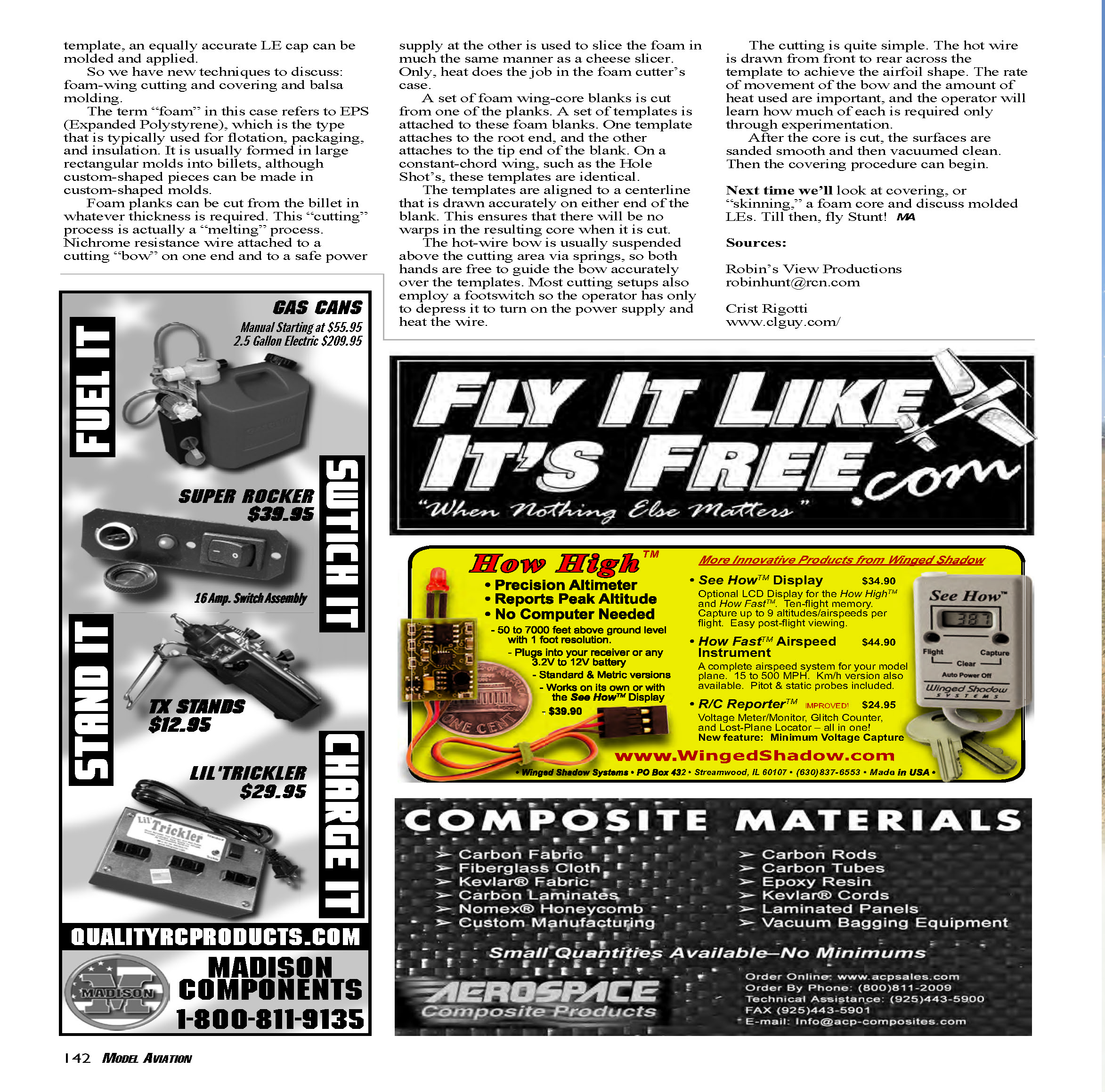
For that reason, I recommend that you cut or purchase cores with rounded foam LEs. If the core is properly cut from an accurate template, an equally accurate LE cap can be molded and applied.
So we have new techniques to discuss:
- Foam-wing cutting
- Covering (or "skinning") a foam core
- Balsa molding for LE caps
How foam cores are produced
The term "foam" here refers to EPS (expanded polystyrene), the type typically used for flotation, packaging, and insulation. It is usually formed in large rectangular molds into billets, although custom-shaped pieces can be made in custom-shaped molds.
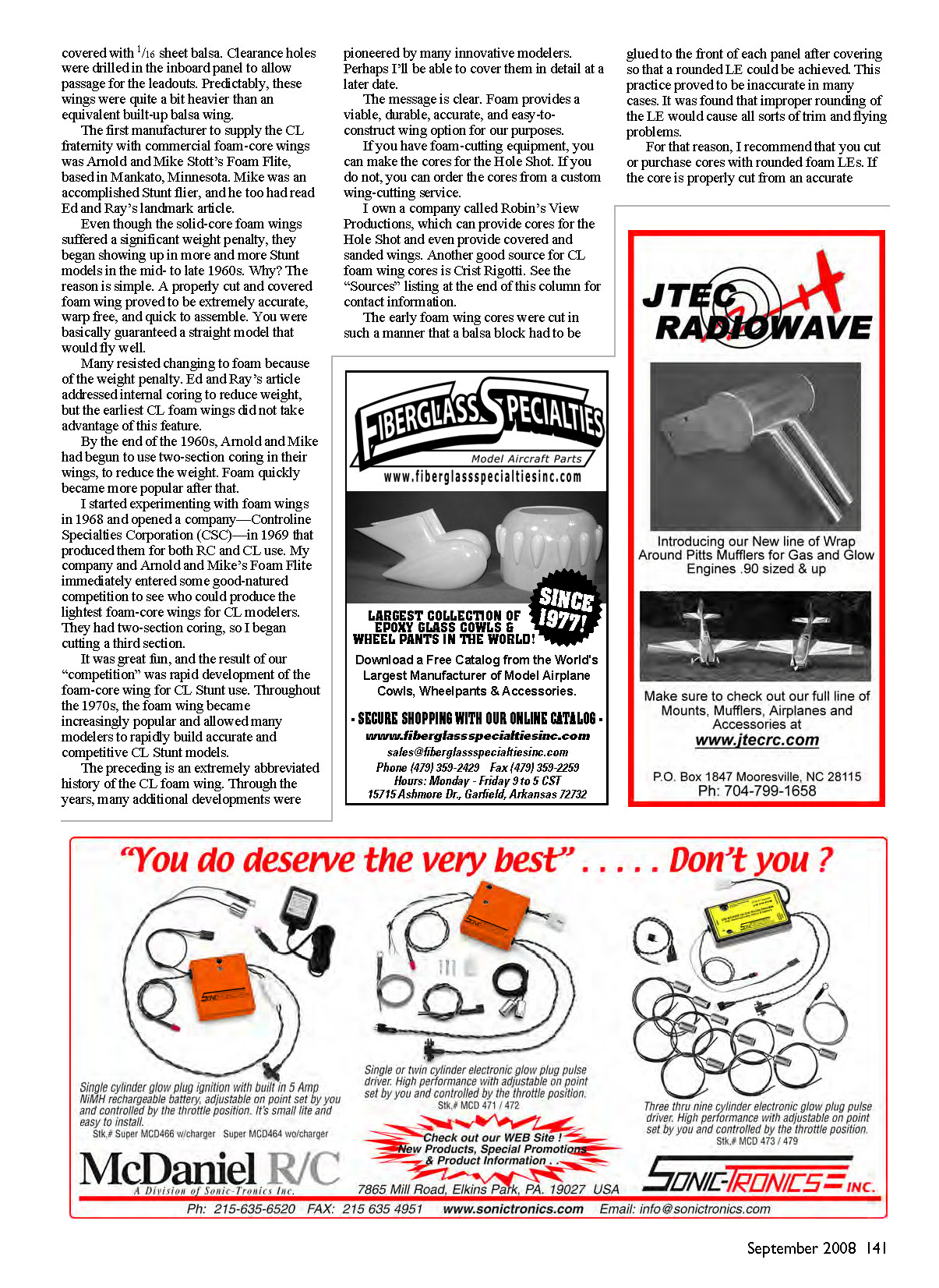
Foam planks can be cut from the billet in whatever thickness is required. This "cutting" process is actually a "melting" process. Nichrome resistance wire attached to a cutting bow on one end and to a safe power supply at the other is used to slice the foam in much the same manner as a cheese slicer—only heat does the job in the foam cutter's case.
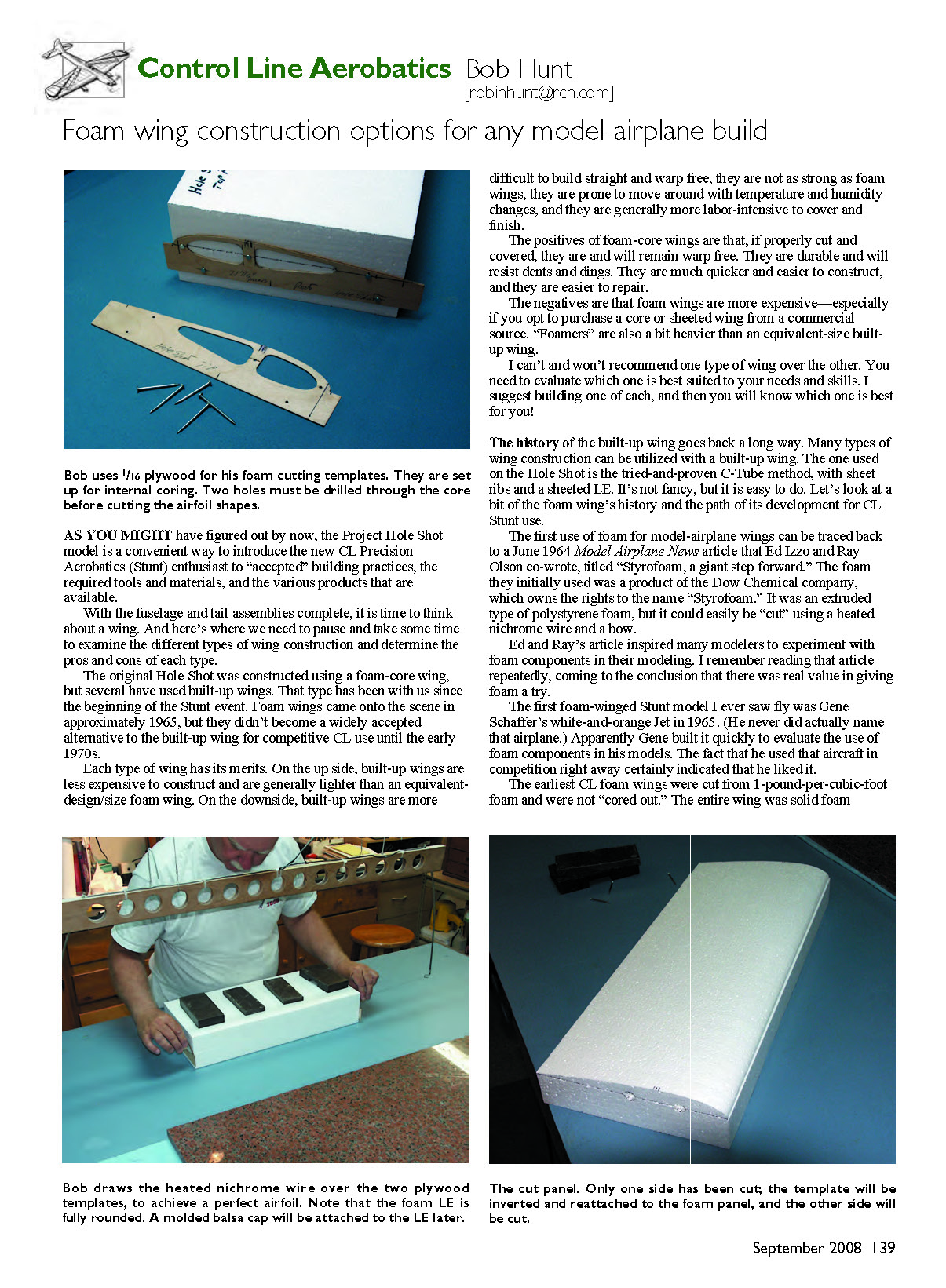
A set of foam wing-core blanks is cut from one of the planks. A set of templates is attached to these foam blanks: one template at the root end and the other at the tip end of the blank. On a constant-chord wing, such as the Hole Shot's, these templates are identical.
The templates are aligned to a centerline that is drawn accurately on either end of the blank. This ensures that there will be no warps in the resulting core when it is cut.
The hot-wire bow is usually suspended above the cutting area via springs so both hands are free to guide the bow accurately over the templates. Most cutting setups also employ a footswitch so the operator only has to depress it to turn on the power supply and heat the wire.
The cutting is quite simple: the hot wire is drawn from front to rear across the template to achieve the airfoil shape. The rate of movement of the bow and the amount of heat used are important, and the operator will learn how much of each is required only through experimentation.
After the core is cut, the surfaces are sanded smooth and then vacuumed clean. Then the covering procedure can begin.
Next time we'll look at covering, or "skinning," a foam core and discuss molded LEs. Till then, fly Stunt!
Sources
- Robin's View Productions — robinhunt@rcn.com
- Crist Rigotti — www.clguy.com/
Transcribed from original scans by AI. Minor OCR errors may remain.

