
CONTROL LINE AEROBATICS
Frank McMillan 12106 Gunter Grove, San Antonio, TX 78231
Introduction
Some years ago I had the rare opportunity to spend several days with Dr. R. V. Jones, Winston Churchill's Senior Technical Advisor during World War II. In the early 1950s he chaired a committee that examined technology and projected what weapons systems should be developed for England to maintain a proper defense posture.
When I talked to him, it had been more than 30 years since that panel, and the Falklands war was over. One of the points I wanted to probe was the methodology his group used to explore technologies and options and make their conclusions.
They looked at the environment, the elements that could change, and those that would remain relatively stable. With that baseline they considered what technologies were likely to be available in the out years.
So what does this have to do with control-line aerobatics? Things are changing in what has been a relatively stable event for many years. For one, Pattern has been stable since 1958, although the possibility of adding an inverted triangle exists. Maximum line length of 70 feet and an engine limit of 10 cc are not likely to change. With that laid out, much has evolved that I would like to touch on, and I want to look a bit into the future to see where our event may go.
Construction techniques: evolution and revolution
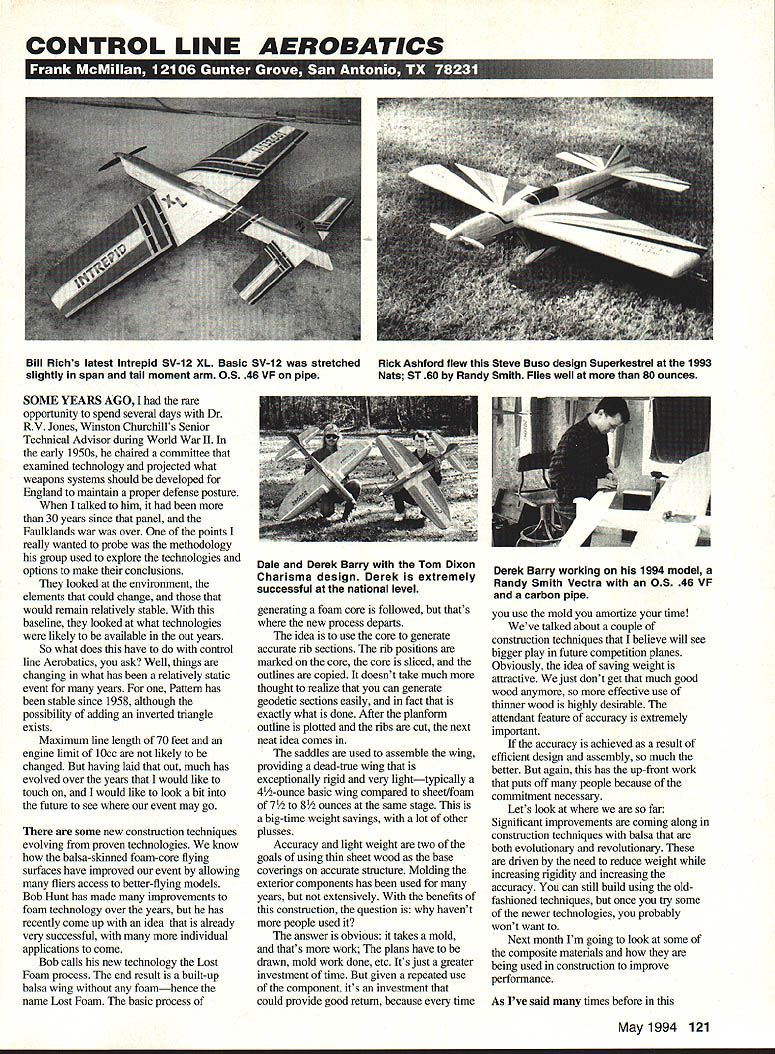
There are some new construction techniques evolving from proven technologies. We know how balsa-skinned, foam-core flying surfaces have improved our event by allowing many fliers access to better-flying models. Bob Hunt has made many improvements to foam technology over the years and has recently come up with an idea that is already very successful, with many more individual applications to come.
Bob calls his new technology the Lost Foam process. The end result is a built-up balsa wing without any foam—hence the name Lost Foam. The basic process of generating a foam core is followed, but that's where the new process departs.
The idea is to use the core to generate accurate rib sections. The rib positions are marked on the core, the core is sliced, and the outlines are copied. It doesn't take much thought to realize that you can generate geodetic sections easily, and in fact that is exactly what is done. After the planform outline is plotted and the ribs are cut, the next neat idea comes.
The saddles are used to assemble the wing, providing a dead-true wing that is exceptionally rigid and very light—typically a 4-ounce basic wing compared to sheet/foam of 7.5 to 8.5 ounces at the same stage. This is a big-time weight savings, with many other pluses.
Accuracy and light weight are two of the goals of using thin-sheet wood as the base coverings on accurate structure. Molding exterior components has been used for many years, but not extensively. With the benefits of this construction, the question is: why haven't more people used it?
The answer is obvious: it takes a mold, and that's more work. The plans have to be drawn, mold work done, etc. It's a greater investment of time. But given repeated use of the component, it's an investment that could provide good return, because every time you use the mold you amortize your time.
We've talked about a couple of construction techniques that I believe will see bigger play in future competition planes. Obviously, the idea of saving weight is attractive. We just don't get that much good wood anymore, so more effective use of thinner wood is highly desirable. The attendant feature of accuracy is extremely important.
If accuracy is achieved as a result of efficient design and assembly, so much the better. But again, this has the up-front work that puts off many people because of the commitment necessary.
Where we are and what's next
Significant improvements are coming along in construction techniques with balsa that are both evolutionary and revolutionary. These are driven by the need to reduce weight while increasing rigidity and increasing accuracy. You can still build using old-fashioned techniques, but once you try some of the newer technologies, you probably won't want to go back.
Next month I'll look at some of the composite materials and how they are being used in construction to improve performance.
Engines and availability
As I've said many times before in this column, just about the time the stunt community figures out that a particular engine or product works extremely well, it goes out of production. Most recently, the piped O.S. .40VF went out of production, and word has it that the O.S. .46VF is out of production, although it is still generally available.
We all know of the excellent ST .46s and .60s that are still in demand and will be for many years to come. Fortunately, there's news that may overcome some of these shortfalls.
A considerable amount of technology has become available from the former Soviet Union—the many changes there have caused a quest for hard foreign currency. The latest situation that may benefit our community is being worked on by Tom Dixon. He has just finished negotiating to import a loop-scavenged 10 cc (.60 ci) true stunt engine. The cylinder/piston is ABC without ring and the projected weight (with muffler) is 12 ounces. The delivered price will be in the $200 range. Tom reports that interested parties should contact him to get on the order list; money will be due when the engines are available for delivery (spring 1994). These engines are being built by world-class FAI Team Race competitors who know what they are doing.
To fill a related need, Tom is having ABC and/or AAC cylinder/piston assemblies made for the ST .51, Merc .61, and possibly the ST .60. These will be made to the same high standards as the 10 cc engines and should also be available in the spring.
Tom is also working with several other new engines suitable for stunt work:
- MVVS .40 (rear or side exhaust), to be refined for pipe and non-pipe work. These engines are similar to the O.S. FSR series.
- MVVS .52 and Moki .51, available at about $180 each. These two engines require no rework for stunt and run well right out of the box.
Kits and designs
- Thunderbird 670: T-Bird resized for ST .51 or similar engines. Features include all-wood construction with carbon-fiber pushrods, adjustable leadouts, and both aluminum gear for fuselage mounting and wing-wire landing gear. Introductory price: $100 plus shipping.
- Box Car Chief: 42-inch span, high-wing Old-Time design from Rick’s MF6 reintroduced by Mike Keville. Exceptionally good OTS plane for .29 to .40 engines. Price: $45. For more information, contact Tom Dixon.
Tom Dixon P.O. Box 671166 Marietta, GA 30066
Control systems
The heart of any good stunt model is a sound control system. I've been using some components purchased from Dan Winship, and I cannot recommend them highly enough. Dan constructed my horns from 1/8" and 3/32" wire, with brass tube bearings and 1/16" steel uprights to my specifications. The center joint is brazed and picture-perfect. Pushed bushings are at the user's option. I've used 1/8" brass tubing before, but I've since turned some phosphor-bronze caps that I've soldered in place. Dan also has bellcranks available to complete the system.
Contact: Winship Models 5971 Oak Hill East Dr. Plainfield, IN 46168 Tel.: (317) 839-8316
Finishing: dry transfers
By the time you read this, it will be time to be in the finishing mode, and there's a new product that should make the job easier. No first-class stunter is complete without some ink work to dress up and detail the finish. It takes me a bunch of time applying ink work. Access panels always give me trouble because they seem to take more time to get right, and I'm prone to make mistakes.
Last year I purchased a sheet of dry transfers by Dry-Set Model Markings of small panels. These are wonderful! They have shapes and sizes that are perfect for modeling. Here's how easy they are to apply:
- The base material is heavy Mylar.
- The instructions call for a pre-release in mild heat by rubbing the sheet—this works.
- Apply finger pressure to transfer the shape to the desired area.
These transfers are attractive and not "model flotsam" once transferred. They are not simply ink; they are a type of epoxy and can be coated with any type of clear coat. This is a great product and works as advertised. You'll like it, but it is not cheap—nearly $12 a sheet.
Contact: Dry-Set Model Markings 7029 Sanger Avenue Waco, TX Tel.: (817) 741-0379
Transcribed from original scans by AI. Minor OCR errors may remain.

