
CONTROL LINE AEROBATICS
Frank McMillan 12106 Gunter Grove, San Antonio, TX 78231
Introduction
Since the memories of Vintage Stunt Championships (VSC) VI are still vivid in my mind, I want to share some of those thoughts here rather than continue with the future-technology column. (I'll tarry more on that in the next column.)
Of particular note was Wynn Paul's history of Stunt/Precision Aerobatics, which really kicked the old memories into high gear. Wynn has been working on this for years, and although I had heard about it, I had no idea of its magnitude or scope until I saw it.
Wynn Paul's Archive
Each year is preserved in its own binder (I believe there are 26 to date), except some of the early years. The assemblage was shipped in several large boxes for everyone to experience and add to at Tucson. Each book has its own character, just as the year it chronicles, and Wynn has come up with a format that captures that essence.
Each book typically includes:
- A picture of the most popular car of the time and a listing of the top popular songs.
- A breakdown of the Nationals winners, with details such as points and places, similar to the Air Trails Annuals.
- Coverage of any FAI team trials/world championships in that year.
From this base, Wynn has assembled a collage of important designs with articles, documentation photos of planes, and fliers of the time, making a fascinating reference that will become even more valuable as time passes.
I-beam Wing History
Documenting the history of the I-beam wing is one example of the tenacity of Wynn and others such as Warren Tiahrt. Generally, I-beam wing construction uses strip ribs laid on a central I-shaped spar that serves as the heart of the structure. The advantages of the system are that it produces very light, rigid structures that are accurately aligned as part of the construction process.
The design was originated by a Mr. Daily and was called the Daily or Detroiter. The Strathmore Club of Detroit used them from the late '40s on and held the method within the club, much like a military secret.
To keep the structure secret, Rolland McDonald, a highly successful Nationals competitor in the '50s and '60s, was persuaded to alter his second-place Nationals Strathmore to a D-tube when he published the plans.
Daily has been contacted; he has retained little information but has some contacts. I hope that everything will be documented on this unusual story.
Anyone with historically significant information about our event—especially prior to the early 1970s—please contact Wynn Paul. Pictures are of great interest. When Wynn considers the history satisfactory, he intends to donate it to the AMA museum to preserve it for future generations. Quite frankly, this magnificent project is awesome. If you get the chance to view it, be prepared: it will really get you in the Classic mood!
Appearance Judging and Notable Models
The VSC had something unusual in the appearance judging this year: three former Nationals champions were judging—Bob Gialdini, Ted Fancher, and Bart Klapinski. They were methodically sorting models into rows. Appearance judging has become more difficult because model quality improves every year.
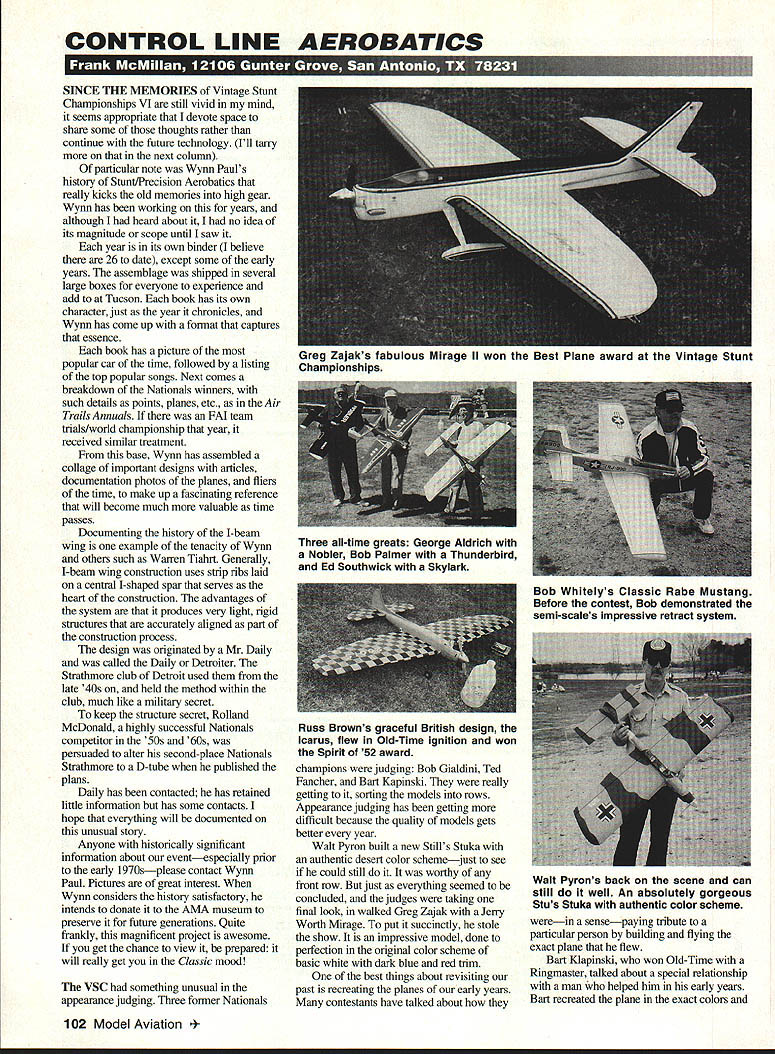
Walt Pyron built a new Still's Stuka with an authentic desert color scheme—just to see if he could still do it. It was worthy of any front row. But just as everything seemed to be concluded and the judges were taking one final look, Greg Zajak walked in with a Jerry Worth Mirage. To put it succinctly, he stole the show. It is an impressive model, done to perfection in the original color scheme of basic white with dark blue and red trim.
Recreating Early Planes
One of the best things about revisiting our past is recreating the planes of our early years. Many contestants said they were—in a sense—paying tribute to a particular person by building and flying the exact plane that person flew.
- Bart Klapinski, who won Old-Time Ringmaster, recreated the plane in the exact colors and configuration of his cousin, Hal Yager.
- Bob Hunt built his classic winning Tucker because of pleasant relationships with some of the Tucker flyers from the early '60s, like Ron O'Toole.
- Ted Fancher is talking about recreating the Bob Gialdini Sting Ray because it had such an influence when he was first exposed to Stunt.
This is a great way to add meaning to our celebration of the heritage of Control Line Aerobatics. Right now, I'm building the George Aldrich Magnum or the Super Nobler, which has not been flown in competition. That's the fun of it: finding the unusual plane and campaigning it. Anybody got plans for Art Pawlowski's Atom, the .57 Senior Nationals winner?
VSC Highlights and Awards
Unless you've been there, it's difficult to convey the camaraderie that pervades the entire contest—and that's really a loose term when applied to VSC. Sure there's competition, but that's not the real purpose—it's to celebrate our past. This is the opportunity to see and talk to many of the greats who established the firm foundation for the future.
Bob Palmer was the featured personality this year. He was the guest of honor at the banquet and shared many stories of his flying days. He also talked about his early professional days at Lockheed Aircraft Company, where he worked on wind-tunnel testing. Other personalities present were Ed Southwick and Charles Mackey, prominent fliers from the early days.
As in previous VSCs, special contributors were recognized for their efforts:
- Don Hutchinson — Keeper of the Flame Award (given to the modeler who most typifies the spirit of the event)
- Bart Klapinski — Gialdini Sportsmanship Award (for outstanding contributions to VSC over the years)
- Rusty Brown — Spirit of '52 (for the Icarus, a large, graceful ignition design from Great Britain)
- Greg Zajak — Best Model Award (for the Mirage)
VSC is a great reason to get away to the desert at the end of winter, even if you just spectate and talk with everyone. There are lots of things for the family to do, and the site is great. Plan now for next year to help us create more memories—you'll come back to "recharge your batteries" every year.
Tech Tip: Sandpaper
I've always said that if I could use one tool properly, I'd pick sandpaper. It may sound odd, but think about it: how much of the final appearance and performance of our models depends on how well we've used sandpaper?
I had a conversation with Charlie Reeves about finishing, and the subject of sandpaper came up. Charlie's models are masterpieces. We discussed various types of paper—not just the grit. It is important to pay attention to the type, because some papers work better than others for our applications.
Recommendations:
- Initial clear coats and filler coats: 3M gray "Free Cut" type, grits 320 and 400.
- Final clear coats: 1000 to 2000 grit, super-fine grade (used wet).
- Woodwork before painting (final shaping): red or garnet paper, grits 180 and 200; it cuts smoother and feels better on wood.
- After garnet, switch to 320–400 gray (wet cut) for smoothing before any paint.
Cautions:
- I don't recommend wet-or-dry 400 for initial wood sanding because the paper is hard and creases can easily scratch the wood before it's hardened with dope.
- Gold paper from auto body shops is okay, but the abrasive can come off on the balsa—I've not had a serious problem yet, but it's a risk.
Buy in quantity to save money. A sheet from an auto paint store will get you the same paper at nearly half the price per sheet. Usually they can order the grades you need (not necessarily the garnet, since that's designed for wood).
Closing
Next time, I'll continue the technology adventure.
Transcribed from original scans by AI. Minor OCR errors may remain.

