
CONTROL LINE AEROBATICS
Frank McMillan, 12106 Gunter Grove, San Antonio, TX 78231
Overview
Each Nats seems to develop its own feeling or character, which, over the years, has been neon models, big models, semiscales, pipes, etc. As I recalled the Lubbock Nationals, the thought struck me that the Precision Aerobatics community has seen significant, worthwhile change. We have evolved from the early Nats, where our entire competitive year was wrapped up in one flight, to an elimination process, where the national champion proves himself or herself.
Over the years we have gradually added other events that developed participation, such as Old-Time, Classic, and the Advanced skill class. We now have a real flying format Monday through Saturday.
But the more things change, the more they remain the same: the character and strength of our event are the people, and it will always be so. As many already know, we have the pleasure of renewing longtime friendships year after year.
Two of our finest modelers returned this year: former world champion Les McDonald and former Precision Aerobatics Model Pilots Association (PAMPA) president and national champion Keith Trostle. Keith was PAMPA president in the formative years, and his remarks during the Nationals and at the banquet triggered the idea of just how far we have come.
We can't all be the national champion, but the current format has events for every interest and skill level. Everyone can participate, be competitive, and be part of the competition with the world's leading fliers.
Practice and Conditions
Although there was flying throughout the Nats, the real showcase of Precision Aerobatics is the Open Championships. The elusive quest began Sunday, with most fliers at the practice site at Texas Tech University. The parking lots were nice, but the strong winds that passed over the adjacent hospital buildings and trees created some interesting conditions. Bill Whiteley saw every side of his model in a less-than-perfect wingover.
Flying in these lots required fliers to adjust their models so that they could recover power and turn. It was expected that the 3,000-foot-plus altitude and temperature would significantly affect performance, and most came prepared with many options. Most fliers initially tried more prop pitch and diameter; that worked well, but usually more adjustments were necessary to extract the power from the engines to comfortably turn the increased load.
The next steps in adjusting engines were increasing venturi size and/or increasing compression in increments. The final option was tipping the nitro can; many chose this over the venturi and compression options. Quite a few of the leading fliers used 15–20%.
Almost everyone had sorted out power problems by Tuesday, but they realized that conditions would change rapidly during the day. Mornings were relatively cool, but the temperature was up by noon, and power was an elusive thing. Most fliers turned up the wick and flew faster than they usually did at their home field to get the authority and penetration in the more demanding parts of the pattern.
Bill Werwage's Junar flew 5.2 seconds a lap in good air and faster in the more turbulent conditions. I was at 5.3 seconds, versus 5.5 at home. The trend in the pinned models was around 5.3 seconds, with Frank Williams the slowest at around 5.6 seconds a lap. The fastest combination by far was Windy Urtnowski's ST .60 with 20% nitro at much less than 5.0 seconds (I caught his at 4.5 seconds on occasion in heavy air).
The type of adjustments made depended on the model type. Medium-to-light models had few problems, although the thin air did tend to reveal trim problems that were not apparent at lower altitudes. Adjusting tip weight (usually lessening it) and perhaps adding a touch of nose weight was common. Most competitors remarked that the models were turning light. Quite a few experienced occasional violent tip-stalling that produced many "warts" on the outboard flaps (trim tabs).
The somewhat heavy models either had to fly fast, or—as was observed later in the week—needed larger flaps to provide extra lift.
David Fitzgerald made an interesting trim adjustment: he added a turbulating strip of .05 cable to the leading edge of the stabilizer, just aft of the high point. The purpose was to reattach the airflow and improve the model's tracking.
There were quite a few turbulence-related situations during practice, but only one "fatality" that was unrelated to the conditions. Bob Whiteley's new stylized Laser 300 looked absolutely super in the air. During a practice flight the engine stopped halfway through a wingover, and the model was destroyed. No doubt Bob would have been a contender with the Laser.
Appearance Judging and Qualifications
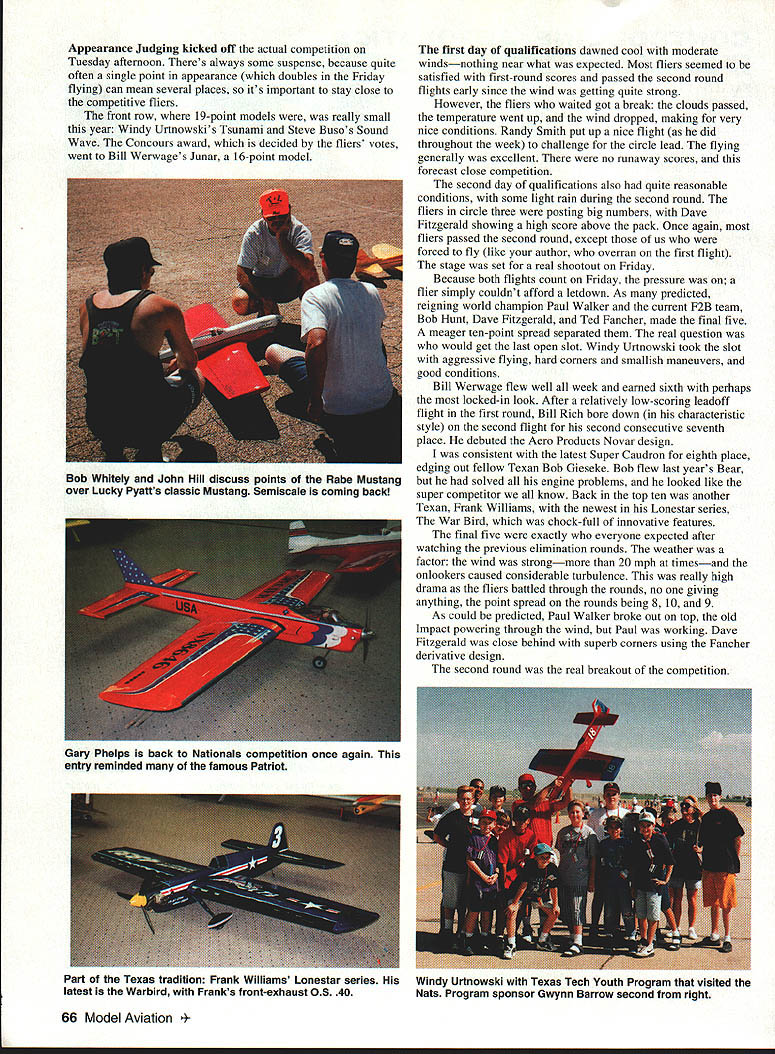
Appearance Judging kicked off the actual competition on Tuesday afternoon. There's always some suspense, because quite often a single point in appearance (which doubles in the Friday flying) can mean several places, so it's important to stay close to the competitive fliers' front row. The front row, where 19-point models were, was really small this year: Windy Urtnowski's Tsunami and Steve Buso's Sound Wave. The Concours award, which is decided by the fliers' votes, went to Bill Werwage's Junar, a 16-point model.
The first day of qualifications dawned cool with moderate winds—nothing near what was expected. Most fliers seemed to be satisfied with first-round scores and passed the second round flights early since the wind was getting quite strong.
However, the fliers who waited got a break: the clouds passed, the temperature went up, and the wind dropped, making for very nice conditions. Randy Smith put up a nice flight (as he did throughout the week) to challenge for the circle lead. The flying generally was excellent. There were no runway scores, and this forecast close competition.
The second day of qualifications also had quite reasonable conditions, with some light rain during the second round. The fliers in circle three were posting big numbers, with Dave Fitzgerald showing a high score above the pack. Once again, most fliers passed the second round, except those of us who were forced to fly (like your author, who overran on the first flight). The stage was set for a real shootout on Friday.
Finals and Open Championship
Because both flights count on Friday, the pressure was on; a flier simply couldn't afford a letdown. As many predicted, reigning world champion Paul Walker and the current F2B team members Bob Hunt, Dave Fitzgerald, and Ted Fancher made the final five. A meager ten-point spread separated them. The real question was who would get the last open slot. Windy Urtnowski took the slot with aggressive flying, hard corners and smallish maneuvers, and good conditions.
Bill Werwage flew well all week and earned sixth with perhaps the most locked-in look. After a relatively low-scoring leadoff flight in the first round, Bill Rich bore down (in his characteristic style) on the second flight for his second consecutive seventh place. He debuted the Aero Products Novak design.
I was consistent with the latest Super Caudron for eighth place, edging out fellow Texan Bob Gieseke. Bob flew last year's Bear, but he had solved all his engine problems, and he looked like the super competitor we all know. Back in the top ten was another Texan, Frank Williams, with the newest in his Lonestar series, the War Bird, which was chock-full of innovative features.
The final five were exactly who everyone expected after watching the previous elimination rounds. The weather was a factor: the wind was strong—more than 20 mph at times—and the onlookers caused considerable turbulence. This was really high drama as the fliers battled through the rounds, no one giving anything; the point spread on the rounds being 8, 10, and 9.
As could be predicted, Paul Walker broke out on top. The old Impact powered through the wind, but Paul was working. Dave Fitzgerald was close behind with superb corners using the Fancher derivative design.
The second round was the real breakout of the competition. "Someone up there" smiled on Bob Hunt! The clouds rolled in, and the wind stopped for about ten minutes. After fixing a loose/leaking coupler from the first round, he got his Saturn singing with the high flight of the day. This was the flying we had been waiting for: confident, aggressive, and dead-on precise! Bob was ahead at the end of Round Two, but only just.
Bob flew early in the final round, with heavy wind, and proved that he could handle it with a strong flight. His Saturn was perhaps the least disturbed by the turbulence. The outcome rested with Paul Walker, and he responded like a World Champion with yet another fine flight. Paul's margin of one-half point reflects how close the skills of these two pilots are.
Dave Fitzgerald and Ted Fancher finished third and fourth, respectively, and proved conclusively that they belong on the February team. Windy Urtnowski really worked hard in the wind to bring his Pattern Master/Tsunami into fifth place.
Senior, Junior, Classic, Old-Time, and Advanced
There was more extremely close competition in Senior, this time between Robbie Hunt and Derek Barry. Robbie flew his Europa/HP .40, and Derek flew the Dixon Charisma/ST .51 design. As has been the case the last few years, Robbie edged out Derek by less than five points and performed some excellent wind flying in the Walker Cup. Robbie will represent the U.S. in Shanghai on the Junior Control Line Team.
Dondi Garrison won the Junior competition with some fine flights on a newly finished SV-12. Anyone who has seen Dondi fly can't forget his two-handed style. Everyone enjoyed his flying in the Walker Cup.
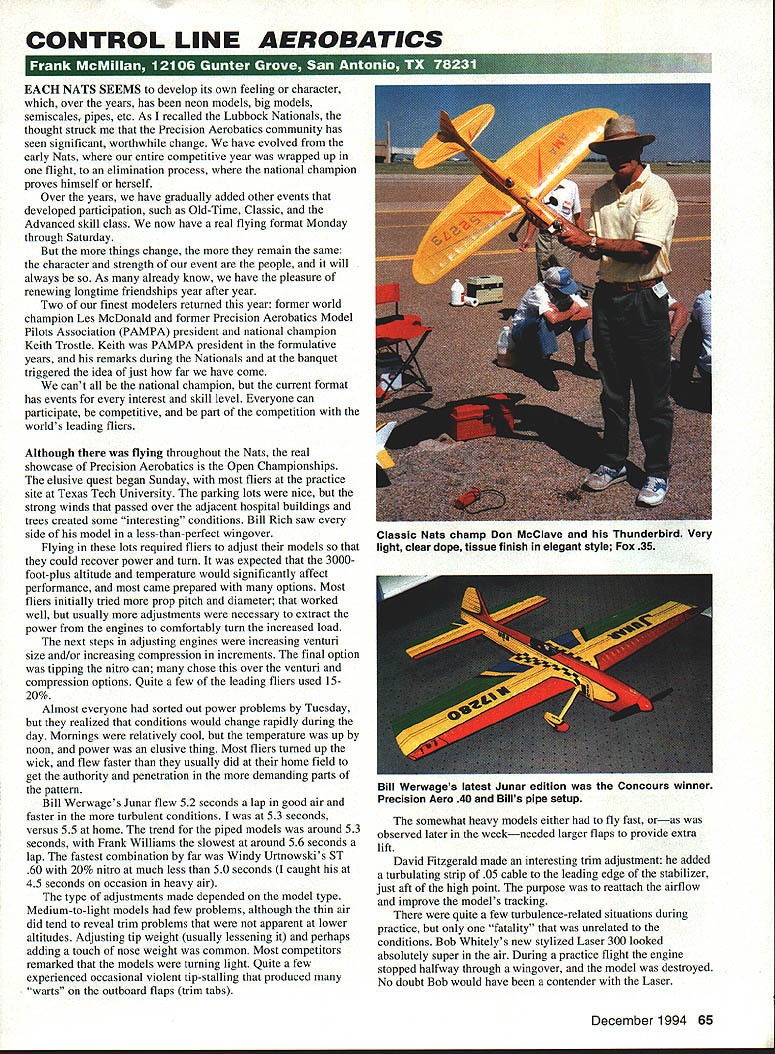
Classic Stunt has become one of the most popular events at the Nats. Although the flying was generally close, as the weather was hot and windy, Don McClave was really the class of the field. His Type 1 Thunderbird was extremely light at 37 ounces, with a super-sounding Fox .35. He was locked in on the bottoms from the first flight and demonstrated that small models can handle the wind well. This was Don's first Nats win after many years, so well-deserved congratulations! Marvin Denny and Carl Lovins were right in there to the end.
Some of the closest competition in the Nats occurs in Old-Time Stunt. This year, Marvin Denny edged out Mike Pratt, Lou Woolard, and Don Hutchinson. But my favorite was fifth-place Rusty Brown and his Icarus; this is a huge elliptical wing of English design with a spark-ignition Super Cycle. I watched one of his flights and reflected on how neat it was! This is what Old-Time Stunt is all about. Thanks, Rusty.
When the Advanced Class was proposed as a Nats event a few years ago, I must admit I was somewhat skeptical, but I was wrong in spades. Thanks to Rollie and Bob McDonald, we have a wonderful venue for up-and-coming fliers to have great competition, and it gets better every year. Make no mistakes, this is just as serious as the Open competition.
It's an interesting grouping because all ages fly against each other. As in 1993, leading Senior flier Derek Barry won a closely contested bout with former Old-Time champ John Wright. Sam Sciarroto was third, and Rick Ashford and Jim Damerell tied for fourth.
Notable Models and Technical Innovation
There are some models that I'd like to highlight:
- Bill Werwage's Junar was really suited to the expected conditions. It was light (52 ounces), about 650 square inches, and the Precision Aero .40 provided plenty of power. The wind and turbulence did not affect it — it was on rails.
- Dave Fitzgerald's new model, Star Gazer, drove incredibly deep into the corners and came out clean and flat — most impressive.
- Bob Hunt's Saturn did everything well.
- Paul Walker's Impact remains a standard, now upgraded with the Precision Aero .40.
- Steve Buso's Sound Wave was new, but it looked like it has good potential.
- Aero Products' new Nayar that Bill Rich flew was excellent.
In terms of technical innovation, Ron Burn's Macchi 202 semi-class was extremely interesting and worthy of mention. Ron is an excellent Scale builder and likes to try something different.
The circular fuselage was molded over a multiple-form male mold with three spirally wrapped layers of 1/32 balsa glued with contact cement. When the molding process was complete, the mold came apart and the pieces were retrieved through the wing opening. (By the way, it was powered by a tuned-pipe .60!)
Even more interesting was the molded wing of glass cloth, 1/32 balsa, and carbon veil. The entire surface was done over a foam core and vacuum-bagged — very strong with minimum interior structure. Really neat stuff. Hope to get pictures, Ron?
Engines and Powerplants
I've saved engine discussion for the end. Many engines ran well. If anything, Stunt has made great strides; not only are a variety of packages working, but those other than the top fliers are using them.
The Randy Smith/Henry Nelson Precision Aero .40 made an auspicious debut with Paul Walker, Bill Werwage, Bill Rich, and others using them. These engines ran reliably, with power and a variety of runs (i.e., some in a fast four-cycle to a harder two-cycle as the occasion demanded).
The OPS .40s that Hunt, McMillan, and Mike Pratt (who flew extremely well) used also ran well with good power.
The O.S. .46 VF AAC that Ted Fancher and Dave Fitzgerald have are working. There were also some excellent ST .60s in the hands of Windy Urtnowski and Terry Wright.
Add this to the legend of the Nats: just when Mike Pratt had his new model working well, it fell victim to faulty leadouts and suffered major damage. However, Paul Walker and Windy Urtnowski did a puzzle reassembly, and had it back together in six hours. They had a dozen people feeding parts, pieces, epoxy, Hot Stuff, Dremel tools, etc. I wouldn't have believed it, but it flew well and carried Mike to fifteenth place in Open—his best finish.
Volunteers and Officials
I must mention the volunteers who make our Nats possible. In what he claims as his last Nats to run, Event Director Bruce Gifford made everything run so smoothly that it looked easy. Not so—just lots of hard work.
Bruce was assisted this year by Bill Hopkins, along with Specialty Events Directors:
- Darrell Harvin (Classic)
- Jim Lee (Old-Time)
- Todd Lee (1/2A)
New to the hot seat as head judge was Gary McClellan, who handled the entire week calmly and professionally. Sticking with Gary were judges:
- Lee Lorio
- Lou Vohsant
- Dan McClellan
- Doug Taffinder
- Robin Siemer
- Doug Cook
- Mary Gebhart
Additional event judges were:
- Bob Whiteley and Carl Rachle (Junior and Senior)
- Bob Parker (Classic)
- Steve Buso (1/2A)
As she has done for longer than I can remember, Shaeren Fancher did a fine job as head tabulator. She was ably assisted by Lisa Lee, Janice Gifford, and Karen Hopkins.
Pit bosses Fred Smith, Bob Brooking, and Bob Harvey kept everything running smoothly throughout the week. Runners Jamie Pratt, Barbara Pratt, and Jessica Pratt kept the flow of score sheets going all week. Jerry Pratt and Elaine Brooks acted as recorders where necessary.
Jim Dean, Jim Allen, and Mike Stokes performed the quite difficult job of appearance judging.
These individuals make the competitor's life easy. The fact that they were virtually invisible during the week is testimony to how well everything went. We extend our sincere thanks and appreciation to all.
Conclusion
Well, another Nats is in the books. If you didn't come, you missed a grand experience. Thanks again to all the volunteers of our Aerobatics community for making the Nats happen. Until next time, good friends.
Transcribed from original scans by AI. Minor OCR errors may remain.

