
CONTROL LINE AEROBATICS
Frank McMillan, 12106 Gunter Grove, San Antonio, TX 78231
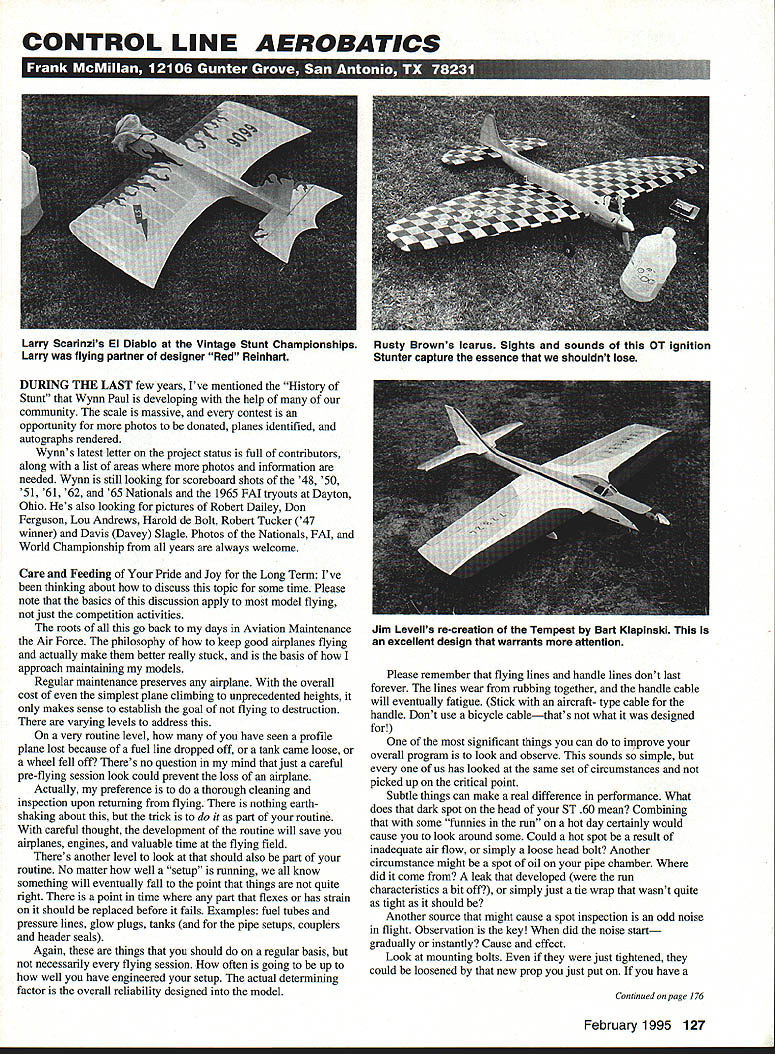
During the last few years, I've mentioned the "History of Stunt" that Wynn Paul is developing with the help of many in our community. The scale is massive, and every contest is an opportunity for more photos to be donated, planes identified, and autographs rendered.
Wynn's latest letter on the project status is full of contributors, along with a list of areas where more photos and information are needed. Wynn is still looking for scoreboard shots of the 1948, 1950, 1951, 1961, 1962, and 1965 Nationals and the 1965 FAI tryouts at Dayton, Ohio. He's also looking for pictures of Robert Dailey, Don Ferguson, Lou Andrews, Harold de Bolt, Robert Tucker (1947 winner) and Davis (Davey) Slagle. Photos of the Nationals, FAI, and World Championship from all years are always welcome.
Care and Feeding of Your Pride and Joy for the Long Term
I've been thinking about how to discuss this for some time. Please note that the basics of this discussion apply to most model flying, not just competition activities.
The roots of all this go back to my days in Aviation Maintenance in the Air Force. The philosophy of how to keep good airplanes flying and actually make them better really stuck, and is the basis of how I approach maintaining my models.
Regular maintenance preserves any airplane. With the overall cost of even the simplest plane climbing to unprecedented heights, it only makes sense to establish the goal of not flying to destruction. There are varying levels to address this.
On a very routine level, how many of you have seen a profile plane lost because a fuel line dropped off, a tank came loose, or a wheel fell off? There's no question in my mind that a careful pre-flight check could prevent the loss of an airplane.
My preference is to do a thorough cleaning and inspection upon returning from flying. There is nothing earth-shaking about this, but the trick is to do it as part of your routine. With careful thought, developing the routine will save your airplanes, engines, and valuable time at the flying field.
There is another level that should also be part of your routine. No matter how well a setup is running, something will eventually fail to the point that things are not quite right. Parts that flex or carry strain should be replaced before they fail.
- Examples to replace regularly:
- Fuel tubes and pressure lines
- Glow plugs
- Tanks, and for pipe setups: couplers and header seals
These are things you should do on a regular basis, but not necessarily every flying session. How often depends on how well you have engineered your setup. The determining factor is the overall reliability designed into the model.
Please remember that flying lines and handle lines don't last forever. The lines wear from rubbing together, and the handle cable will eventually fatigue. Use an aircraft-type cable for the handle — don't use a bicycle cable; that's not what it was designed for.
One of the most significant things you can do to improve your overall program is to look and observe. This sounds simple, but every one of us has looked at the same set of circumstances and missed the critical point.
Subtle things can make a real difference in performance. Examples to watch for:
- A dark spot on the head of your ST-60 combined with odd behavior on a hot day — could indicate inadequate airflow or a loose head bolt.
- A spot of oil on your pipe chamber — did a leak develop? Were the run characteristics slightly off?
- An odd noise in flight — when did it start; gradually or instantly? Observation is the key to cause and effect.
Look at mounting bolts. Even if they were just tightened, they could be loosened by a new prop you just put on.
With a good maintenance program these things normally won't happen; but that, in a sense, actually makes it more difficult to pick up on some problems.
A lesson I learned in maintenance is the importance of continual evaluation and upgrade. Some time ago we mentioned that Al Rabe used to dissect planes that crashed to see what survived and what failed. Remember that we build to fly, not to survive crashes, and in the context of this discussion, to sustain performance over the useful life of the model.
That's a tall order, considering how difficult it is to reduce weight yet still meet all other criteria. It requires careful thought and evaluation of various systems in existence. The front end takes the most abuse — remember that vibration generator we have up front — but the whole airplane needs to be considered.
Controls should be pushed and lubricated for longevity. Perhaps even more important is their alignment and fit. Time spent at this stage really pays off in more linear control.
You are looking for the pushrods to be perpendicular to the bearing axis on the horns. Bearings should be as tight as possible — you can't have free controls and tight bearings unless the alignment is correct. I have models with thousands of flights that have free controls and no perceptible wear. By the way, I don't believe that slop in the elevator horn is necessary; it promotes uneven wear in the system.
Back to engineering: the best approach I can give is to check what the leading fliers are doing and compare their approaches to see what suits your needs.
One thing to keep in mind is stress management. Make sure that in every area the stress lines tie into the outer shell. Once you have done that, you can start to minimize structure and weight.
Another factor that is a killer on keeping an excellent plane healthy is assumptions.
- Example: A new finishing technique using carbon mat and nitrate dope was applied to a proven wing structure. The carbon stiffened the structure and created a stress point, causing the wing to fold after about 50 flights.
- Another example: A superb builder folded wings by using inappropriately soft wood for the wing spar.
The idea that "I assume" the structure was sufficiently strong didn't take into account either the cause or the possibility that a spar failure was an aberration. You must thoroughly evaluate situations and come to a reasoned conclusion.
If you have any doubts, please give me a call. Evolution is the best approach.
Transcribed from original scans by AI. Minor OCR errors may remain.

