
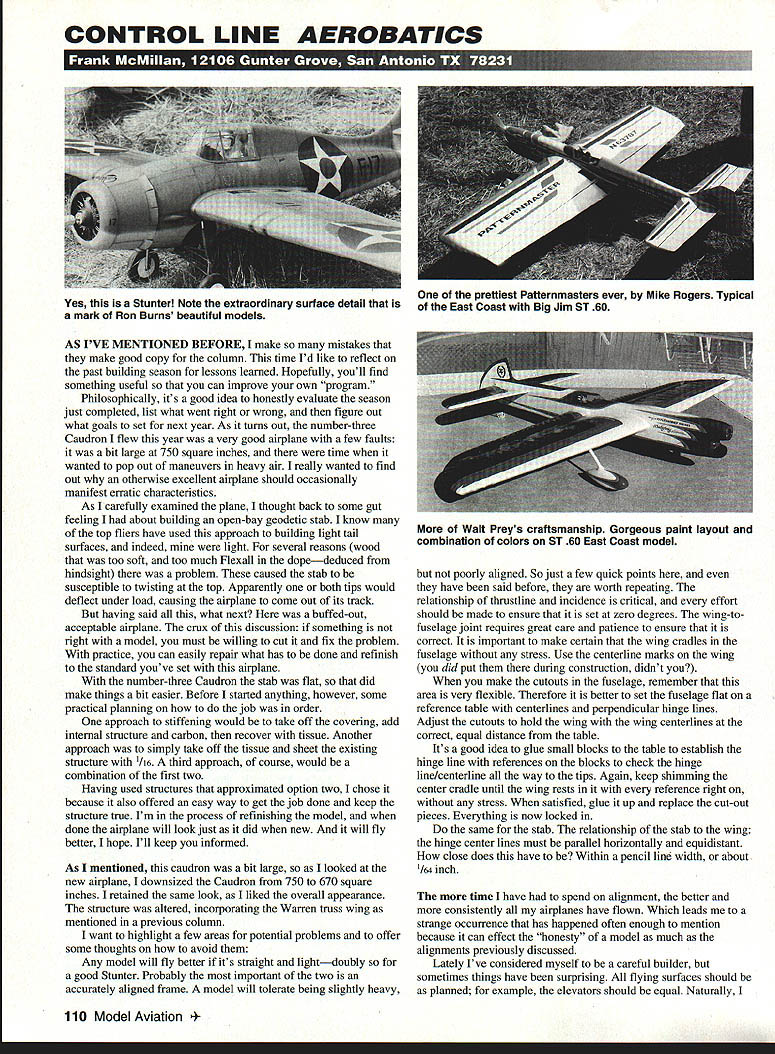
CONTROL LINE AEROBATICS
Frank McMillan
12106 Gunter Grove, San Antonio, TX 78231
As I've mentioned before, I make so many mistakes that they make good copy for the column. This time I'd like to reflect on the past building season for lessons learned. Hopefully you'll find something useful so that you can improve your own "program."
Philosophically, it's a good idea to honestly evaluate the season just completed, list what went right or wrong, and then figure out what goals to set for next year. As it turned out, the number-three Caudron I flew this year was a very good airplane with a few faults: it was a bit large at 750 square inches, and there were times when it wanted to pop out of maneuvers in heavy air. I really wanted to find out why an otherwise excellent airplane should occasionally manifest erratic characteristics.
As I carefully examined the plane, I thought back to some gut feeling I had about building an open-bay geodetic stab. I know many of the top fliers have used this approach to building light tail surfaces, and indeed mine were light. For several reasons (wood that was too soft, and too much Flexall-doped—deduced in hindsight) there was a problem. The stab was susceptible to twisting at the top. Apparently one or both tips would deflect under load, causing the airplane to come out of its track.
But having said all this, what next? Here was a buffed-out, acceptable airplane. The crux of this discussion: if something is not right with a model, you must be willing to cut it and fix the problem. With practice, you can easily repair what has been done and refinish to the standard you've set with this airplane.
With the number-three Caudron the stab was flat, so that did make things a bit easier. Before I started anything, however, some practical planning on how to do the job was in order.
Approaches to stiffening the stab
One approach to stiffening would be to take off the covering, add internal structure and carbon, then recover with tissue. Another approach was to simply take off the tissue and sheet the existing structure with 1/16 inch balsa. A third approach, of course, would be a combination of the first two.
Having used structures that approximated option two, I chose it because it also offered an easy way to get the job done and keep the structure true. I'm in the process of refinishing the model, and when done the airplane will look just as it did when new. And it will fly better, I hope. I'll keep you informed.
As I mentioned, this Caudron was a bit large, so as I looked at the new airplane I downsized the Caudron from 750 to 670 square inches. I retained the same look, as I liked the overall appearance. The structure was altered, incorporating the Warren-truss wing as mentioned in a previous column.
Areas to watch and tips to avoid problems
Any model will fly better if it's straight and light—doubly so for a good Stunter. Probably the most important of the two is an accurately aligned frame. A model will tolerate being slightly heavy, but not poorly aligned. So just a few quick points here, and even they have been said before, they are worth repeating.
- The relationship of thrustline and incidence is critical; every effort should be made to ensure that it is set at zero degrees.
- The wing-to-fuselage joint requires great care and patience to ensure that it is correct. Make certain the wing cradles in the fuselage without any stress. Use the centerline marks on the wing (you did put them there during construction, didn't you?).
- When you make the cutouts in the fuselage, remember that this area is very flexible. It is better to set the fuselage flat on a reference table with centerlines and perpendicular hinge lines. Adjust the cutouts to hold the wing with the wing centerlines at the correct, equal distance from the table.
- Glue small blocks to the table to establish the hinge line, with references on the blocks to check the hinge line/centerline all the way to the tips. Keep shimming the center cradle until the wing rests in every reference right on, without any stress. When satisfied, glue it up and replace the cut-out pieces. Everything is now locked in.
- Do the same for the stab. The relationship of the stab to the wing—the hinge center lines—must be parallel horizontally and equidistant. How close? Within a pencil line width, or about 1/64 inch.
- The more time you spend on alignment, the better and more consistently your airplanes will fly.
Which leads me to a strange occurrence that has happened often enough to mention because it can affect the "honesty" of a model as much as the alignments previously discussed.
Lately I've considered myself to be a careful builder, but sometimes things have been surprising. All flying surfaces should be as planned; for example, the elevators should be equal. Naturally I constructed them to be equal, and after sanding them I again matched them. However, when doing a final control alignment some months later, I thought to check the equality again. There was a little more than 1/32 inch difference in one root chord. I have no idea how it happened (perhaps in some touch-up sanding), but it was there.
This could have caused a differential turn or rolling tendency, with the reason obscured in the finished airplane. Likewise, I've experienced the same condition in the flaps, where the dimensions changed. The only real cure is to check, recheck, then check again. It's better to perform these checks when fresh, rather than at the end of a long building session.
Another area where things are not always as they seem is in the alignment of the flaps and elevators. Establishing an accurate centerline on the wing and stab helps, but there are many slots to be cut for the hinges, so the possibility of accumulating errors is present.
(By the way, if I haven't mentioned it before, a fresh Dremel cutoff disc works well as a slotting tool. I suggest making the slots and fitting one at a time, starting with the tip slot.)
Fit the flap or elevator to the horn and then the tip. Check carefully that the surface is centered on the fixed edge—this is very important to an honest-flying airplane. If everything is OK with the first one, then work from the tip to the middle. Each time you install a hinge, check centering and, if you have bowed the surface in any way, make adjustments.
The easiest procedure is to plug up the first slot, i.e., the surface, and redo. It's not that much fun and sometimes can be very tedious, but this is necessary and will really help in bringing in a good airplane. To give you a feel, five to ten thousandths of an inch off will require adjustments.
I haven't talked about anything complex—just an investment of time in properly aligning your airplane. The important thing is to take care in the alignment and then check, check, and check again.
Engine notes: ABC cylinder/piston for the Fox .35
Some months ago I mentioned that George Aldrich was pursuing an ABC cylinder/piston setup for the Fox .35. Why mess with the "standard" for Stunt for so long? It's obvious that technology has advanced, with both ABC and the newer higher-silicon aluminum alloys reaching the point of extreme reliability. In recent years, the Fox .35 has seen renewed interest with new parts, hemi head, stuffer backplate, etc., being developed and now readily available, so why not look at its character.
After a prolonged delivery process, George has 200 cylinder/piston assemblies in hand. I've examined several examples, and they are prime. The assembly is five grams lighter than the steel/iron stock set. However, the piston is one-third lighter than the stock Mehanite piston! That's significant, as the Fox is noted as a real "pounder." Additionally, a major advantage of the ABC technology is the tolerance to hard, lean running, which rapidly "kills" an iron/steel set.
The sets are a direct exchange for the stock assembly and have the additional feature of using snap rings to retain the wrist pin. This prevents scoring of the liner during "meltdown" runs. The ABC sets can be purchased separately or in complete engines. Contact George for complete details:
- Aldrich Models
12822 Tarrytown, San Antonio, TX 78233 Tel: (210) 656-2021
I suggest you order George's new catalog of services. He has produced a ten-page collection of tips on engine-related topics such as fuels and Stunt engine tuning that are both extremely valuable and highly interesting. At $3 this is well worth it.
Aero Products news
More breaking news at Aero Products! Randy Smith is now delivering an .82 version of the extremely successful revision to the Aero 40. Exterior dimensions are identical, so the engine drops right in. Prototype testing indicates it will swing significantly more prop diameter than the .40 version. It will be available in side or rear exhaust.
Several new carbon-fiber tuned pipes will be available—a three-chamber resonator and a smaller pipe for the .35–.40 range. Contact Randy at:
- Randy Smith / Aero Products
1880 Scenic Highway, Snellville, GA 30278 Tel: (404) 979-2035
Transcribed from original scans by AI. Minor OCR errors may remain.

