
CONTROL LINE AEROBATICS
Frank McMillan, 12106 Gunter Grove, San Antonio TX 78231
Tuned-Pipe Stunt Engine Development
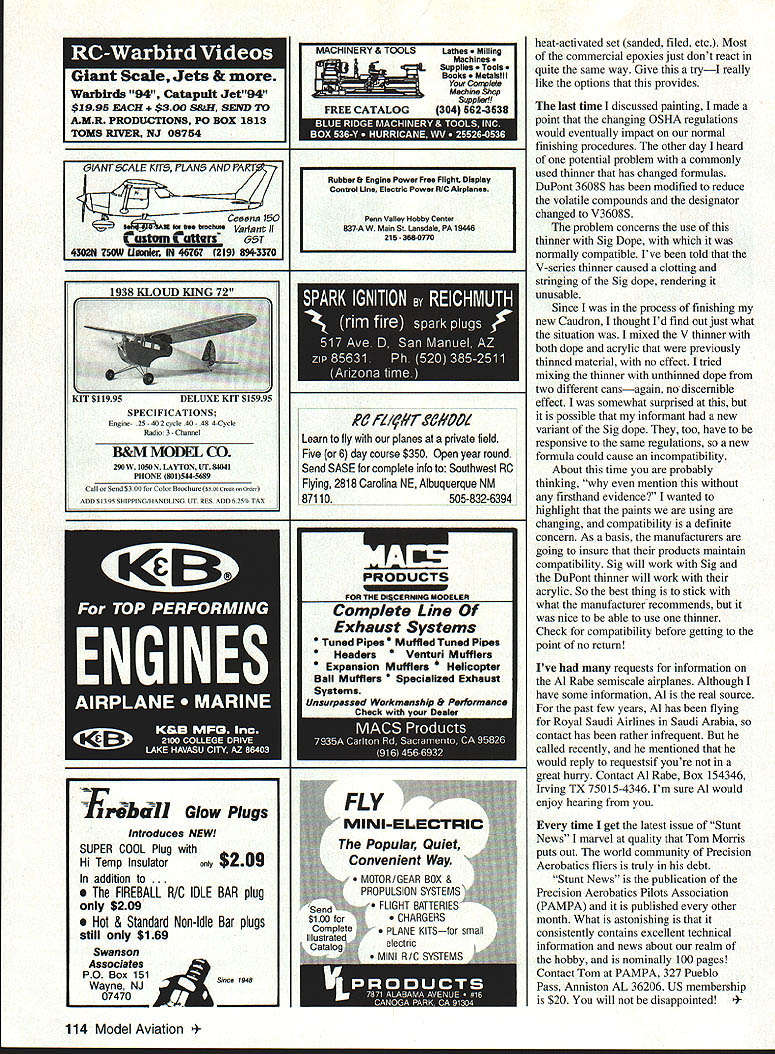
For the last six months, George Aldrich and I have been working with Willie Wylie to develop a tuned-pipe Stunt engine based on Willie's very successful Fast Combat engines. His engines are examples of the finest craftsmanship.
The path to a really good Stunt engine was not a direct translation from a 20–25,000 rpm Combat engine. We started with the basic timing of the OPS SPA, and from the very first flight the prototype showed some very nice characteristics.
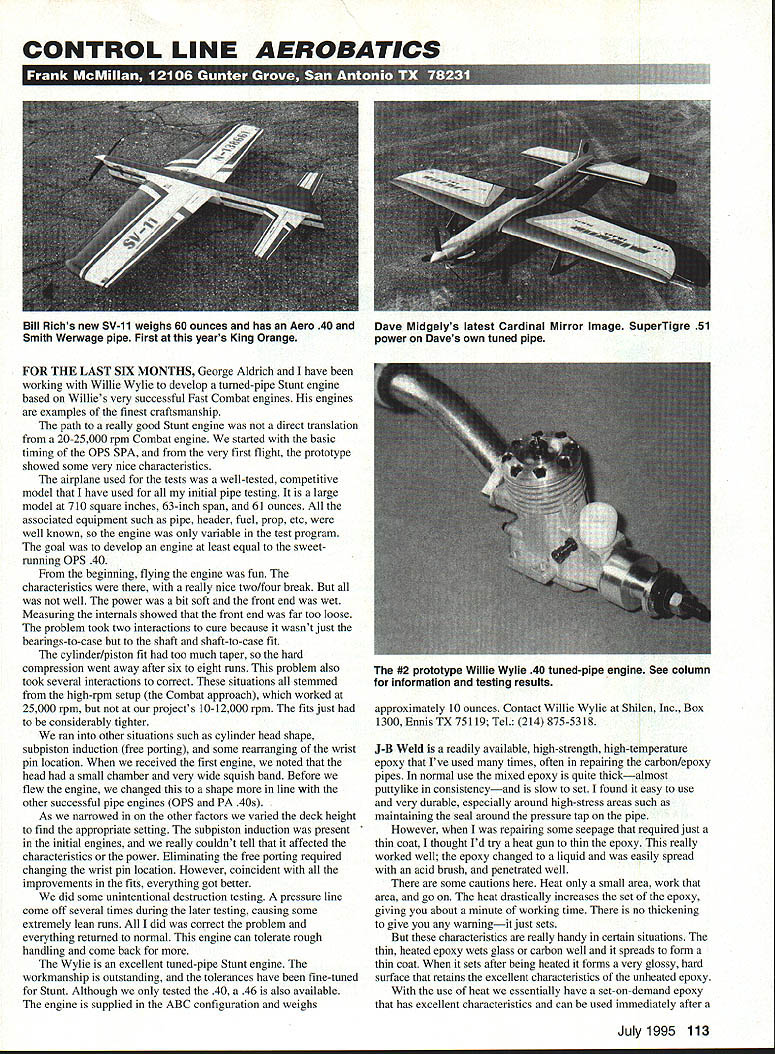
The airplane used for the tests was a well-tested, competitive model that I have used for all my initial pipe testing. It is a large model at 710 square inches, 63-inch span, and 61 ounces. All the associated equipment such as pipe, header, fuel, prop, etc., were well known, so the engine was the only variable in the test program. The goal was to develop an engine at least equal to the sweet-running OPS .40.
From the beginning, flying the engine was fun. The characteristics were there, with a really nice two/four break. But all was not well. The power was a bit soft and the front end was wet. Measuring the internals showed that the front end was far too loose. The problem took two iterations to cure because it wasn't just the bearings-to-case fit but the shaft and shaft-to-case fit as well.
The cylinder/piston fit had too much taper, so the hard compression went away after six to eight runs. This problem also took several iterations to correct. These situations all stemmed from the high-rpm setup (the Combat approach), which worked at 25,000 rpm but not at our project's 10–12,000 rpm. The fits just had to be considerably tighter.
We ran into other situations such as cylinder head shape, subpiston induction (free porting), and some rearranging of the wrist-pin location. When we received the first engine, we noted that the head had a small chamber and a very wide squish band. Before we flew the engine, we changed this to a shape more in line with other successful pipe engines (OPS and PA .40s).
As we narrowed in on the other factors we varied the deck height to find the appropriate setting. The subpiston induction was present in the initial engines, and we really couldn't tell that it affected the characteristics or the power. Eliminating the free porting required changing the wrist-pin location. However, coincident with all the improvements in the fits, everything got better.
We did some unintentional destruction testing. A pressure line came off several times during the later testing, causing some extremely lean runs. All I did was correct the problem and everything returned to normal. This engine can tolerate rough handling and come back for more.
The Wylie is an excellent tuned-pipe Stunt engine. The workmanship is outstanding, and the tolerances have been fine-tuned for Stunt. Although we only tested the .40, a .46 is also available. The engine is supplied in the ABC configuration and weighs approximately 10 ounces.
- Contact: Willie Wylie, Shilen, Inc., Box 1300, Ennis TX 75119
- Tel: (214) 875-5318
J-B Weld: heat-activated thinning and use
J-B Weld is a readily available, high-strength, high-temperature epoxy that I've used many times, often in repairing carbon/epoxy pipes. In normal use the mixed epoxy is quite thick—almost puttylike in consistency—and is slow to set. I found it easy to use and very durable, especially around high-stress areas such as maintaining a seal around pressure-tap pipes.
When I was repairing some seepage that required just a thin coat, I tried using a heat gun to thin the epoxy. This worked very well: the epoxy changed to a liquid, was easily spread with an acid brush, and penetrated well.
Cautions:
- Heat only a small area, work that area, and then move on. The heat drastically decreases working time, giving about one minute of workable time.
- There is no thickening to warn you—the epoxy just sets quickly.
- These characteristics are handy in certain situations. The thin, heated epoxy wets glass or carbon well and spreads to form a thin coat. When it sets after being heated it forms a very glossy, hard surface that retains the excellent characteristics of the unheated epoxy.
With the use of heat we essentially have a set-on-demand epoxy that can be sanded or filed immediately after the heat-activated set. Most commercial epoxies do not react in quite the same way. Give this a try—I really like the options this provides.
Painting and Thinner Compatibility
The last time I discussed painting, I noted that changing OSHA regulations would eventually impact our finishing procedures. Recently I heard of a potential problem with a commonly used thinner that has changed formulas. DuPont 3608S has been modified to reduce volatile compounds and the designator changed to V3608S.
The problem reported concerned the use of this thinner with Sig Dope, with which it was normally compatible. I've been told that the V-series thinner caused clotting and stringing of the Sig dope, rendering it unusable.
Since I was finishing my new Caudron, I decided to test the situation. I mixed the V thinner with both previously thinned dope and acrylic with no effect. I also tried mixing the thinner with unthinned dope from two different cans—again, no discernible effect. I was somewhat surprised, but it's possible that the informant had a new variant of the Sig dope. Manufacturers must also respond to regulations, so a new formula could cause an incompatibility.
Why mention this without definitive proof? I wanted to highlight that the paints we use are changing, and compatibility is a definite concern. As a rule, manufacturers will work to ensure their products maintain compatibility. Sig will work with Sig and DuPont thinner will work with their acrylic. The best practice is to stick with what the manufacturer recommends, but it can be convenient to use one thinner. Check for compatibility before you get to the point of no return.
Al Rabe Semiscale Airplanes
I've had many requests for information on the Al Rabe semiscale airplanes. Although I have some information, Al is the real source. For the past few years Al has been flying for Royal Saudi Airlines in Saudi Arabia, so contact has been rather infrequent. He called recently and mentioned that he would reply to requests if you're not in a great hurry.
- Contact: Al Rabe, Box 154346, Irving TX 75015-4346
Stunt News (P.A.P.A.)
Every time I get the latest issue of Stunt News I marvel at the quality that Tom Morris puts out. The world community of precision aerobatics fliers is truly in his debt.
Stunt News is the publication of the Precision Aerobatics Pilots Association (P.A.P.A.) and is published every other month. It consistently contains excellent technical information and news about our realm of the hobby, and is normally 100 pages.
- Contact: Tom Morris, P.A.P.A., 327 Pueblo Pass, Anniston AL 36206
- US membership: $20
You will not be disappointed.
Transcribed from original scans by AI. Minor OCR errors may remain.

