
CONTROL LINE AEROBATICS
Frank McMillan 12106 Gunter Grove, San Antonio TX 78231
Safety first
Safety is always a consideration, but sometimes it's more paramount than others. When we don't think about it, we become vulnerable to a variety of accidents that can be life‑threatening. Control-line (CL) equipment that seems benign can cause serious injury if we are careless.
Stooge and launching — a cautionary tale
A recent accident involved an experienced flier practicing alone using a stooge to launch his model. After starting the engine he walked out to the handle in his usual way, running the lines between his fingers to remove twists. His back was to the model. The stooge released unexpectedly, and when the slack was taken up the airplane's weight and speed on the wires cut several fingers to the bone.
This could happen to any of us. Many fliers use stooges and run lines between their fingers. Consider these procedures to reduce risk:
- Bolt the stooge mechanism securely to a substantial plate (epoxy board, aluminum, or heavy plywood).
- Secure the plate so the airplane cannot move until intentionally released. For example: make holes in the plate that fit over the legs of a toolbox; use rubber legs attached with heavy screws. This works on both hard surfaces and grass.
- Do not assume ground-driven spikes are fail‑safe. Depending on how they are used, they may eventually fail. Think through the mounting and release mechanics thoroughly.
Handling the lines
We need to reexamine running the lines between our fingers. Keep lines clean and remove twists before flight. Recommended practice:
- If flying from a clean surface, clean the lines and run them out before starting the engine.
- Start the engine only after the lines are prepared; then proceed to the handle and go.
- If you must clean lines with the engine running:
- Use a paper towel saturated with a cleaning/lubricating liquid to handle the lines.
- Hold the lines so they will be jerked away from your hands without catching a finger when tension is applied.
- Position your body aft of the lines and hold the cleaning towel in your left hand so the lines have an unobstructed path away if the model breaks loose.
- Never hook your fingers in the lines.
CL accidents can be very serious—do not assume they can't happen to you.
Test running and engine break‑in
Many of us are superficial about test running and engine break‑in. Follow these guidelines:
- Use a commercial engine-test fixture or a heavy-duty model stand. Machined-aluminum stands are preferred. If you use a wooden stand, protect it with epoxy or polyurethane.
- Use a reduced-load prop for break‑in: most experts recommend cutting a large prop down to a smaller diameter so it retains the mass ("meat") but reduces load. Example: cut a 12‑inch prop down to 8–9 inches for .40–.60 engines.
- Break‑in procedures differ by engine type (ringed/lapped cast-iron vs. AAC/ABC).
Traditional ringed or lapped cast‑iron engines:
- Prefer a clean four‑cycle break‑in: not too hard, not too hot.
- Use short runs repeated after cooling-down periods.
Newer AAC/ABC engines:
- Have a very tight fit (a "pinch") near the top of the stroke; they must be run harder during break‑in.
- Stunt setups require a hard pinch. The sleeve is designed to expand more than the piston, so hot runs are not damaging—rather, you need to get the engine hot to expand the sleeve.
- If not run hot enough, these engines can suffer premature piston wear and undue stress on the connecting rod.
- Run AAC/ABC engines in a hard four‑cycle, bordering on a two‑cycle, during break‑in.
Prop note: over the years many clipped and prepared props have failed under heavy break‑in loads. A solution is glass/epoxy props designed for high-rpm/heavy-duty break‑in; these are more durable for the task. For information, contact Mike Hazel, 1073 Windemere Dr. N.W., Salem OR 97304; Tel.: (503) 364-8593.
Stooge mechanism and accessories
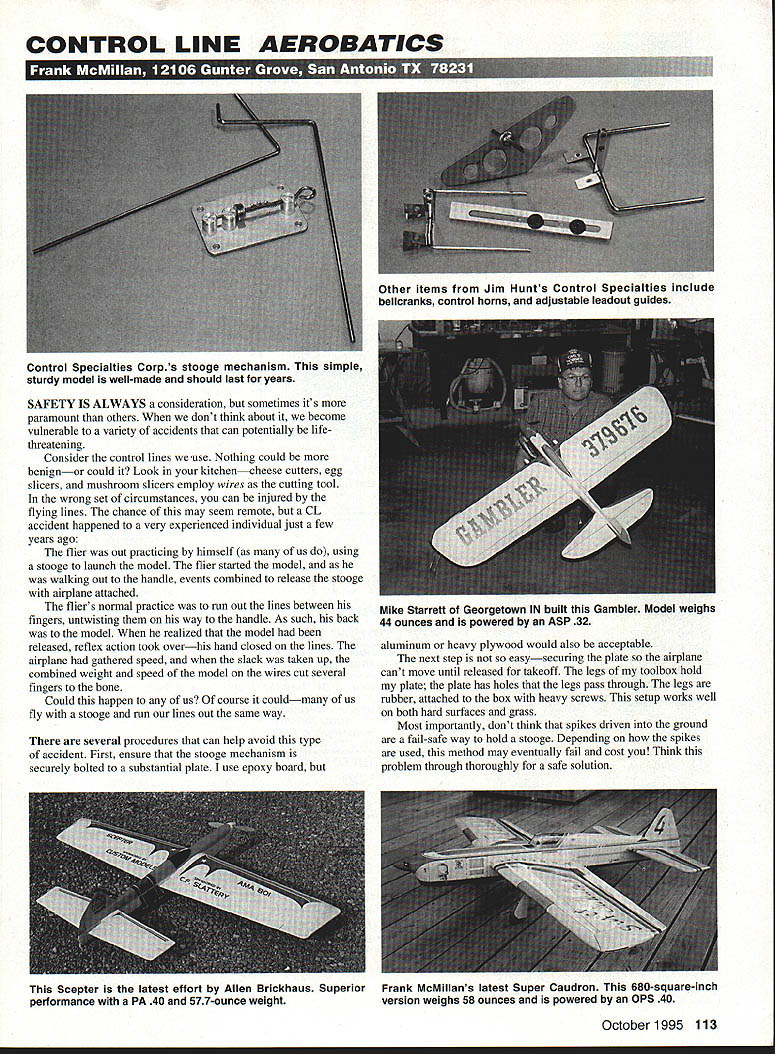
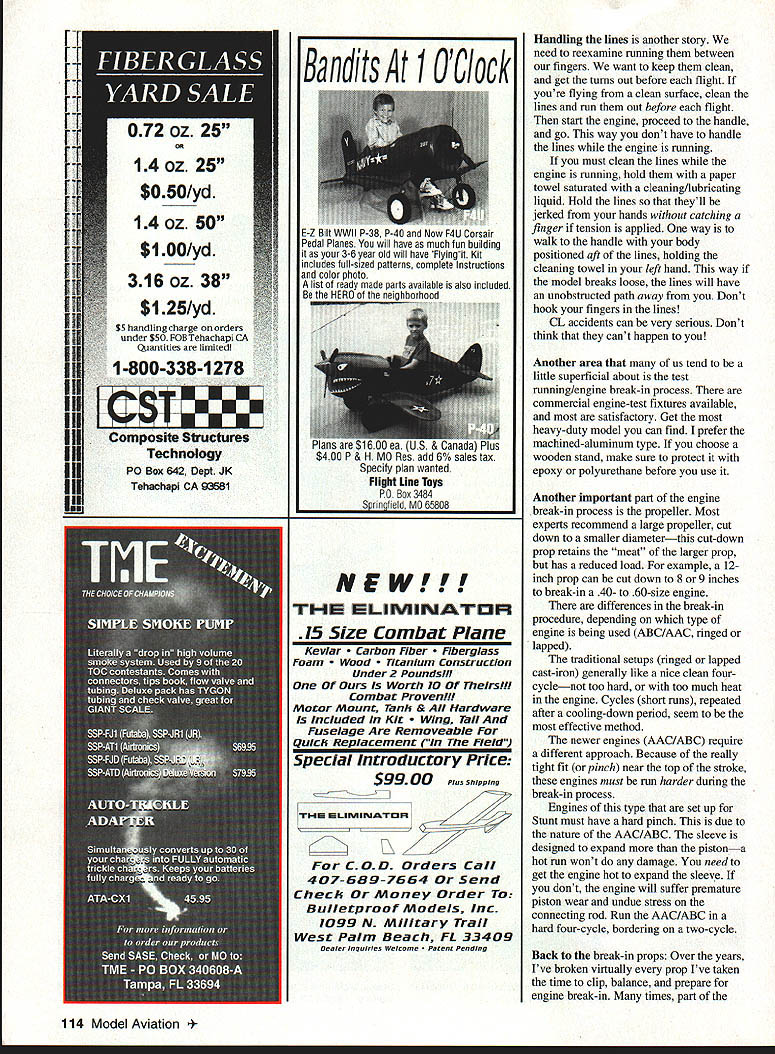
A reliable stooge is worth the investment. Control Specialties Corporation (Jim Hunt) offers a simple, solid stooge design that has proven durable over many years. Other useful items from Control Specialties include:
- Phenolic bellcranks (once lubricated require little further attention).
- Machined‑brass bushings at .001 clearance, hard‑soldered to 1/4" music wire for longevity.
- CSC horns, landing-gear blocks, and adjustable leadout guides.
- A switch from nylon to phenolic for leadout guides (an improvement).
- Special control sets with moment arms adjusted to duplicate Paul Walker's slow controls (useful for fliers who want reduced control sensitivity).
Contact Jim Hunt, Control Specialties Corporation, Box 68, Stockton PA 18083; Tel.: (215) 746-0106.
Spray guns and finishing
You may encounter high volume, low pressure (HVLP) spray guns—OSHA now requires this type for auto paint shops. HVLP guns deliver a lot of paint at low pressure and are designed for materials other than the dopes and lacquers used in modeling. Painters have found HVLP guns can overapply paint and have trouble matching fine detail.
Recommendations:
- Avoid HVLP guns for modeling applications unless you practice extensively and can control the heavy output.
- Use the minimum amount of paint necessary to cover an area on airplanes.
Closing reminder
Be deliberate about safety, testing, and equipment selection. Secure stooges properly, handle lines so they cannot catch your fingers, use appropriate break‑in methods for your engine type, and choose tools and accessories suited to modeling materials. Careful preparation and respect for the hazards will keep you flying—and safe.
Transcribed from original scans by AI. Minor OCR errors may remain.

