
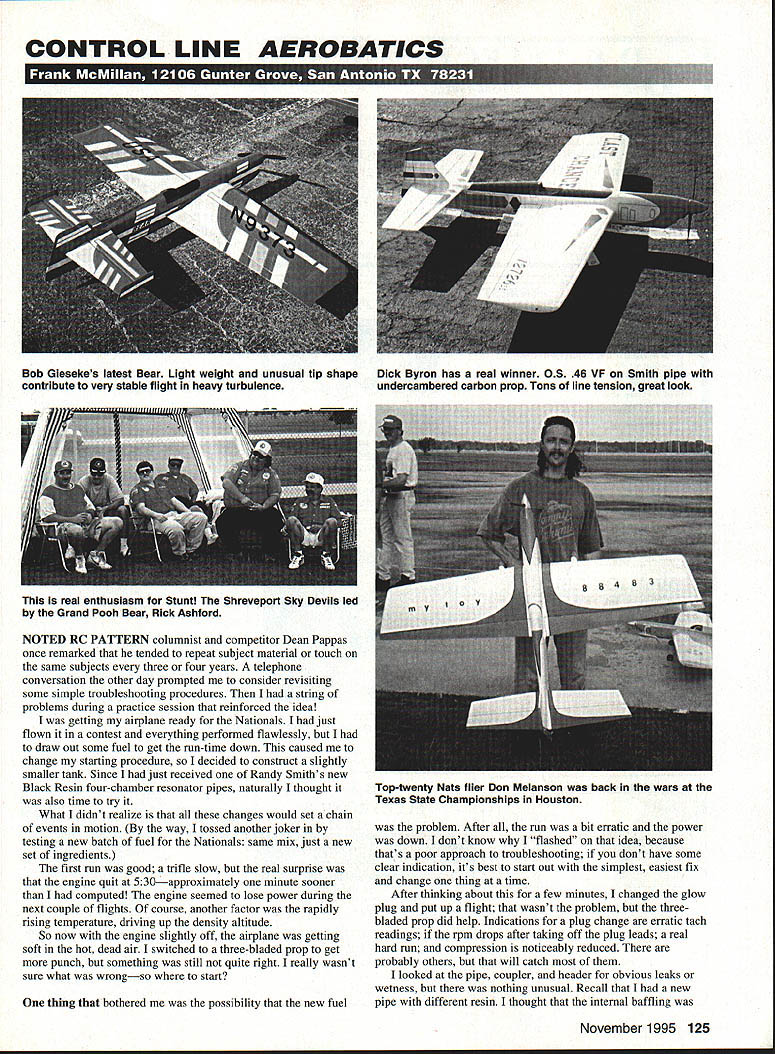


Control Line: Aerobatics
Frank McMillan, 12106 Gunter Grove, San Antonio TX 78231
Noted RC pattern columnist and competitor Dean Pappas once remarked that he tended to repeat subject material or touch on the same subjects every three or four years. A telephone conversation the other day prompted me to consider revisiting some simple troubleshooting procedures. Then I had a string of problems during a practice session that reinforced the idea.
The setup and the problem
I was getting my airplane ready for the Nationals. I had just flown it in a contest and everything had performed flawlessly, but I had to draw out some fuel to get the run-time down. This caused me to change my starting procedure, so I decided to construct a slightly smaller tank. Since I had just received one of Randy Smith's new Black Resin four-chamber resonator pipes, I also thought it was time to try it. I tossed another joker in by testing a new batch of fuel for the Nationals: same mix, just a new set of ingredients.
The first run was good—slightly slow—but the engine quit at 5:30, approximately one minute sooner than I had computed. The engine seemed to lose power during the next couple of flights. Another factor was the rapidly rising temperature, which raised density altitude. With the engine slightly off, the airplane was getting soft in the hot, dead air. I switched to a three-bladed prop to get more punch, but something was still not quite right.
Troubleshooting approach
I briefly considered that the new fuel might be the problem, but that's a poor first troubleshooting step unless you have clear evidence. It's best to start with the simplest, easiest fixes and change only one thing at a time.
I changed the glow plug and flew again; that wasn't the problem, though the three-bladed prop did help. Indications that a glow plug should be changed include:
- Erratic tachometer readings.
- RPM drops after takeoff.
- A very hard run (hesitation or misfires).
- Noticeably reduced compression.
I inspected the pipe, coupler, and header for obvious leaks or wetness—nothing unusual was apparent. Then my good buddy John Hill checked the fuel filter. The light bulb went on: there was visible crud. He changed the filter and the fuel lines, and everything was back to normal. I should have thought of the filter sooner.
Fuel-system notes and examples
A new tank makes it especially important to check the filter. Changing the fuel line is an easy, preventative measure—slit silicone tubing can develop a hidden slit that travels and causes problems. Bob Hunt mentioned running down a nagging issue that turned out to be fuel-line-related. Plastic tanks can also develop rubber-stopper problems after some use.
Another example: at the Tidewater Nats, Glen Meador helped a friend whose S.T. 60 model would only run rich or stop. After changing tank, engine, fuel line, filter, prop, and spinner, the problem turned out to be the small molded plastic cover used to close the overflow vent after filling the tank. It had a hole and wouldn't hold pressure. Leaks of any kind in any system are bad—check them.
After the repair — unexpected runtime change
After fixing the clogged fuel filter, the engine returned to its normal stable, powerful self, but it still ran almost a full minute shorter than I had predicted. Back at home that night, I tried my old tank and found that a 7:10 previously normal run was now 6:20. I had noted that the pipe was really "rattling"—I was pulling a lot of power. My analysis is that the new pipe was a bit different in the baffling or just that much better than the previous unit, so it consumed more fuel and shortened run time.
Trim: tip weight, leadouts and line tension
Another flier had an overweight ST .60 model (about 80 ounces) that had done well in the Advanced class for several seasons. In hot, turbulent air the performance envelope was limited. We suggested sealing the hinge gaps, which improved the corner but introduced wingtip banging.
The flier backed out tip weight to stop the tip banging. When he did this, line tension decreased, so he moved the leadouts forward to compensate. That was the wrong move. What we didn't know was that the airplane was tailheavy. Moving the leadouts forward, coupled with removing tip weight and the extra turn provided by sealed hinge gaps, almost caused him to lose the airplane on a wingover.
He reacted by restoring the original trim—again a bad move because the performance availability had changed. The correct procedure would have been:
- Correct the CG first (add a little nose weight).
- Then, if needed, move the leadouts aft to afford extra tension.
- Make one trim change at a time and think through each change.
General guidelines:
- As you reduce tip weight, leave the leadouts alone until you are near where you want to be.
- Make minute changes to both weight and leadouts; don't make multiple changes at once.
- Rule of thumb: as the CG moves forward, leadouts move forward. As the CG moves aft, leadouts move aft, but in smaller amounts.
- Changing line length and line type (solid vs. cable) significantly affects tip weight and line adjustment.
Remember: nothing is fixed. Be prepared to change and tune step by step.
Transcribed from original scans by AI. Minor OCR errors may remain.

