
Control Line: Aerobatics
Byline
Frank McMillan 12106 Gunter Grove, San Antonio, TX 78231
Overview
Each Nationals seems to take on its own character—neon paint schemes, checkerboards, and the like. This year's Nats at Tri-Cities, Washington, July 10–15 had so many different themes that, instead of selecting just one, I will try to capture some of the more interesting highlights.
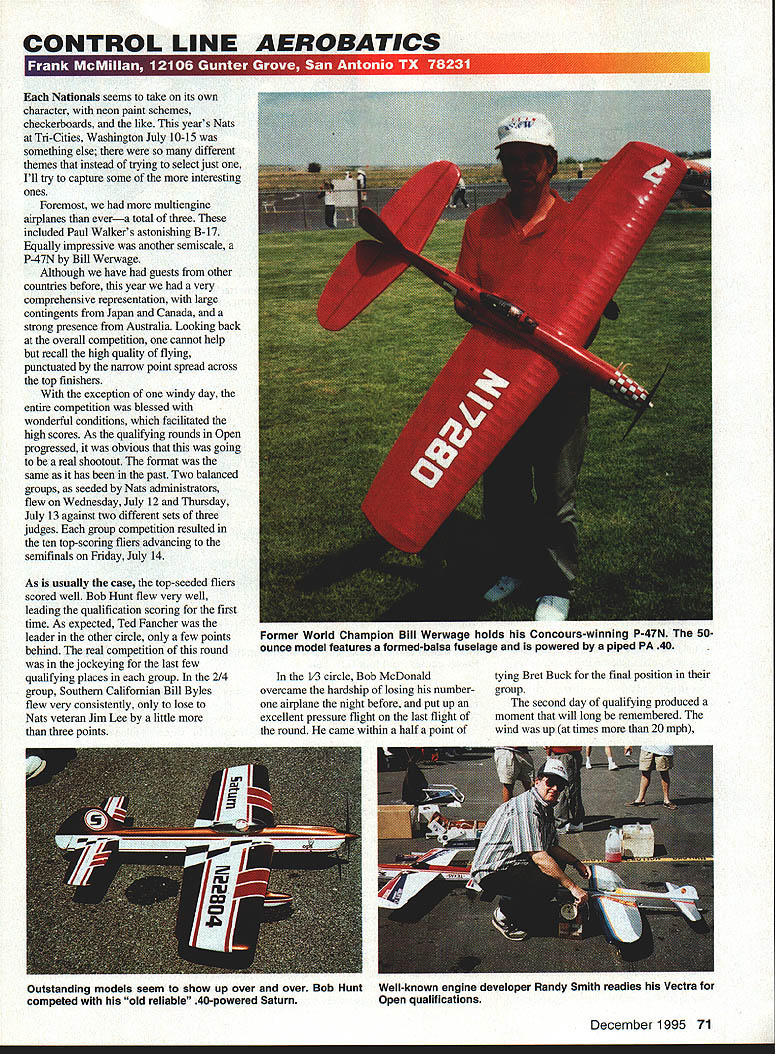
Foremost, we had more multiengine airplanes than ever—a total of three—including Paul Walker's astonishing B-17. Equally impressive was another semiscale, a P-47N by Bill Werwage.
We also enjoyed a very international field, with large contingents from Japan and Canada and a strong presence from Australia. Looking back at the overall competition, one cannot help but recall the high quality of flying, punctuated by the narrow point spread across the top finishers.
With the exception of one windy day, the entire meet enjoyed wonderful conditions, which facilitated high scores. As qualifying rounds in Open progressed, it was obvious this was going to be a real shootout.
Format and Qualifying
- The format: two balanced groups, seeded by Nats administrators, flew on Wednesday, July 12 and Thursday, July 13 against two different sets of three judges.
- Each group competition resulted in the ten top-scoring fliers advancing to the semifinals on Friday, July 14.
- Chief judge Gary McClellan insisted on five judges per circle for the finals, with the high and low scores dropped.
Top-seeded fliers scored well as usual. Bob Hunt led the qualification scoring in one circle, while Ted Fancher led the other, only a few points behind. The real competition in qualifying was jockeying for the last few advancing spots. In the 2/4 circle, Southern Californian Bill Byles flew consistently but lost to veteran Jim Lee by a little more than three points. In the 1/3 circle, Bob McDonald overcame losing his number-one airplane the night before to put up an excellent pressure flight and nearly tied Bret Buck for the final position in their group.
Multiengine and Semiscale Highlights
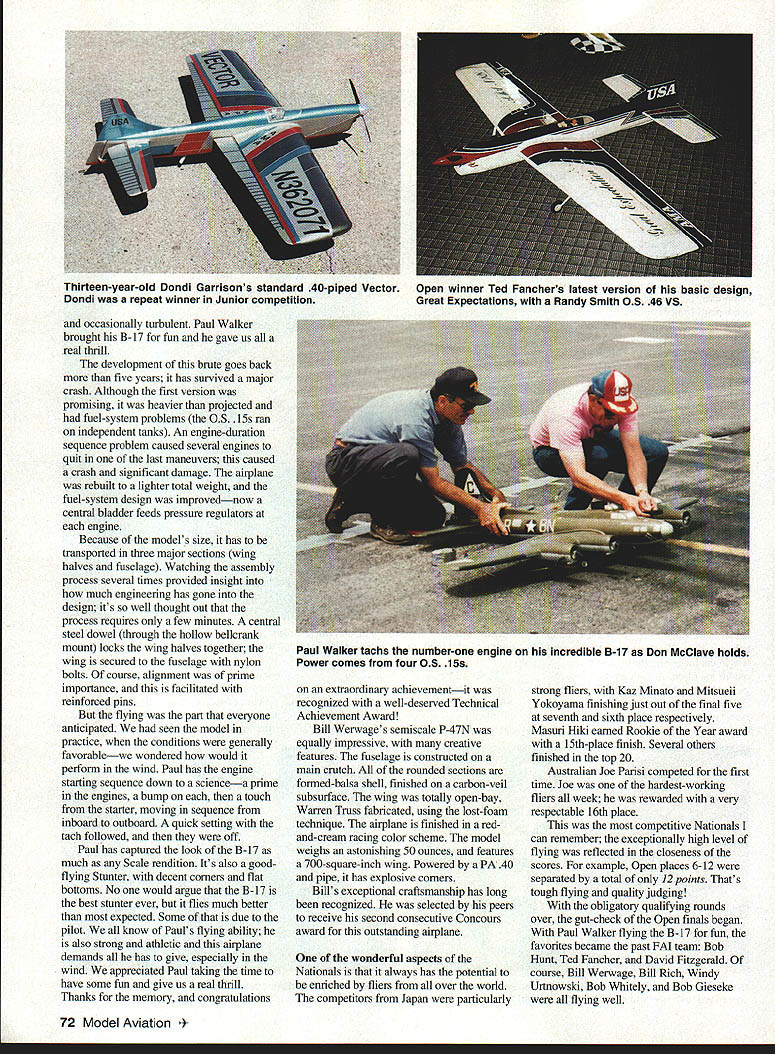
Paul Walker’s B-17
Paul Walker brought his five-year project B-17 for demonstrations, and it was a real thrill. The development history includes a major crash caused by fuel-system and engine-duration sequence problems in the early version. The rebuilt airplane is lighter, with an improved fuel system: a central bladder feeds pressure regulators to each engine. Because of its size the model is transported in three major sections (wing halves and fuselage). Assembly is well engineered and takes only a few minutes: a central steel dowel through the hollow bellcrank mount locks the wing halves; the wing is secured to the fuselage with nylon bolts; reinforced pins facilitate alignment.
Paul’s engine-starting sequence is efficient—engines are bumped and touched with the starter in a moving sequence (inboard then outboard), a quick tach check, then shutoff. The model captures the B-17 look in much of the scale rendition and is a surprisingly good-flying stunter with decent corners and flat bottoms. It demands athletic flying in wind, and Paul’s skill made it a memorable demonstration. The model received a well-deserved Technical Achievement Award.
Bill Werwage’s P-47N
Bill Werwage’s semiscale P-47N was equally impressive. Creative features include:
- A fuselage built over a main crutch with rounded sections and a formed-balsa shell finished with carbon-veil subsurface.
- A totally open-bay Warren-truss wing fabricated using a lost-foam technique.
- A red-and-cream racing color scheme.
The model weighs about 50 ounces with a 700-square-inch wing and is powered by a PA .40 with a pipe, giving it explosive corners. Bill’s craftsmanship earned him a consecutive Concours award.
International Competitors
The Nationals were enriched by strong international competitors:
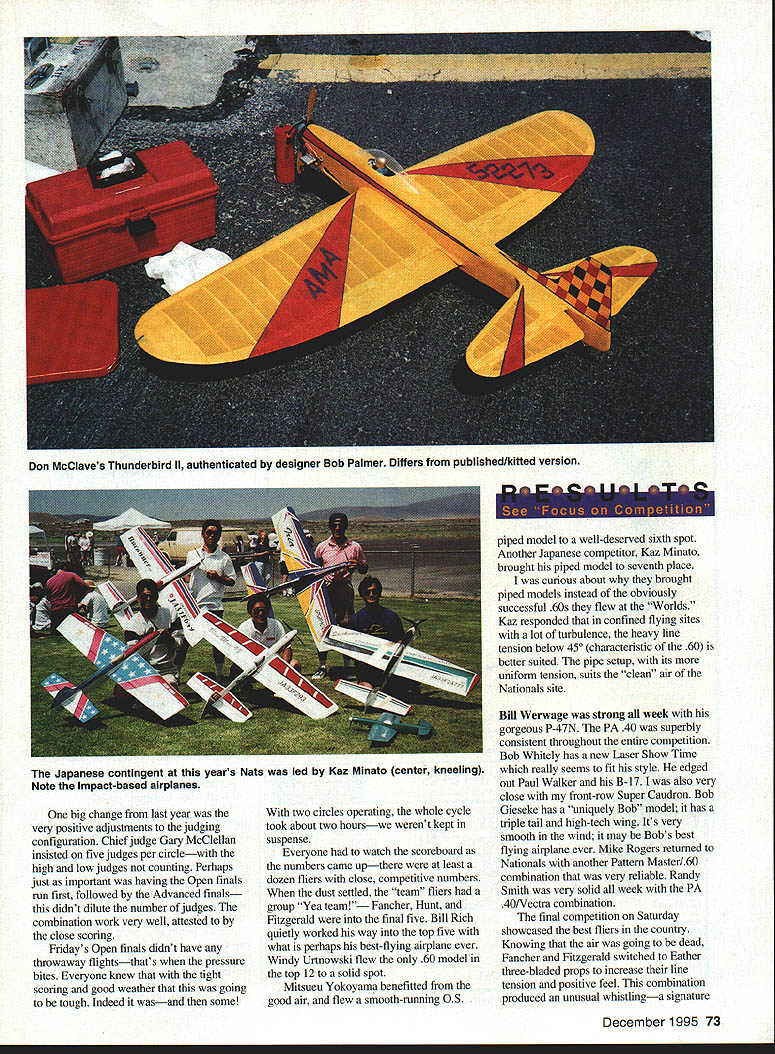
- Japan: Kaz Minato and Mitsuei Yokoyama finished seventh and sixth, respectively, just outside the final five. Masuri Hiki earned Rookie of the Year with a 15th-place finish. Several other Japanese fliers finished in the top 20.
- Australia: Joe Parisi competed for the first time, worked very hard all week, and finished a respectable 16th.
Some Japanese pilots favored piped engine setups over .60s at this site; they reported that in confined flying sites with turbulence, the heavier line tension below 45° associated with .60s is less suited, while piped setups provide more uniform tension in the “clean” air at the Nationals site.
Open Finals
With Paul Walker flying the B-17 for fun, the favorites in Open became the past FAI team: Bob Hunt, Ted Fancher, and David Fitzgerald. Bill Werwage, Bill Rich, Windy Urtnowski, Bob Whiteley, and Bob Gieseke were also flying well.
Judging adjustments—five judges per circle with high and low dropped—and running the Open finals first, followed by Advanced, improved judging depth and did not dilute judge availability. With two circles operating, the Open finals cycle took about two hours.
When the dust settled, the team fliers Fancher, Hunt, and Fitzgerald made the final five. Bill Rich quietly worked his way into the top five with perhaps his best-flying airplane ever. Windy Urtnowski flew the only .60 model in the top 12 to a solid spot. Mitsuei Yokoyama and Kaz Minato showed the effectiveness of piped models at this site, finishing sixth and seventh, respectively.
In the final rounds, air was dead, so Fancher and Fitzgerald switched to feathered three-blade props to increase line tension and feel; the setup produced an unusual whistling sound and proved effective. Ted Fancher dominated the contest with two excellent opening flights, putting everyone away early. Bill Rich flew well with good shapes and sizes but had occasional slight climbs or dives in square bottoms. David Fitzgerald retained his precision but an engine change the night before may have cost him some crispness. Bob Hunt improved every flight but couldn’t overcome an early deficit. Windy Urtnowski flew well with a Pattern Master/Strega.
- Open winner: Ted Fancher (also won the Walker Cup)
Advanced, Junior, and Senior
Advanced
The Advanced class continues to develop into a highly competitive field. Top finishers:
- Jim Damrell (clear winner; improved from last year)
- Dondi Garrison
- Dale Barry
- John Leidle
- Gary Nelson
Alice Cotton-Royer, competing in her first Nationals, finished eighth.
Junior
Dondi Garrison repeated as Junior winner. Now 13, his two-handed style is a treat to watch. He flies a .40-powered piped Vector and is very tough—he also finished second in Advanced. Up-and-coming Brian Helfer impressed everyone with a Sig Banshee and O.S. .35FP.
Senior
Although only two competitors entered Senior, Robbie Hunt and Derek Barry (both past Advanced winners) pushed each other hard. Robbie outflew Derek and went on to the Walker Cup flyoffs. Watching Robbie and Dondi together brought to mind a young Bill Werwage and David Fitzgerald.
Old-Time Stunt and Classic
Old-Time Stunt
Monday featured older airplanes and more senior fliers. Old-Time Stunt produced very close scores. Top placings:
- Rusty Brown (convincing win)
- Walt Poynter
- Bob Emmett
- Jim Rhoades
- Jim Lee
Classic
Classic produced a battle among three past Classic winners:
- Bob Whiteley flew his Shark 35 (a smaller version of the .45) powered by an O.S. .40FP.
- Frank McMillan flew the Aldrich Magnum (follow-up to the Noble) with an O.S. .35S.
- Don McClave flew an original Bob Palmer–designed Thunderbird with a stock Fox .35.
Bob Whiteley came through with a superb flight to edge Frank on landing scoring; Don placed a strong third. It was one of the best Classic competitions in many years.
Equipment and Designs
There were a number of excellent-flying designs at this year’s Nationals. Walker’s Impact was present in many guises; Fancher’s design was represented among the winners; several Pattern Masters were seen. Top fliers used a variety of power packages; most worked well, even through Old-Time and Classic classes. There is readily available information to get many engines running well—pick one that suits you and go for it.
Bob Whiteley introduced a new Laser Show Time that fits his style and edged out Paul Walker’s B-17 in some matchups. Bob Gieseke showed a “uniquely Bob” model with a triple tail and a high-tech wing, very smooth in wind and perhaps his best-flying airplane ever. Mike Rogers returned with a reliable Pattern Master/.60 combination. Randy Smith was solid all week with a PA .40/Vectra combination.
1/2A Stunt (Cox Sponsorship)
Once again, Cox Manufacturing sponsored 1/2A Stunt, contributing Me 109 stunners to support one of the most fun events at the Nats. Larry Renger (representing Cox Hobbies) was overall director, assisted by Pete Peterson, judge John Miller, flying assistants Chris Cox and James Cox, and tabulator Joan Cox. Derek Barry received the highest impression points in the Me 109 event.
Officials and Volunteers
An event runs smoothly when organizers and volunteers plan and execute well. Special recognition to:
- Event Director (ED): Dave Gardner; Assistant ED: Alice Gamber
- Head judge: Gary McClellan
- Judges and assistants: Bob Emmett, Bill and Sue Howe, Ken Stout, Bill Fitzgerald, Lee Lorio, Doug Taffinder, Mary Gebhart, Gene Mills, Warren Thalhert
- Head tabulator: Sharon Fancher; Assistants: Kathy Fitzgerald, Peggy Parker
- Pit bosses: Lee Ueberbacher, Don West, Carl Rehnberg, Pete Peterson
- Runners: Carl Rehnberg, Brian Keefer, Joan Cox, Gary Nelson, and many others
Old-Time Stunt Classic specifics:
- ED: Don West
- Old-Time Stunt judges: Jim Darnell, Dale Barry, Ken Stout
- Classic judges: Rusty Brown, Bob Parker, Doug Taffinder
- Pit bosses: John Leidle, Lee Ueberbacher
Closing
This was the most competitive Nationals I can remember; the exceptionally high level of flying was reflected in the closeness of the scores. For example, Open places 6–12 were separated by a total of only 12 points—tough flying and quality judging. Thanks to all competitors, international guests, organizers, and volunteers for a memorable contest.
Transcribed from original scans by AI. Minor OCR errors may remain.

