
CONTROL LINE AEROBATICS
Frank McMillan, 12106 Gunter Grove, San Antonio TX 78231
CALL IT WHAT you will, the World Championship Team Trials — Control Line Precision Aerobatics (F2B) — serves one purpose: to select the best fliers to represent the United States.
If you have any tendency to take this lightly, just ask one of our former World Champions what it feels like to stand number one and listen to your national anthem played for your accomplishment. I asked Bob Gieseke about it, and you only have to look into his eyes to know what it means and why the top fliers consider being on the team such a prestigious achievement. That's why the best Stunt fliers in the country gathered in Muncie, Indiana over the Labor Day weekend.
Venue and museum
This was the first opportunity I'd had to see the new AMA Headquarters and National Flying Site. Although the venue is not yet complete, you can see that this is going to be something special.
For our purpose the ramp space provided four clean circles and an administrative pavilion with a good view of the flying area. With 20 fliers entered, this provided more-than-sufficient access throughout the week.
The AMA Museum was much more than I expected. It seemed that everywhere I turned there was an airplane or an engine or something that turned back the pages to what seemed to be a less-complicated time. Steve Wooley's Cobra and Bob Palmer's T-Bird were in the rafters of a recreated 1950s hobby shop. Bob Gialdini's famous Olympic Eclipse and Sting Ray are awaiting space to be displayed.
You need to visit the museum and turn back the hands of time. Plan on seeing it at next year's Nats and paying a couple of visits.
Officials and judges
- Warren Tiahrt — Event Director (as in previous team selections)
- Gary McClellan — Head judge, responsible for training and administration of the judges
- Core judges selected by the F2B Team Selection Committee from an extensive list of volunteers included respected personages such as Keith Trostle, Bob Gialdini, and Bart Klapinski.
- Dave Cook provided the computer programs and equipment necessary to rapidly process the scores using the international K-factor scoring system.
This was a well-trained, highly professional group. They put on one of the best contests I've ever experienced.
Senior division — overview and results
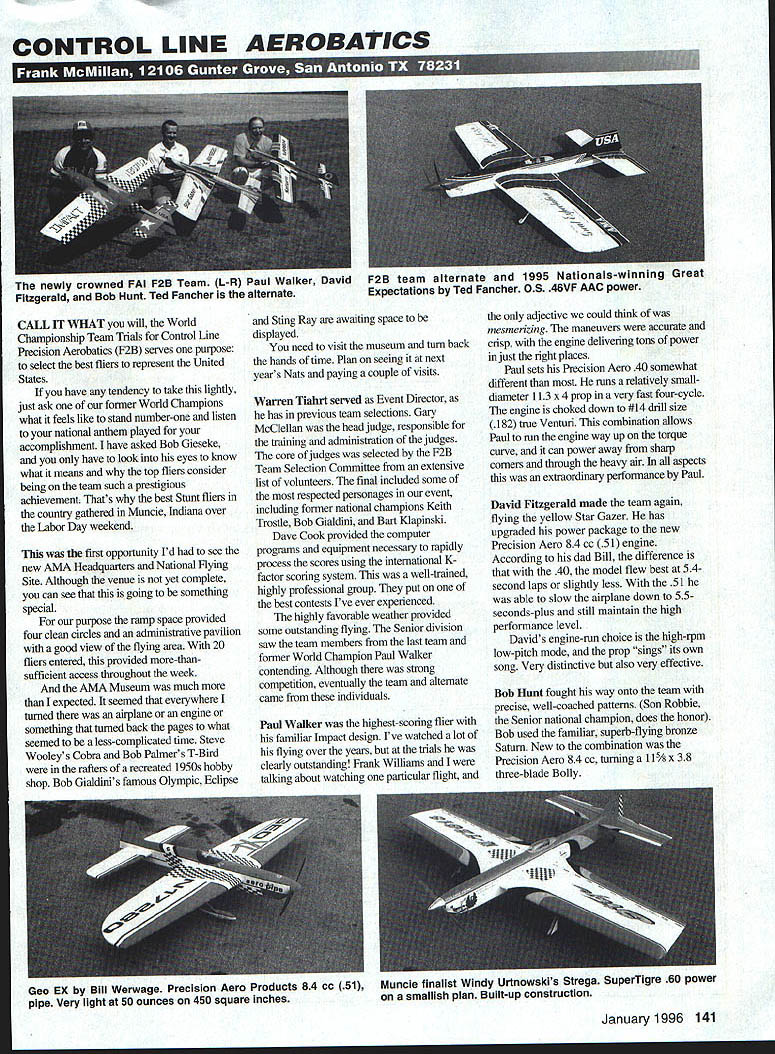
The highly favorable weather provided some outstanding flying. The Senior division saw returning team members and former World Champion Paul Walker contending. Although there was strong competition, eventually the team and alternate came from the following individuals:
- Team members:
- Paul Walker (highest-scoring flier)
- David Fitzgerald
- Bob Hunt
- Alternate:
- Ted Fancher
Paul Walker was the highest-scoring flier with his familiar Impact design. I've watched a lot of his flying over the years, but at the trials he was clearly outstanding. Frank Williams and I watched one particular flight and the only adjective we could think of was "mesmerizing." The maneuvers were accurate and crisp, with the engine delivering tons of power just in the right places.
Paul sets his Precision Aero .40 somewhat differently than most. He runs a relatively small-diameter 11.3 x 4 prop in a very fast four-cycle. The engine is choked down to a #14 drill size (.182) true Venturi. This combination allows Paul to run the engine way up on the torque curve and power away from sharp corners and through heavy air. In all aspects this was an extraordinary performance.
David Fitzgerald made the team again, flying the yellow Star Gazer. He has upgraded his power package to the new Precision Aero 84 cc (.51) engine. According to his dad Bill, with the .40 the model flew best at 54-second laps; with the .51 he was able to slow the airplane down to 55-plus second laps and still maintain a high performance level. David's engine-run choice is the high-rpm, low-pitch mode, and the prop "sings" its own song — very distinctive and effective.
Bob Hunt fought his way onto the team with precise, well-coached patterns. (Son Robbie, the Senior national champion, does the honor.) Bob used the familiar, superb-flying bronze Saturn. New to the combination was the Precision Aero 84 cc (.51), turning an 11½ x 3.8 three-blade Bolly. Bob's setup was again different: he ran a bellowing four-cycle all the way. The engine ran a moderate venturi (.189) with the early molded three-chamber pipe. The engine gave Bob a major performance increase over his previous OPS .40.
Fresh from his well-deserved Nationals win, Ted Fancher continued his smooth, consistent flying to the team alternate position. Like David Fitzgerald, Ted prefers the high-rpm, low-pitch approach and really pulls a lot of power from his Randy Smith O.S. .46VF. Along with a Brian Eather ultralight undercambered three-blade prop, Ted's airplane also has a characteristic whine when it's "on song."
Someone said that at the team trials there are three winners and everyone else. But that's not quite so.
There was an elimination to pick the top ten finalists. The competition was as intense as I can remember. Four official flights for each flier put a lot of pressure on the fliers and the judges on Saturday; then there was the finals on Sunday. Sunday started out with a clean slate and the Saturday scores didn't count, so the finalists had truly earned their right to compete for the team places.
The flying was extremely close — in some cases only a couple of points (out of 2,000) separating fliers. The remaining top ten included:
- Bill Werwage
- Windy Urtnowski
- Bob Baron
- Bill Rich
- Frank McMillan
- Bob Gieseke
Incidents and highlights
Behind the results of every contest there are usually some circumstances that grab everyone's interest.
- The weather had some unusual quirks — "biscuits" floating through the circles throughout the week. As the biscuits rolled through, Frank Williams caught one in the inside rounds and had his Lone Star pancaked in, breaking the fuselage and stabilizer.
- At the time he had no remaining official flight and not much to gain. With a lot of help and encouragement from the competitors, he put the puzzle back together. For safety he put up a practice flight, and it actually flew better!
- During the official flight, Frank flew exceptionally well, posting a very competitive score. But the real reward was a round of applause from his fellow competitors, recognizing a gutsy performance in the face of adversity. He was the only competitor to receive a round of applause during the competition.
Junior competition
The Junior competition was just as intense, but only one could represent the United States. It was flown as a separate event for the first time. Robbie Hunt represented the U.S. last year, but there was no selection process then due to short notice.
AMA Junior national champion Dondi Garrison, Brian Kieffer, and Senior Derek Barry put up some really good flights, with Derek Barry winning the honor. However, AMA does not provide travel funding for this category. Let's get behind Derek and give him some help getting to Sweden!
Transcribed from original scans by AI. Minor OCR errors may remain.

