
CONTROL LINE AEROBATICS
Frank McMillan, 12106 Gunter Grove, San Antonio TX 78231
When there's time to reflect on modeling in general and our event in particular, I can't help but conclude these are the "Good Old Days." Look at the marvelous array of items available: new engines, control systems, and lightweight parts. Compare them to what we had 10 years ago.
Engines — Modusa Stalker 10cc
The other day I watched Frank Williams work with the Modusa Stalker 10cc installed on a profile model to experiment before developing a new design. As configured it was a rear-exhaust model coupled to the Stalker muffler — a very light and quiet setup. The layout resembles the Chinese side-mount design Tom Dixon copied in his Praxis (11/95 MA).
Frank had been flying the engine and said it really likes big props. With an assortment of 14x5 props the engine just loafed along, showing lots of power. The engine clearly reflects an attempt to keep weight down: the backplate screws on (providing a good seal and saving screw weight), the castings are clean and precise, and the piston seal on this ABC engine is first-rate. The red-anodized head, however, turned gold after use. In a conventional setup with a muffler it performed acceptably at the price point. There was some vibration, but I attributed that to the profile configuration.
After gathering baseline data on the muffler setup, Frank removed the muffler and tried one of his tuned pipes. Smaller props raised the revs, but the engine would not come up on the pipe. The experiment aimed to find a lightweight tuned-pipe .60 that produced proportionally more power; apparently this did not work. Frank surmised the problem was the very mild timing — the engine works as a lugger but is not ideal out of its element. Contact Modusa at 4A Rundell Road, Kingston Upon Thames, Surrey KT1 3RZ, UK.
Engines — Precision Aero .51 (8.4cc)
Some months ago I mentioned an 8.4cc (.51 cu. in.) version of the very successful Precision Aero .40 by Randy Smith. I've been watching top fliers (such as Paul Walker and Bill Rich) and listening to the smooth, turbine-like runs. After talking with Bill Werwage and Randy Smith about how well the engine performed, I had to have one.
Run-in procedure and performance
- I followed the recommended two careful hours on the bench; experienced fliers advise expecting about 25 flights before the engine is fully ready. My engine had just over 30 flights as I write and continues to get smoother and more powerful.
- The engine likes to be loaded and will turn large propellers at normal pipe rpm. Most fliers are using the Bolly carbon 12 x 3.9/3.8 three-blade propeller with launch rpm around 10,800.
- Fuel consumption is economical — a shade over six ounces.
Competition feedback
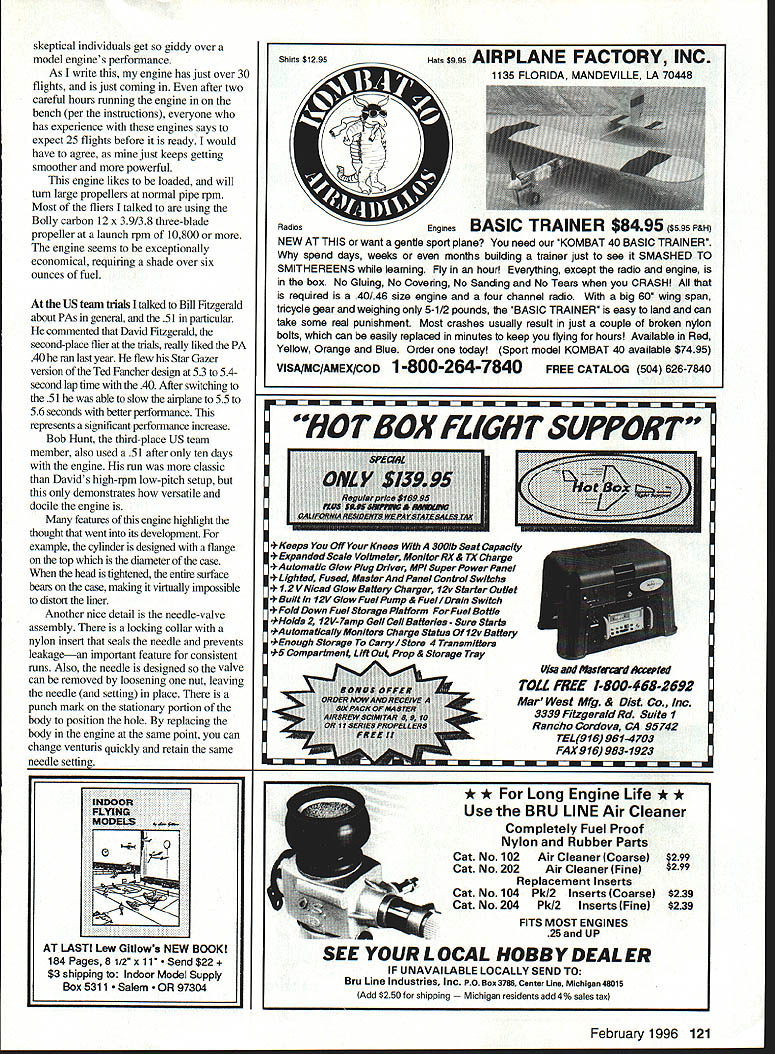
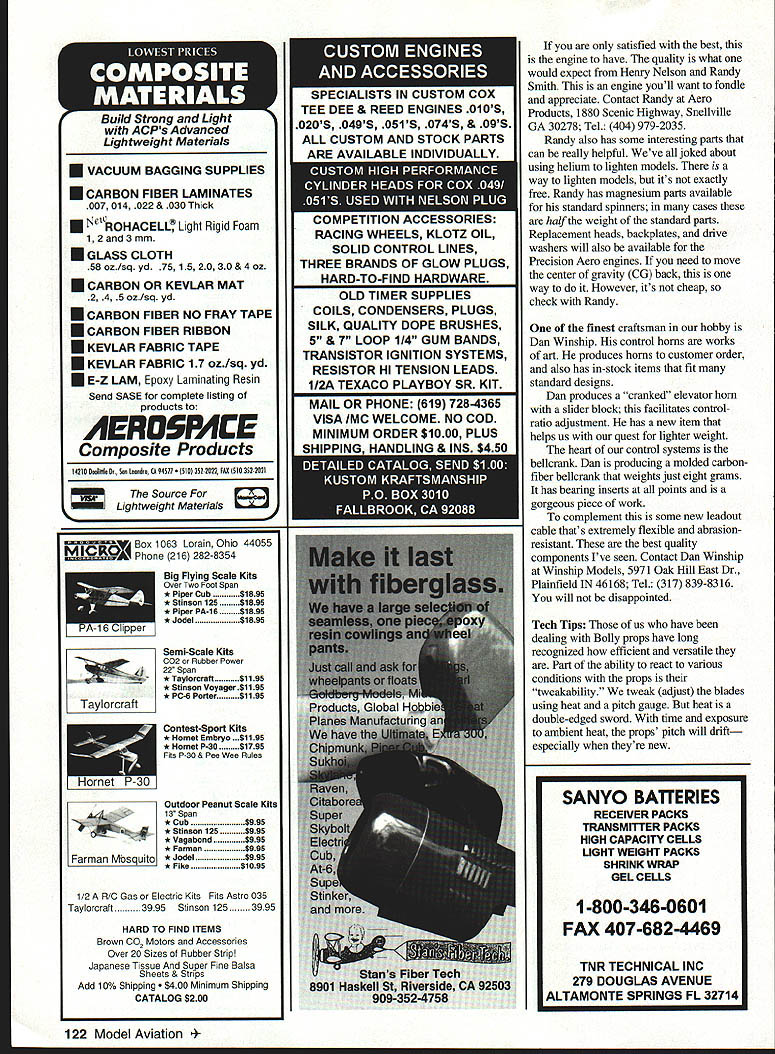
- At the US team trials I spoke with Bill Fitzgerald. David Fitzgerald (second place) ran a PA .40 last year in a Ted Fancher Star Gazer and recorded 53–54 second lap times. After switching to the .51 he was able to slow the airplane to 55–56 seconds with better overall performance — a significant increase.
- Bob Hunt (third-place US team member) also used the .51.
Notable design details
- The cylinder is designed with a flange on the top diameter of the case where the head tightens. The entire surface bears on the case, making it virtually impossible to distort the liner.
- The needle-valve assembly has a locking collar with a nylon insert to seal the needle and prevent leakage — important for consistent runs.
- The assembly can be removed by loosening the nut while leaving the needle setting in place. A punch mark on the stationary portion of the body shows the position so you can change venturis quickly and retain the same needle setting.
If you want the best, this is an engine to consider — the quality you expect from Henry Nelson and Randy Smith. Contact Randy at Aero Products, 1880 Scenic Highway, Snellville, GA 30278; Tel: (404) 979-2035.
Parts and accessories
Randy also offers magnesium parts for his standard spinners and other components. These are often about half the weight of standard parts. Replacement heads, backplates, and drive washers will also be available for Precision Aero engines. If you need to move the center of gravity (CG) back, magnesium parts are one way to do it — but they aren't cheap.
One of the finest craftsmen in the hobby is Dan Winship. His control horns are works of art: he produces custom horns and keeps in-stock items that fit many designs. Dan makes a "cranked" elevator horn with a slider block to facilitate control-ratio adjustment. His new molded carbon-fiber bellcrank weighs just eight grams, has bearing inserts at all points, and is excellently crafted. Complementing this are high-quality leadout attachments — the best end fittings I've seen. Contact Dan Winship at Winship Models, 5971 Oak Hills East Dr., Plainfield, IN 46168; Tel: (317) 839-8316.
Tech Tips
Bolly props are efficient and versatile; part of that versatility is their tweakability. We tweak the blades just behind the root at a pitch gauge. Heat, however, is a double-edged sword: with time and exposure to ambient heat a prop's pitch can drift, especially when new. In hot weather, leaving an airplane uncovered can lead to a loss of punch; check each blade on a pitch gauge — usually at least one blade will have moved.
Covering and transport ideas
- On the way to the team trials, Frank Williams protected his airplane in transport with an aluminized bubble-foam insulating material. It was light, soft, and heat-reflective.
- Uses we discussed:
- A covering blanket for transport or storage, with small weights at the edges to hold the airplane down in wind.
- Individual propeller blade covers: fold the material over each blade and tape with metallic tape. String the individual covers together loosely with string to keep them organized.
- The material we used: Reflectix (R rating 4.55), available in 16- or 24-inch widths. The aluminum tape used was 3M Metal Repair Tape (#305NA). These protect blades from damage, heat, and light and help control exposure of carbon/epoxy blades to heat and sunlight.
Events — Vintage Stunt Championships
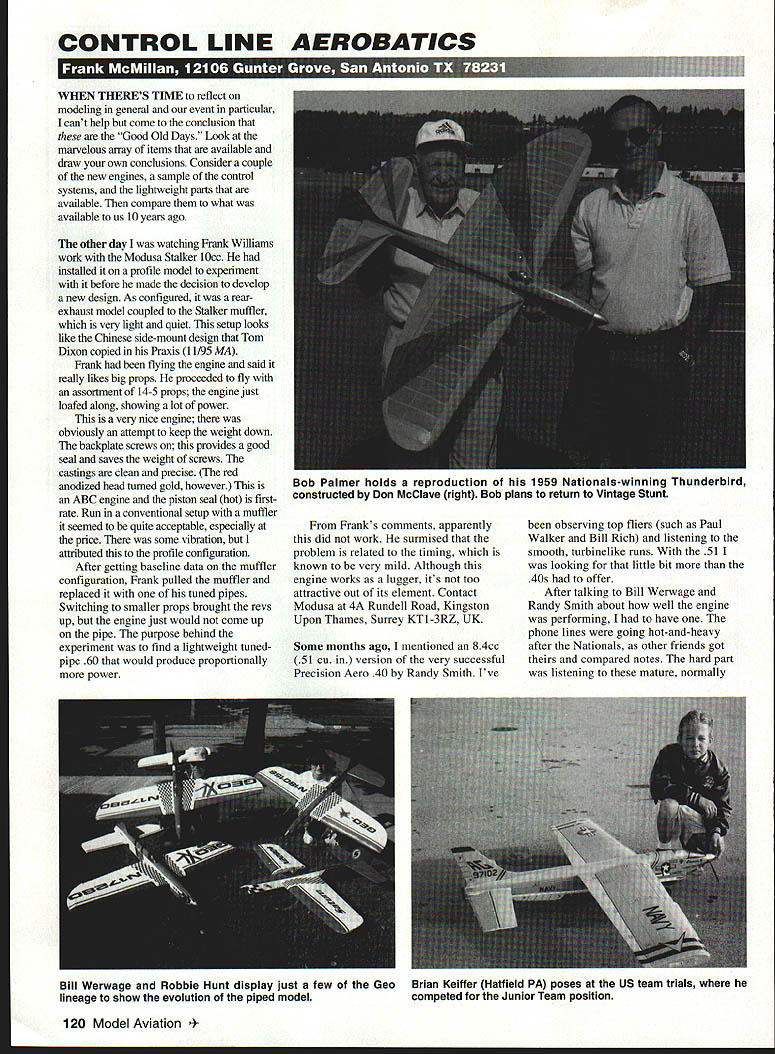
Charlie Bruce, president of the Model Engine Collectors Association (MECA), will sponsor a special event at the upcoming Vintage Stunt Championships on March 22–24, 1996. The event is for Precision Aerobatics Model Pilots Association (PAMPA) Old-Time ignition designs that weren't published or kitted (wing flaps not allowed).
Purpose: to get more old designs flown and documented. These unpublished, developmental designs are part of U/C stunt history and will soon be lost if not brought forward. I agree with Charlie — we need to capture and document these forward-thinking designs.
Transcribed from original scans by AI. Minor OCR errors may remain.

