
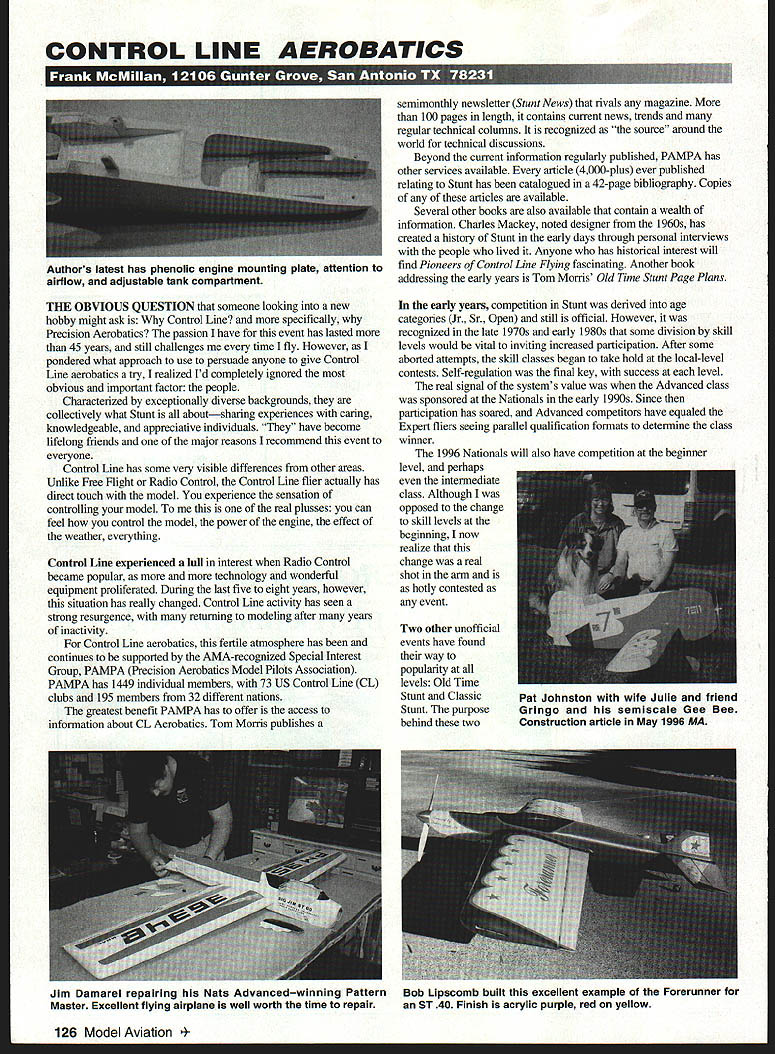
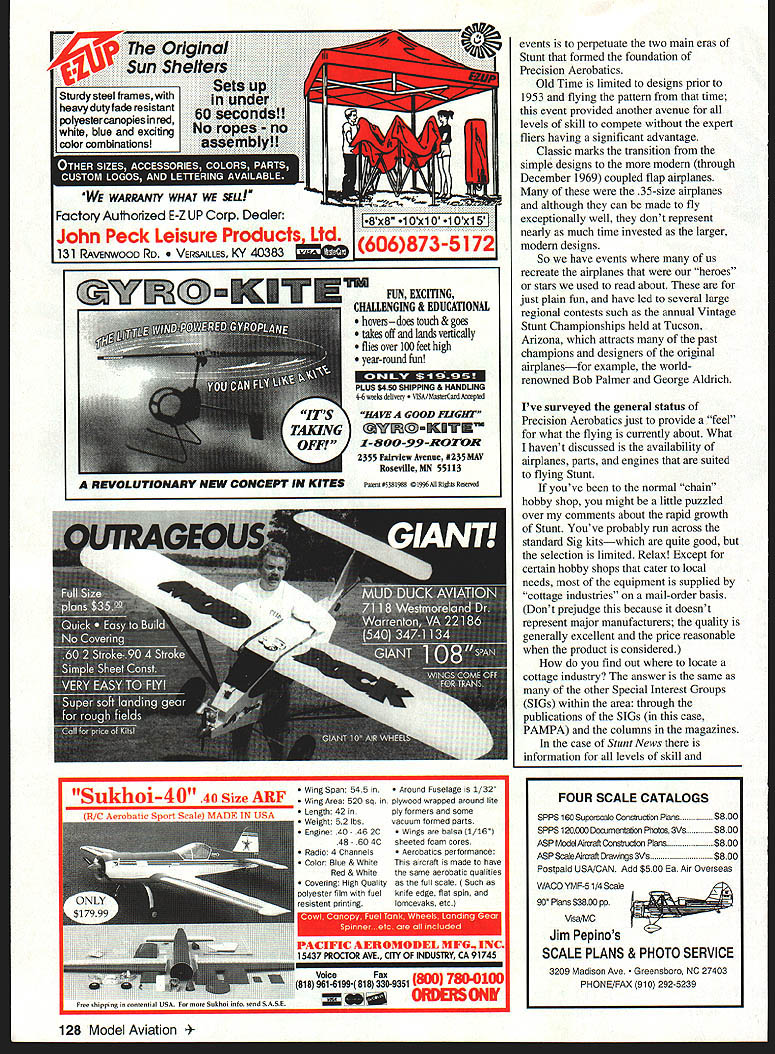
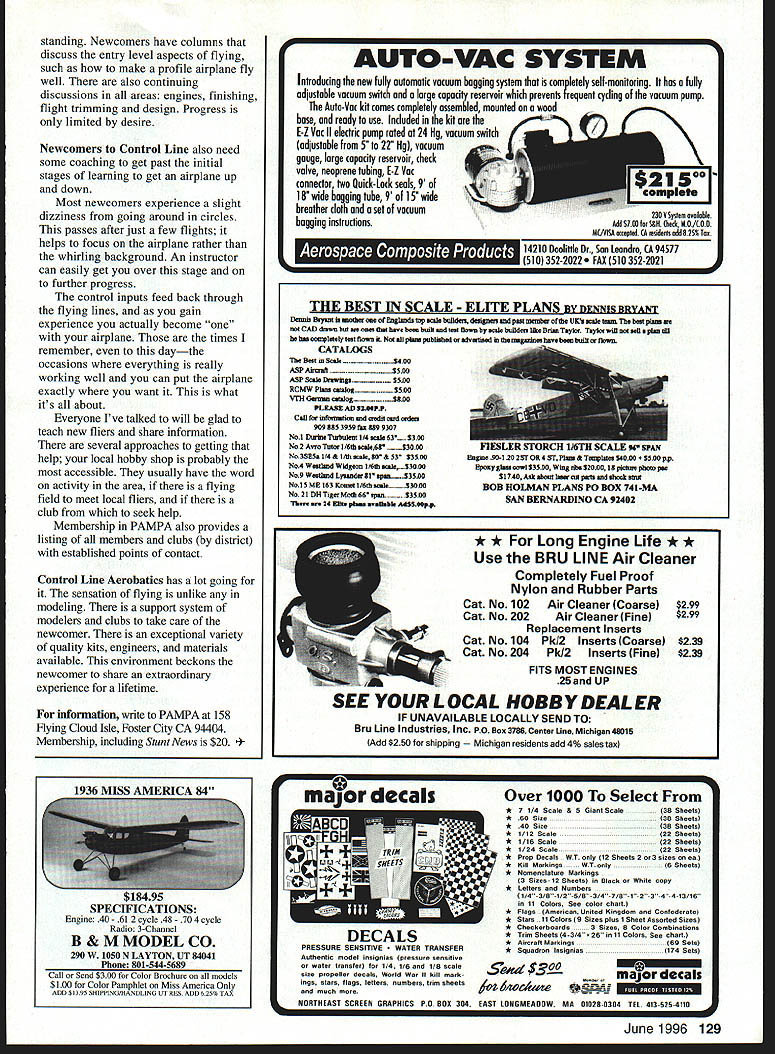
Control Line: Aerobatics
Frank McMillan 12106 Gunter Grove, San Antonio, TX 78231
Why Control Line?
The obvious question someone looking into a new hobby might ask is: Why Control Line? and more specifically, why Precision Aerobatics? My passion for this event has lasted more than 45 years, and it still challenges me every time I fly. As I considered how to persuade someone to try Control Line aerobatics, I realized I'd completely ignored the most important factor: the people.
Characterized by exceptionally diverse backgrounds, the people involved are collectively what Stunt is all about—sharing experiences with caring, knowledgeable, and appreciative individuals. They have become lifelong friends and one of the major reasons I recommend this event to everyone.
Control Line has some very visible differences from other areas. Unlike Free Flight or Radio Control, the Control Line flier actually has direct touch with the model. You experience the sensation of controlling your model. You can feel how you control the model, the power of the engine, the effect of the weather—everything.
Resurgence and PAMPA
Control Line experienced a lull in interest when Radio Control became popular and more technology and equipment proliferated. During the last five to eight years, however, this situation has changed. Control Line activity has seen a strong resurgence, with many returning to modeling after years of inactivity.
For Control Line aerobatics, this fertile atmosphere has been and continues to be supported by the AMA-recognized Special Interest Group PAMPA (Precision Aerobatics Model Pilots Association).
- PAMPA has 1,449 individual members, 73 U.S. Control Line (CL) clubs, and 195 members from 32 other nations.
- Tom Morris publishes a semimonthly newsletter, Stunt News, that rivals any magazine. More than 100 pages in length, it contains current news, trends, and many regular technical columns. It is recognized as the source worldwide for technical discussions.
- PAMPA has cataloged every article (4,000-plus) ever published relating to Stunt in a 42-page bibliography; copies of any of these articles are available.
Several books also contain a wealth of information:
- Charles Mackey’s Pioneers of Control Line Flying, a history of Stunt through personal interviews with early participants.
- Tom Morris’ Old Time Stunt Page Plans, addressing the early years and classic designs.
Skill Levels and Events
In the early years, competition in Stunt was divided into age categories (Jr., Sr., Open) and that remains official. In the late 1970s and early 1980s it was recognized that some division by skill levels would be vital to inviting increased participation. After some aborted attempts, skill classes began to take hold at local contests, with self-regulation and success at each level proving the concept.
The real signal of the system’s value came when the Advanced class was sponsored at the Nationals in the early 1990s. Since then participation has soared. Advanced competitors have equaled the Expert fliers, with parallel qualification formats to determine the class winner.
The 1996 Nationals will also include competition at the beginner level, and perhaps even the intermediate class. Although I was opposed to the change in skill levels at the beginning, I now realize it was a real shot in the arm and is hotly contested like any event.
Two other unofficial events have become popular at all levels: Old Time Stunt and Classic Stunt. Their purpose is to perpetuate the two main eras of Stunt that formed the foundation for Precision Aerobatics.
- Old Time Stunt limits designs to those prior to 1953; flying the pattern for time provides another avenue for pilots of various skill levels to compete (expert fliers have a significant advantage).
- Classic Stunt marks the transition from simple designs to modern (through December 1969), encompassing coupled-flap airplanes and 35-size airplanes. Older designs can be made to fly exceptionally well, but they usually require less time investment than larger modern designs.
These events recreate the airplanes our heroes and stars used and read about—just plain fun. They have led to several large regional contests, such as the annual Vintage Stunt Championships held in Tucson, Arizona, which attracts past champions and designers of the original airplanes—for example, Bob Palmer and George Aldrich.
Equipment and Suppliers
If you've only visited a typical chain hobby shop, you might be puzzled about the rapid growth of Stunt. The selection there is limited (the standard Sig kits are quite good but few). Most equipment is supplied by cottage industries on a mail-order basis.
- Do not prejudge mail-order cottage industries; the quality is generally excellent and the price reasonable considering the product.
- How do you find them? Through the publications of the SIGs (in this case, PAMPA) and the columns in the magazines.
Newcomers have columns that discuss entry-level aspects of flying, such as how to make a profile airplane fly well. There are also continuing discussions in all areas: engines, finishing, flight trimming, and design. Progress is only limited by desire.
Learning to Fly and Community Support
Newcomers to Control Line need some coaching to get past the initial stages of learning to get an airplane up and down.
- Most newcomers experience slight dizziness from going around in circles. This passes after just a few flights; it helps to focus on the airplane rather than the whirling background.
- An instructor can easily get you over this stage and on to further progress.
- The control inputs feed back through the flying lines, and as you gain experience you actually become “one” with your airplane. Those occasions when everything is really working and you can put the airplane exactly where you want it are what it’s all about.
Everyone I’ve talked to will be glad to teach new fliers and share information. Your local hobby shop is probably the most accessible starting point; they usually know about local activity, flying fields, and clubs. Membership in PAMPA also provides a listing of all members and clubs (by district) with established points of contact.
Conclusion and Contact
Control Line Aerobatics has a lot going for it. The sensation of flying is unlike any in modeling. There is a support system of modelers and clubs to help newcomers. There is an exceptional variety of quality kits, engines, and materials available. This environment beckons the newcomer to share an extraordinary experience for a lifetime.
For information, write to PAMPA at 158 Flying Cloud Isle, Foster City, CA 94404. Membership, including Stunt News, is $20.
Transcribed from original scans by AI. Minor OCR errors may remain.

