
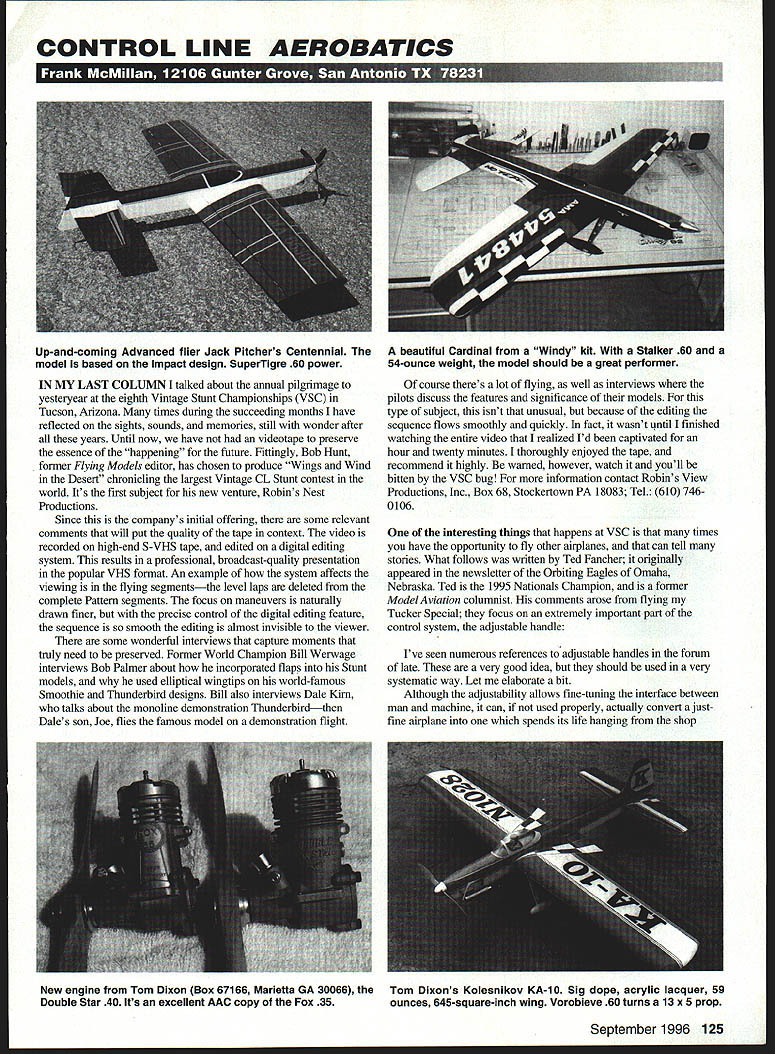
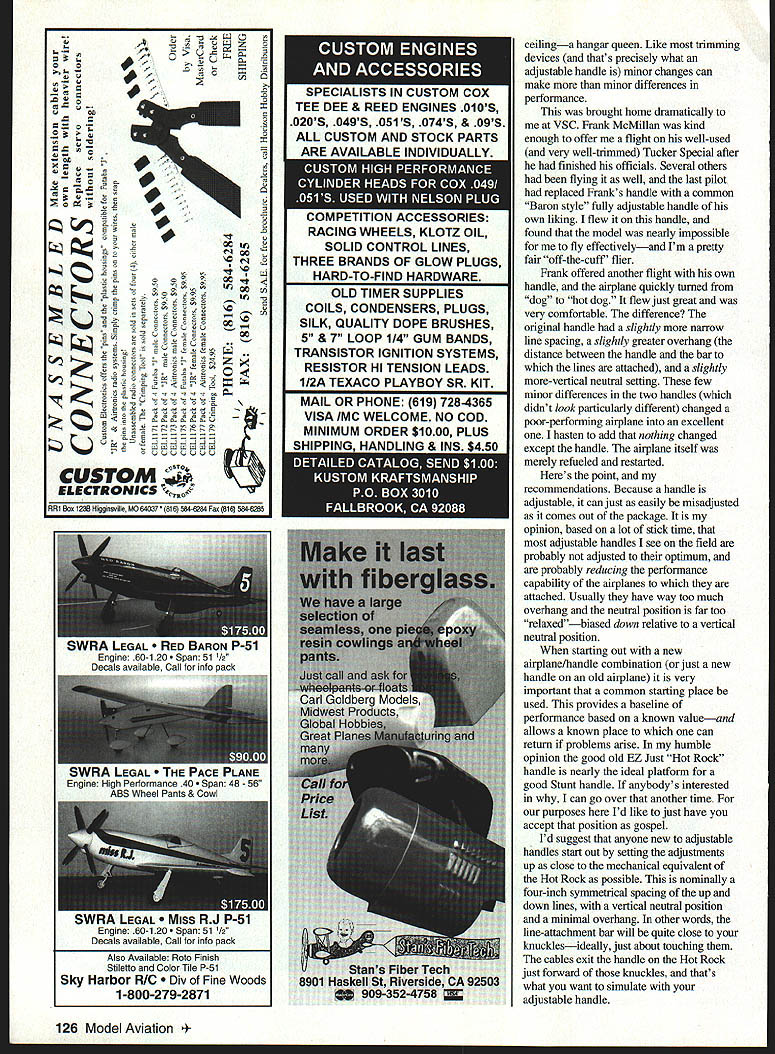
CONTROL LINE AEROBATICS
Frank McMillan 12106 Gunter Grove, San Antonio TX 78231
Vintage Stunt Championships video
In my last column I wrote about the annual pilgrimage to yesteryear—the eighth Vintage Stunt Championships (VSC) in Tucson, Arizona. Many times during the succeeding months I have reflected on the sights, sounds, and memories. Until now we have not had a videotape to preserve the essence of the event for the future. Bob Hunt, former Flying Models editor, has chosen to produce "Wings and Wind in the Desert," chronicling the largest Vintage CL Stunt contest in the world. It's the first subject for his new venture, Robin's Nest Productions.
A few notes on the production quality: the video is recorded on high-end S-VHS tape and edited on a digital editing system, resulting in a professional, broadcast-quality presentation in the popular VHS format. For example, level laps are deleted from the complete Pattern segments, focusing attention on the maneuvers. The precise control of the digital editing makes the sequence smooth and nearly invisible to the viewer.
There are some excellent interviews that capture moments worth preserving. Former World Champion Bill Werwage interviews Bob Palmer about how he incorporated flaps into his Stunt models and why he used elliptical wingtips on his world-famous Smoothie and Thunderbird designs. Bill also interviews Dale Kim, who talks about the monoline demonstration Thunderbird—then Dale's son Joe flies the famous model on a demonstration flight.
Of course there is a lot of flying, as well as interviews where pilots discuss the features and significance of their models. Because of the tight editing the sequence flows quickly; I was captivated for an hour and twenty minutes. I thoroughly enjoyed the tape—you'll likely be bitten by the VSC bug. For more information contact Robin's Nest Productions, Inc., Box 68, Stockertown PA 18083; Tel. (610) 746-0106.
Flying other people's airplanes at VSC
One of the interesting things that happens at VSC is the opportunity to fly airplanes you don't normally fly. Those flights can tell many stories. The following remarks were written by Ted Fancher and originally appeared in the newsletter of the Orbiting Eagles of Omaha, Nebraska. Ted is the 1995 Nationals Champion and a former Model Aviation columnist. His comments arose after flying my Tucker Special and focus on an extremely important part of the control system: the adjustable handle.
Adjustable handles — a cautionary tale
I've seen numerous references to adjustable handles in the forum of late. These are a very good idea, but they should be used in a systematic way.
Although adjustability allows fine-tuning the interface between pilot and machine, if not used properly it can convert a just-fine airplane into one that spends its life hanging from the shop ceiling. Like trimming devices, minor changes in an adjustable handle can produce more than minor differences in performance.
This was brought home to me at VSC. Frank McMillan offered me a flight on his well-used, very well-trimmed Tucker Special after he finished his official flights. Several others had been flying it, and the last pilot had replaced Frank's handle with a common "Baron-style" fully adjustable handle set to his liking. I flew it with that handle and found the model nearly impossible to fly effectively—and I'm a pretty fair off-the-cuff flier.
Frank then offered another flight with his own handle, and the airplane quickly turned from "dog" to "hot dog." It flew great and felt very comfortable. The differences were small: Frank's handle had slightly narrower line spacing, slightly greater overhang (the distance between the handle and the bar to which the lines are attached), and a slightly more vertical neutral setting. These few minor differences (the handles didn't look especially different) changed a poor-performing airplane into an excellent one. Nothing else changed—the airplane was merely refueled and restarted.
Recommendations for adjustable handles
Because a handle is adjustable, it can just as easily be misadjusted as it comes out of the package. Based on a lot of stick time, I believe most adjustable handles seen on the field are probably not adjusted to their optimum relationship with the airplane. Usually they have too much overhang and a neutral position that is too "relaxed"—biased down relative to vertical.
Here is a suggested procedure and settings to use as a baseline:
- Start with a known baseline (the Hot Rock paradigm)
- Use the EZ Just "Hot Rock" handle as the mechanical equivalent to emulate.
- Nominally: four-inch symmetrical spacing of the up and down lines, a vertical neutral position, and minimal overhang.
- The line-attachment bar should be about the knuckles—ideally just about touching them. The cables exit the handle just forward of those knuckles.
- Trim the airplane first
- Fly the model with the handle in this configuration until all basic airplane trim is correct:
- wings level,
- good line tension,
- leadouts properly located,
- center of gravity (CG) close to optimum.
- Make only small adjustments, and only if necessary
- Close the line spacing to reduce sensitivity. A little change makes a big difference—go slowly.
- Most control systems will not require more than four inches of handle spacing if the CG is properly located.
- Lines should normally be equal distances from the center of the handle. Changing them independently alters response for only the adjusted line and usually indicates the airplane has not been properly trimmed.
- Adjust the overhang to vary the perceived "load" on the controls:
- Moving the bar farther from your knuckles increases the heavy feel for a given deflection.
- Use overhang sparingly—most top stunters prefer very little overhang because increased effort becomes detrimental in wind.
- Neutral setting is partly personal preference, but most top fliers prefer a very vertical neutral. Many can pick up another pilot's model and fly it without changing neutral.
- Handle spacing can legitimately vary depending on system geometry; I've seen spacing somewhat less than three inches. This is the main parameter where personal preference may justify deviation from the Hot Rock.
If you're having trouble getting your airplane to perform as it should, compare your handle to these parameters. If you're way off—too much overhang, a big difference between up and down spacing, or a neutral far from vertical—consider returning to the baseline and starting the process over.
Transcribed from original scans by AI. Minor OCR errors may remain.

