
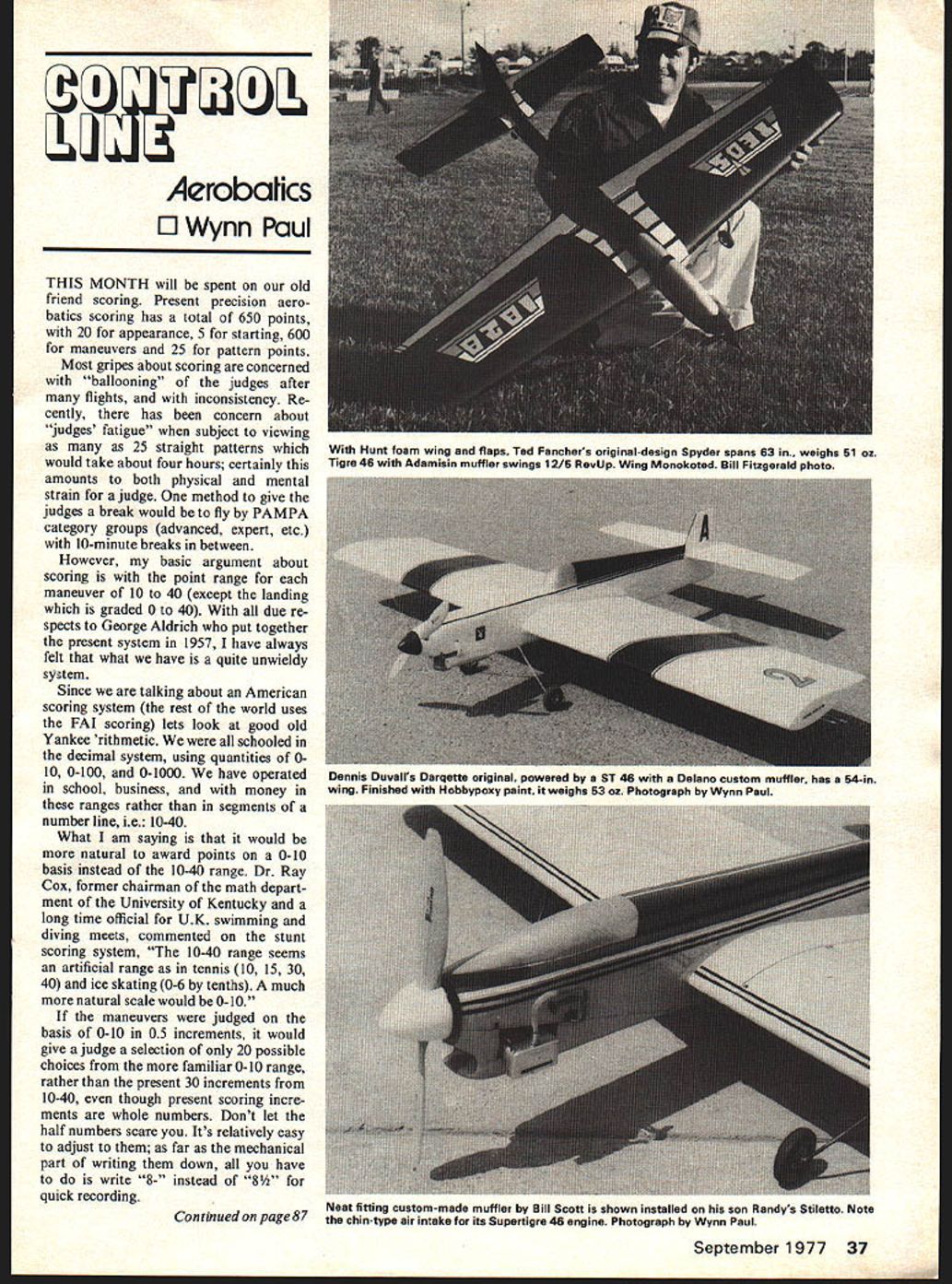
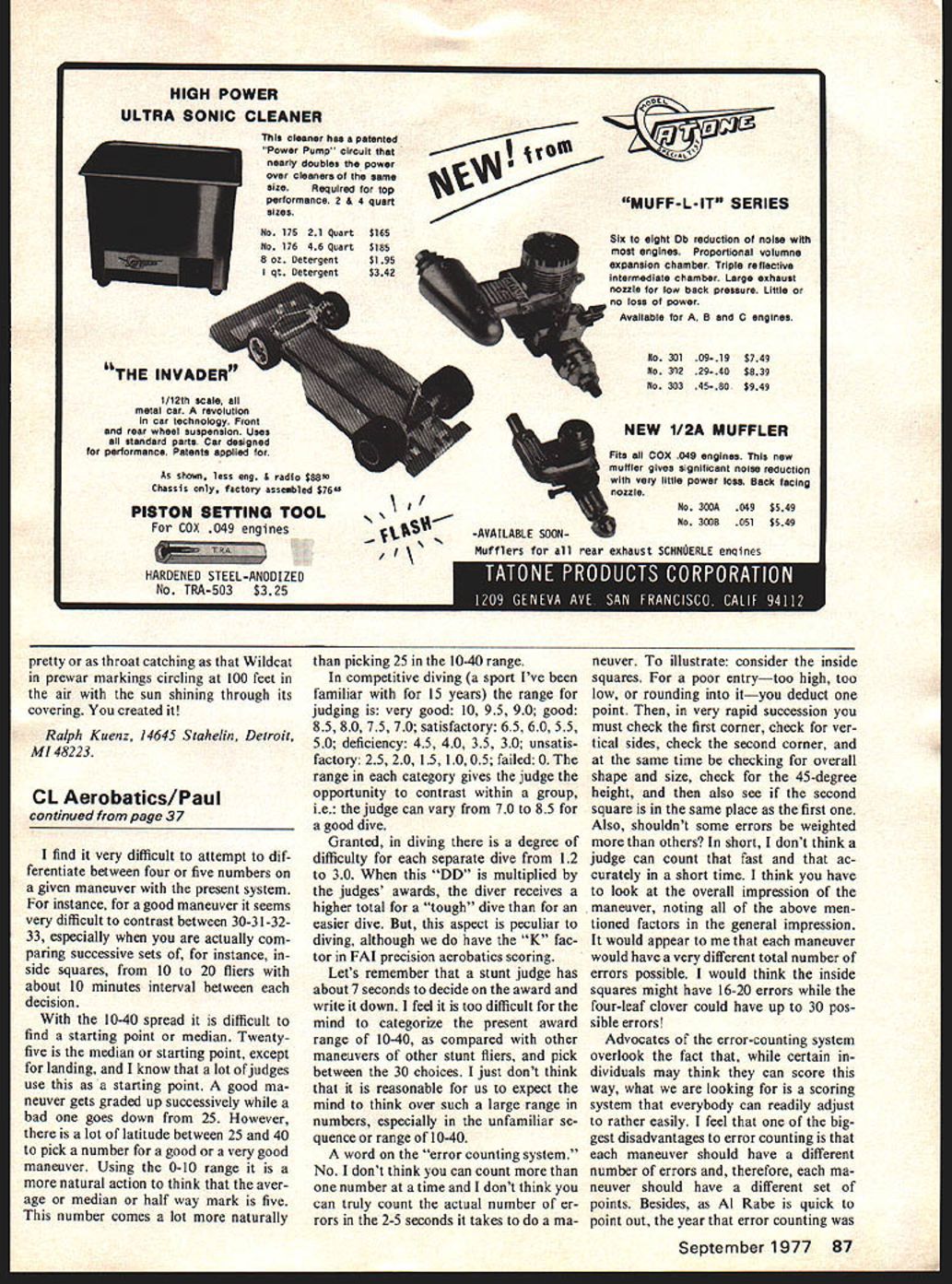
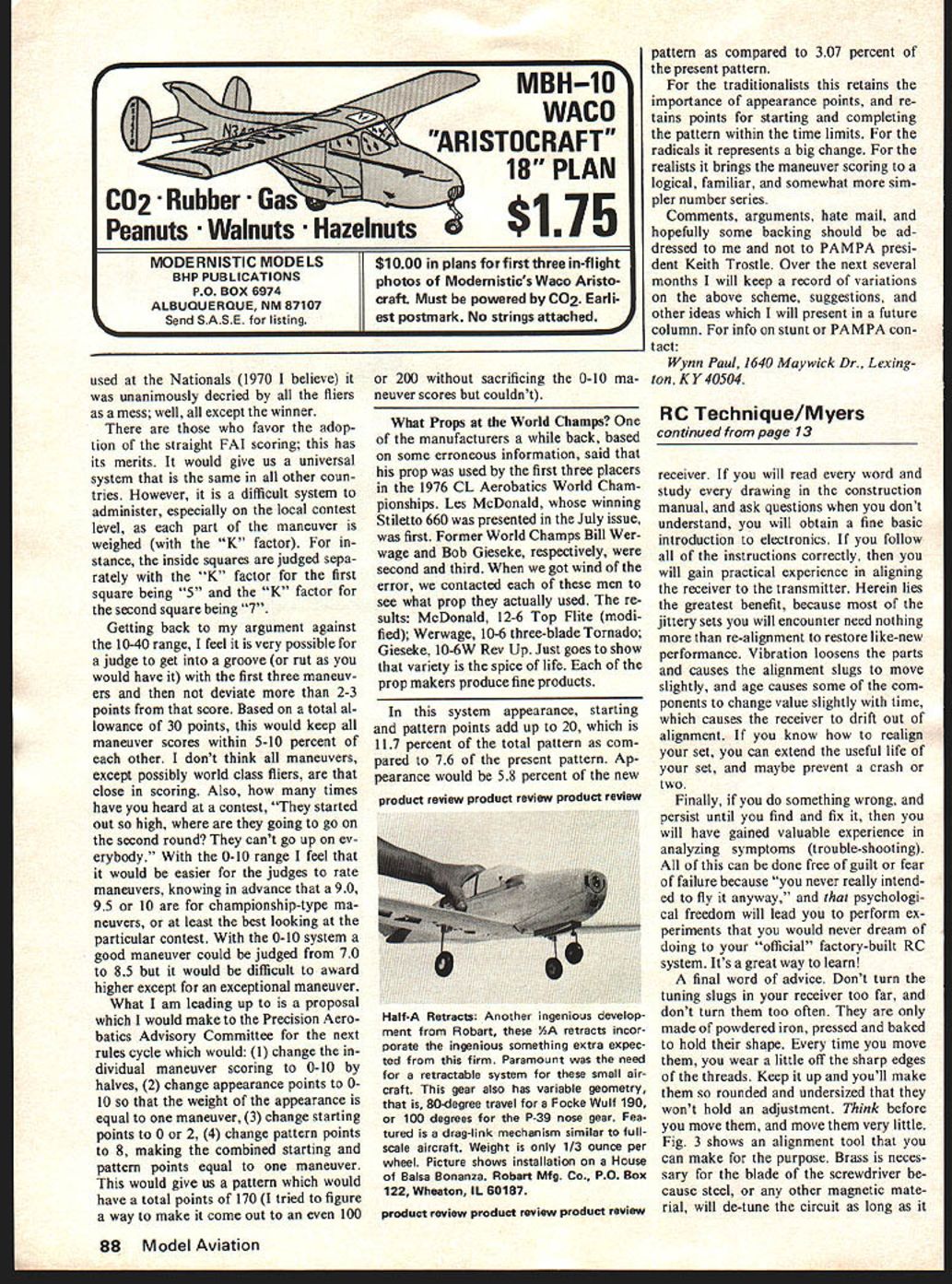
Control Line: Aerobatics
Wynn Paul
THIS MONTH will be spent on our old friend scoring. Present precision aerobatics scoring has a total of 650 points, with 20 for appearance, 5 for starting, 600 for maneuvers and 25 for pattern points.
Most gripes about scoring are concerned with "ballooning" of the judges after many flights, and with inconsistency. Recently, there has been concern about "judges' fatigue" when subject to viewing as many as 25 straight patterns which would take about four hours; certainly this amounts to both physical and mental strain for a judge. One method to give the judges a break would be to fly by PAMPA category groups (advanced, expert, etc.) with 10-minute breaks in between.
However, my basic argument about scoring is with the point range for each maneuver of 10 to 40 (except the landing which is graded 0 to 40). With all due respects to George Aldrich who put together the present system in 1957, I have always felt that what we have is a quite unwieldy system.
Since we are talking about an American scoring system (the rest of the world uses the FAI scoring) let's look at good old Yankee arithmetic. We were all schooled in the decimal system, using quantities of 0-10, 0-100, and 0-1000. We have operated in school, business, and with money in these ranges rather than in segments of a number line, i.e.: 10-40.
What I am saying is that it would be more natural to award points on a 0-10 basis instead of the 10-40 range. Dr. Ray Cox, former chairman of the math department of the University of Kentucky and a long time official for U.K. swimming and diving meets, commented on the stunt scoring system, "The 10-40 range seems an artificial range as in tennis (10, 15, 30, 40) and ice skating (0-6 by tenths). A much more natural scale would be 0-10."
If the maneuvers were judged on the basis of 0-10 in 0.5 increments, it would give a judge a selection of only 20 possible choices from the more familiar 0-10 range, rather than the present 30 increments from 10-40, even though present scoring increments are whole numbers. Don't let the half numbers scare you. It's relatively easy to adjust to them; as far as the mechanical part of writing them down, all you have to do is write "8-" instead of "8½" for quick recording. I find it very difficult to attempt to differentiate between four or five numbers on a given maneuver with the present system. For instance, for a good maneuver it seems very difficult to contrast between 30-31-32-33, especially when you are actually comparing successive sets of, for instance, inside squares, from 10 to 20 fliers with about 10 minutes interval between each decision.
With the 10-40 spread it is difficult to find a starting point or median. Twenty-five is the median or starting point, except for landing, and I know that a lot of judges use this as a starting point. A good maneuver gets graded up successively while a bad one goes down from 25. However, there is a lot of latitude between 25 and 40 to pick a number for a good or a very good maneuver. Using the 0-10 range it is a more natural action to think that the average or median or half way mark is five. This number comes a lot more naturally than picking 25 in the 10-40 range.
In competitive diving (a sport I've been familiar with for 15 years) the range for judging is: very good: 10, 9.5, 9.0; good: 8.5, 8.0, 7.5, 7.0; satisfactory: 6.5, 6.0, 5.5, 5.0; deficiency: 4.5, 4.0, 3.5, 3.0; unsatisfactory: 2.5, 2.0, 1.5, 1.0; failed: 0. The range in each category gives the judge the opportunity to contrast within a group, i.e., the judge can vary from 7.0 to 8.5 for a good dive.
Granted, in diving there is a degree of difficulty for each separate dive from 1.2 to 3.0. When this "DD" is multiplied by the judges' awards, the diver receives a higher total for a "tough" dive than for an easier dive. But, this aspect is peculiar to diving, although we do have the "K" factor in FAI precision aerobatics scoring.
Let's remember that a stunt judge has about 7 seconds to decide on the award and write it down. I feel it is too difficult for the mind to categorize the present award range of 10-40, as compared with other maneuvers of other stunt fliers, and pick between the 30 choices. I just don't think that it is reasonable for us to expect the mind to think over such a large range in numbers, especially in the unfamiliar sequence or range of 10-40.
A word on the "error counting system." No. I don't think you can count more than one number at a time and I don't think you can truly count the actual number of errors in the 2-5 seconds it takes to do a maneuver. To illustrate: consider the inside squares. For a poor entry—too high, too low, or rounding into it—you deduct one point. Then, in very rapid succession you must check the first corner, check for vertical sides, check the second corner, and at the same time be checking for overall shape and size, check for the 45-degree height, and then also see if the second square is in the same place as the first one. Also, shouldn't some errors be weighted more than others? In short, I don't think a judge can count that fast and that accurately in a short time. I think you have to look at the overall impression of the maneuver, noting all of the above mentioned factors in the general impression.
It would appear to me that each maneuver would have a very different total number of errors possible. I would think the inside squares might have 16-20 errors while the four-leaf clover could have up to 30 possible errors.
Advocates of the error-counting system overlook the fact that, while certain individuals may think they can score this way, what we are looking for is a scoring system that everybody can readily adjust to rather easily. I feel that one of the biggest disadvantages to error counting is that each maneuver should have a different number of errors, and therefore, each maneuver should have a different set of points. Besides, as Al Rabe is quick to point out, the year that error counting was used at the Nationals (1970 I believe) it was unanimously decried by all the fliers as a mess; well, all except the winner.
There are those who favor the adoption of the straight FAI scoring; this has its merits. It would give us a universal system that is the same in all other countries. However, it is a difficult system to administer, especially on the local contest level, as each part of the maneuver is weighed (with the "K" factor). For instance, the inside squares are judged separately with the "K" factor for the first square being "5" and the "K" factor for the second square being "7".
Getting back to my argument against the 10-40 range, I feel it is very possible for a judge to get into a groove (or rut as you would have it) with the first three maneuvers and then not deviate more than 2-3 points from that score. Based on a total allowance of 30 points, this would keep all maneuver scores within 5-10 percent of each other. I don't think all maneuvers, except possibly world class fliers, are that close in scoring. Also, how many times have you heard at a contest, "They started out so high, where are they going to go on the second round? They can't go up on everybody." With the 0-10 range I feel that it would be easier for the judges to rate maneuvers, knowing in advance that a 9.0, 9.5 or 10 are for championship-type maneuvers, or at least the best looking at the particular contest. With the 0-10 system a good maneuver could be judged from 7.0 to 8.5 but it would be difficult to award higher except for an exceptional maneuver.
What I am leading up to is a proposal which I would make to the Precision Aerobatics Advisory Committee for the next rules cycle which would: (1) change the individual maneuver scoring to 0-10 by halves, (2) change appearance points to 0-10 so that the weight of the appearance is equal to one maneuver, (3) change starting points to 0 or 2, (4) change pattern points to 8, making the combined starting and pattern points equal to one maneuver. This would give us a pattern which would have a total points of 170 (I tried to figure a way to make it come out to an even 100 or 200 without sacrificing the 0-10 maneuver scores but couldn't).
What Props at the World Champs? One of the manufacturers a while back, based on some erroneous information, said that his prop was used by the first three placers in the 1976 CL Aerobatics World Championships. Les McDonald, whose winning Stiletto 660 was presented in the July issue, was first. Former World Champs Bill Werwage and Bob Gieseke, respectively, were second and third. When we got wind of the error, we contacted each of these men to see what prop they actually used. The results: McDonald, 12-6 Top Flite (modified); Werwage, 10-6 three-blade Tornado; Gieseke, 10-6 W Rev Up. Just goes to show that variety is the spice of life. Each of the prop makers produce fine products.
In this system appearance, starting and pattern points add up to 20, which is 11.7 percent of the total pattern as compared to 7.6 of the present pattern. Appearance would be 5.8 percent of the new pattern as compared to 3.07 percent of the present pattern.
For the traditionalists this retains the importance of appearance points, and retains points for starting and completing the pattern within the time limits. For the radicals it represents a big change. For the realists it brings the maneuver scoring to a logical, familiar, and somewhat more simpler number series.
Comments, arguments, hate mail, and hopefully some backing should be addressed to me and not to PAMPA president Keith Trostle. Over the next several months I will keep a record of variations on the above scheme, suggestions, and other ideas which I will present in a future column. For info on stunt or PAMPA contact:
Wynn Paul, 1640 Maywick Dr., Lexington, KY 40504.
Transcribed from original scans by AI. Minor OCR errors may remain.

