
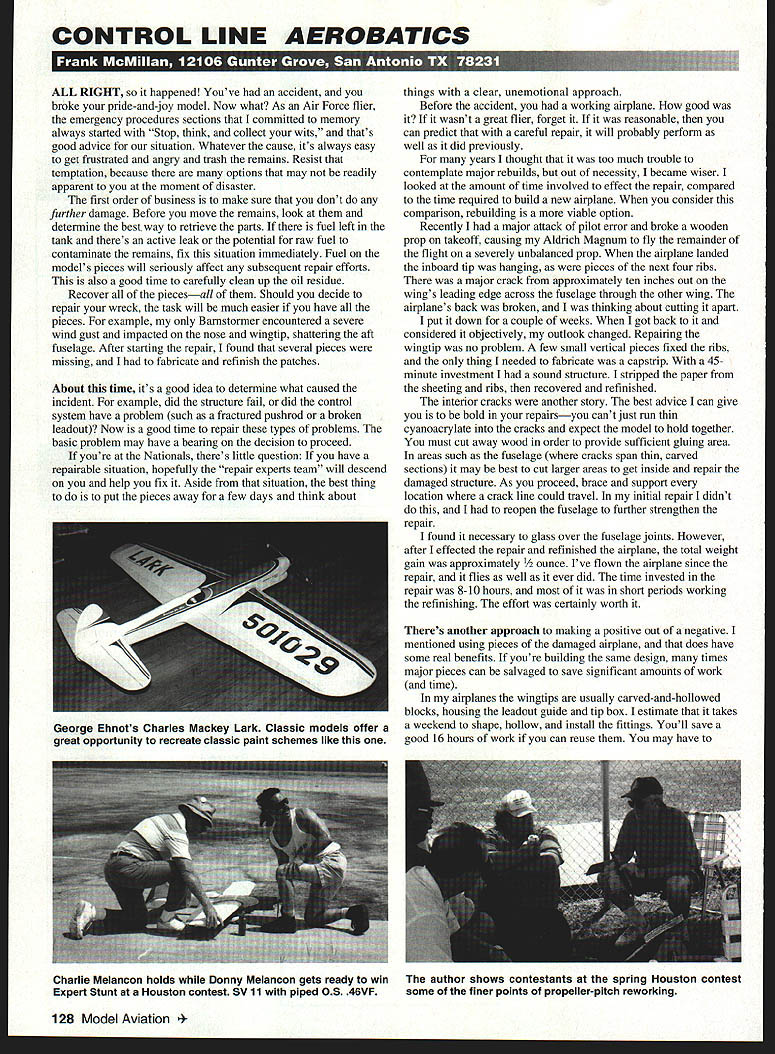
CONTROL LINE AEROBATICS
Frank McMillan 12106 Gunter Grove, San Antonio TX 78231
After the crash — first steps
All right — so it happened: you had an accident and broke your pride-and-joy model. As an Air Force flier, the emergency-procedure phrase I committed to memory was "Stop — think — collect your wits," and that's still good advice here. Whatever the cause, it's easy to get frustrated, angry, and want to trash the remains. Resist that temptation: there are often repair or salvage options that aren't obvious at first.
Do not do anything that might cause further damage. Before you move the remains, look them over and determine the best way to retrieve parts. Ask these questions:
- Is there fuel left in the tank?
- Is there an active leak, or the potential for raw fuel to contaminate parts?
- Is there oil residue to clean up?
Fix any fuel leaks immediately — fuel and oil on parts will seriously affect later repair work. Recover all pieces; repairs are much easier if you have every fragment.
Diagnose the cause
Once everything is secured, determine what caused the incident. For example:
- Did structure fail?
- Did the control system have a problem (fractured pushrod, broken leadout, etc.)?
Repair obvious control or structural faults before proceeding. The basic cause may influence whether you should repair the airplane at all. If you're at a big event such as the Nationals and you have a repairable situation, a repair team or experienced fliers will often help. Otherwise, put the pieces away for a few days and reassess them with a clear, unemotional approach.
Decide whether to repair or rebuild
Before the accident, how good was the airplane? If it wasn't a great flier, don't bother. If it was reasonable, a careful repair will probably restore its previous performance.
For years I thought major rebuilds were too much trouble, but necessity taught me otherwise. Compare the time required to repair versus the time to build a new airplane. Often rebuilding is a viable — and worthwhile — option.
Repair techniques and practical advice
I once had a major pilot error: a wooden prop broke on takeoff and the airplane flew the rest of the flight on a severely unbalanced prop. On landing the inboard wingtip was hanging and the next four ribs were in pieces. There was a major crack about ten inches out on the wing leading edge across the fuselage and into the other wing. I thought about cutting it apart, then set it aside for a couple of weeks. When I returned with an objective outlook the repair looked much more feasible.
Some specific points from that repair:
- Small vertical pieces can often fix damaged ribs; fabricating a new capstrip may be all that's needed to restore structure. A 45-minute investment can yield a sound wingtip structure.
- Strip the covering and inspect ribs and sheeting before repairing and recovering.
- Be bold with interior repairs: you can't rely on thin cyanoacrylate run into cracks and expect a durable repair. Cut away wood to provide sufficient gluing area and access for reinforcement.
- In fuselage areas where cracks span thin carved sections, cut larger access openings to repair the internal structure properly.
- Brace and support every location where a crack line could travel; failure to do so can require reopening repairs later.
- Consider glassing (fiberglass) over fuselage joints for added strength. In my repair that added only about 1/2 ounce and the airplane flew as well as ever.
- Expect the repair time to include refinishing; my complete repair took about 8–10 hours, mostly in short sessions.
Salvaging parts — save time and effort
Making a positive out of a negative: salvage usable pieces from the damaged airplane to save time when building the same design.
Common salvage candidates:
- Wingtips (often carved-and-hollowed blocks that house the leadout guide and tip box) — shaping and fitting these can take a weekend, so reusing them can save ~16 hours.
- Flaps — critical components that can require 6–8 hours to set up properly.
- Stabilizer/elevators and control-system components.
You may need to make small adjustments (spreading or compressing shapes) to integrate salvaged parts. Adding up the saved hours often approaches half the time required to build a new airplane from scratch. I recently saw Bob Gieseke salvage these pieces for his Bear and integrate them into a competitive, stylish airplane.
NEW ITEMS
Stunt flier video magazine — Robin's View Productions
A few columns ago I mentioned the forthcoming Stunt flier video magazine from Bob Hunt's Robin's View Productions. Bob has strong credentials as both a flier and an editor (many years at Flying Models), and he is a past world and Nationals champion and Hall of Fame member. The first issue of the quarterly Stunt Magazine has just been released, and it's excellent.
Highlights of the first issue:
- A "talk show" interview with Bill Werwage, covering the evolution of the Geo XL series, the heritage from the world-champion USA 1, and the latest version flown from inside the circle over his shoulder. Discussions include adjustable features, prop selection, and lightweight finishing techniques.
- Dan Winship demonstrates molding carbon-composite control-system accessories, from mold design to finished parts. He also shows how he installs cable in bellcranks using annealed brass tubing to prevent the cable from sawing through the bellcrank. His horns are shown in the Werwage segment.
- A tour of the Brodak facilities. Brodak has long supported control-line flying; the video shows kits produced in-house, the mail/telephone order setup, and a four-circle test facility. (Contact Brodak at 100 Park Ave., Carmichaels, PA 15320; Tel.: (412) 966-2726.)
- A technical presentation on engine timing by Dean Pappas. He shows how to construct a degree wheel, install it on an engine, read timing with a pointer system, and how to adjust timing for desired characteristics. A degree-wheel chart is included as a first-issue bonus.
This is a true video magazine, available quarterly by subscription. Rates:
- Annual subscription: $79.50
- Individual tapes: $24.95
Contact Robin's View Productions at 205 E. Center St., Box 68, Stockertown, PA 18083; Tel.: (610) 746-0106.
This is a high-quality product that will be a "must see" for precision aerobatics fliers and of broad interest to modelers generally. It makes a great gift; I recommend it highly. My subscription is in the mail.
Transcribed from original scans by AI. Minor OCR errors may remain.

