
CONTROL LINE AEROBATICS
Author
Frank McMillan, 12106 Gunter Grove, San Antonio TX 78231
When you arrive at the Nationals, you never know what "character" the week will take on. Sometimes it's a dominant flier, the weather, the site, or all three. This time we had absolutely wonderful, mild weather. It was a marvelous setting, and I would have to say that this was really a "social" Nationals. Perhaps it's because I remember the old days, but to see and chat with many of the top competitors from the '50s and '60s was a trip down memory lane.
Perhaps it was the central location; maybe it was just time to be part of this event again. Stories of the old days abounded from:
- Jim Silhavy
- Les McDonald
- Rolland McDonald
- Bob Gialdini
- George Aldrich
- Dave Hemstraught
- Stan Powell
- John Davis
- Keith Trostle
- Charlie Reeves
- Gary Phelps
- Bob Gieseke
- Bill Werwage
It was a different era, long gone, but friendships forged in competition really have stood the test of time.
Wynn Paul's documentation of control line precision aerobatics history was available in the pavilion area through the week, and it took many of us back to our youth. Thanks again, Wynn, for your extraordinary efforts on this project.
Along with the exhibition flying Saturday and Sunday, the busy competition schedule preempted significant practice flying early in the week. Many fliers were experiencing some difficulty finding drive in the lighter air of the Muncie site. Also, when the wind came up over the pavilion, the "top of a rise" positioning of the circles caused unusual swirling air downwind where everyone was forced to place their maneuvers. This condition jumped up and devoured many of the top competitors as the competition progressed through the week.
In trying to find "the" combination, most fliers first went to a little less pitch and slightly more rpm. More often this just wasn't enough, so the next step was a three-blade carbon prop with a similar pitch profile to get blade area and provide punch in the upper parts, verticals, etc.
Another unusual phenomenon showed up: piped models on cool mornings (55–65°F) manifested starting rpm much lower than normal — as much as 600–700 rpm. RPM slowly returned to normal as the systems' operating temperatures stabilized. Quite a few really fast flights occurred before competitors picked up the cure. The remedy seemed a combination of finding a good setting and sticking with it, with a slight lengthening of the pipe. Blocking the tank vent to increase rpm and heat up the system also helped. After a couple of days everyone seemed to settle and the serious competition process began.
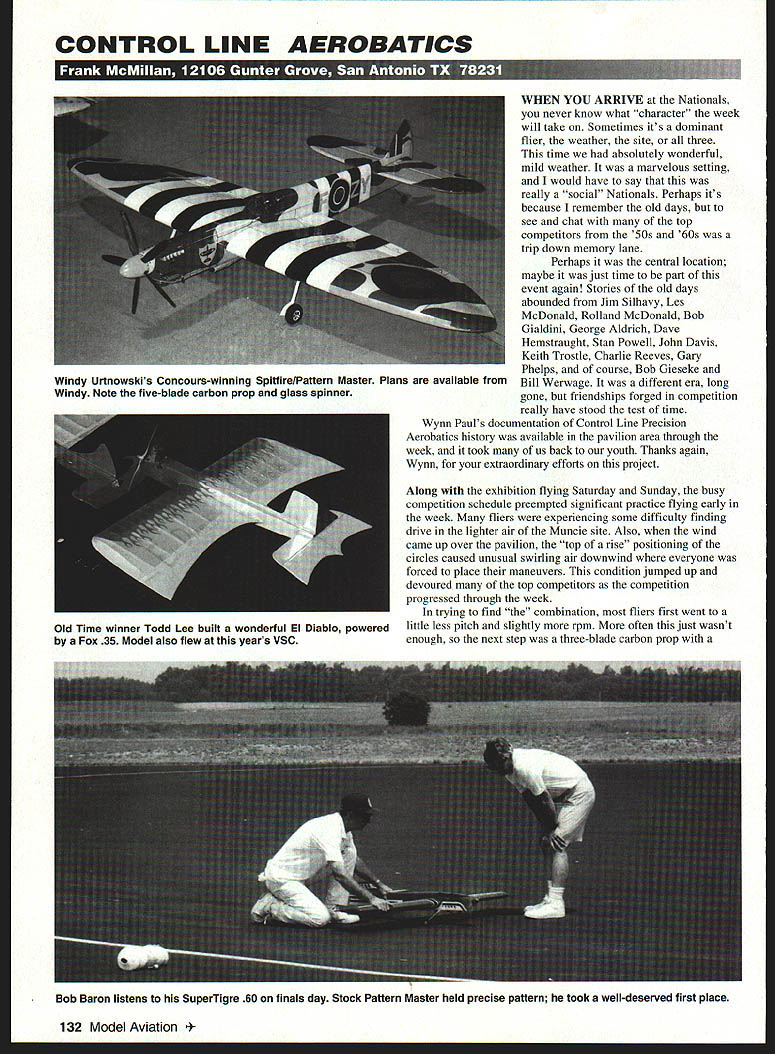
Appearance judging Tuesday was handled by former world/nationals champion Les McDonald, who performed the difficult task. Nearly 80 entries were presented for judging craftsmanship and finish. Team-built Spitfires by Joe Adamusko and Windy Urtnowski were clearly superior and spectacular, deserving high placing. Windy's example was subsequently selected Concours winner — a well-deserved choice.
As competition predictions aren't always realized in the results, during Expert qualification rounds Wednesday and Thursday several usual Top 20 qualifiers fell to various difficulties. Frank Williams succumbed to a series of power-plant problems and withdrew. Randy Smith had a subtle solder leak at the tank filler vent which manifested as short runs, lean runs, overruns, and eventually an underrun — an incomplete official flight that left him barely out of the Top 20. A real highlight of this unusual Nationals was after high qualifying flights when FAI team member Bob Hunt's airplane crashed due to an internal control failure; he chose to fly his backup airplane in the Top 20 round.
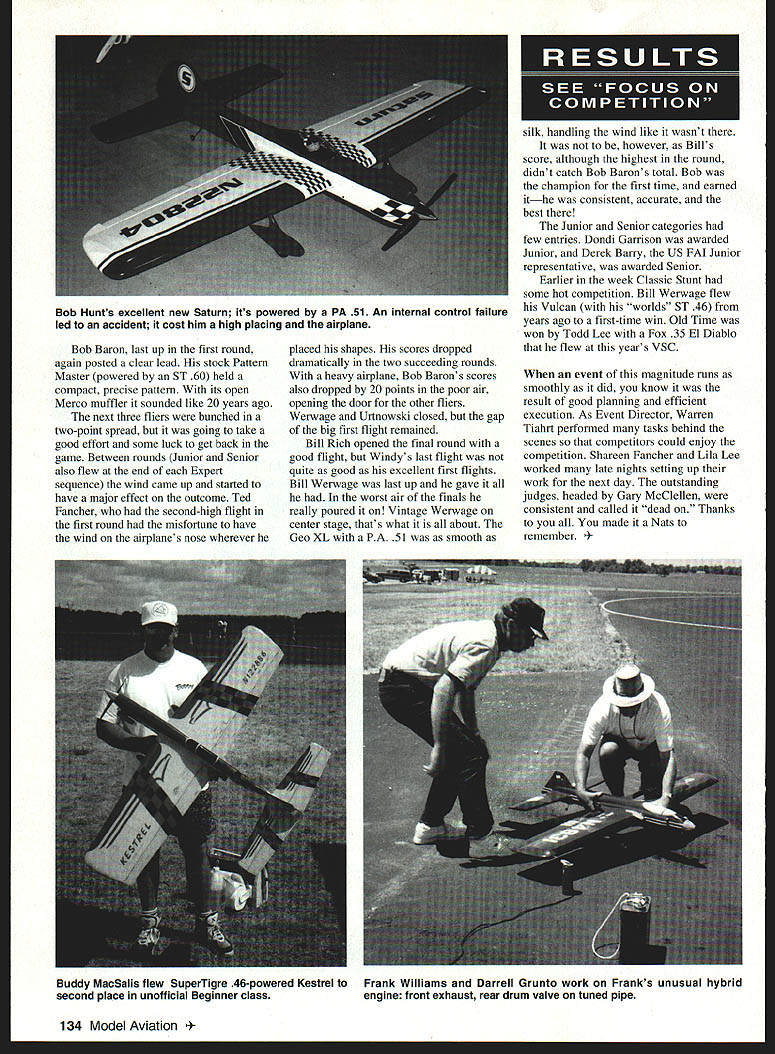
Without a throwaway flight, the Top 20 day was the toughest to get through this year based on previous scores. Bob Baron was really hot in the early rounds, especially in good air. As the first round concluded everyone carefully watched the scores. Warren Tiahrt posted a score that depended on whether he could deliver his last flight. Eight fliers shot final five scores that were finally posted, and several fliers who had been on the bubble saw their hopes fade in a closely contested event.
Final placements in the middle of the field included:
- Bob Whitely — ninth
- Bob Gieseke — eighth
- Wynn Paul — seventh
- Frank McMillan — sixth, besting Bill Rich by 2 points
The total spread of six points (1,040 points) separated positions five through eight and set the stage for the Walker Cup.
It was not to be, however, as Bill's score, although the highest in the round, didn't catch Bob Baron's total. Bob was the champion for the first time, and earned it — he was consistent, accurate, and the best there!
The Junior and Senior categories had few entries. Dondi Garrison was awarded Junior, and Derek Barry, the US FAI Junior representative, was awarded Senior.
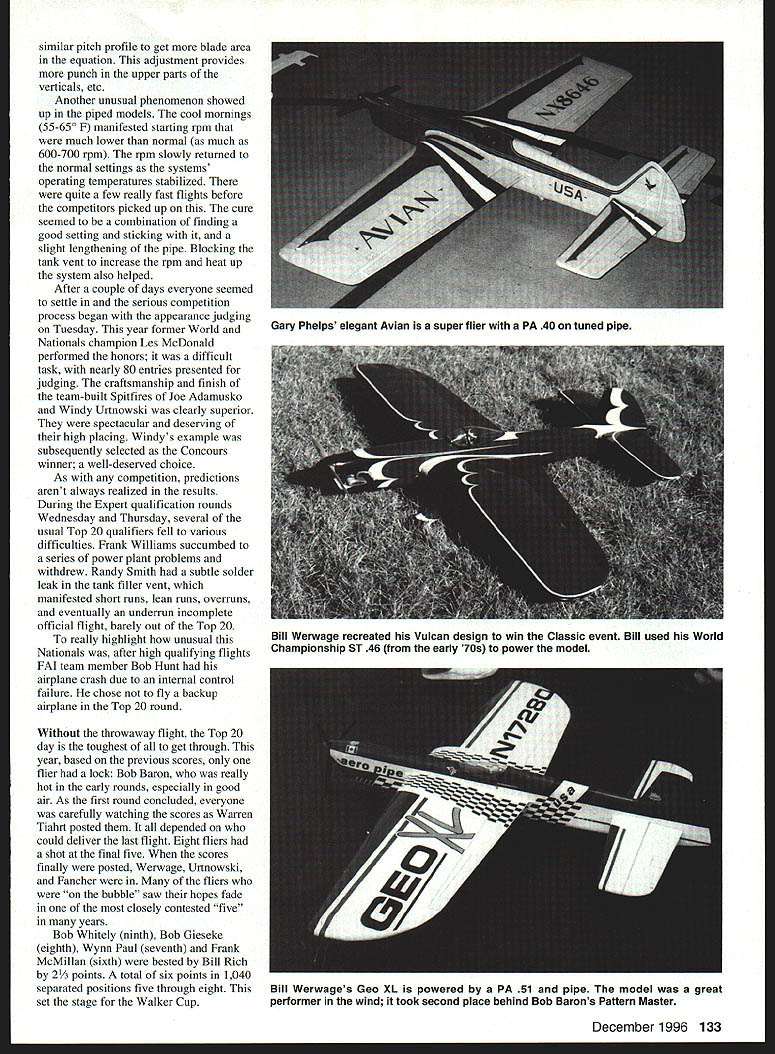
Earlier in the week Classic Stunt had some hot competition. Bill Werwage flew his Vulcan (with his "worlds" ST .46) from years ago to a first-time win. Old Time was won by Todd Lee with a Fox .35 El Diablo that he flew at this year's VSC.
When an event of this magnitude runs as smoothly as it did, you know it was the result of good planning and efficient execution. As Event Director, Warren Tiahrt performed many tasks behind the scenes so that competitors could enjoy the competition. Sharen Fancher and Lila Lee worked many late nights setting up their work for the next day. The outstanding judges, headed by Gary McClellen, were consistent and called it "dead on."
Thanks to you all. You made it a Nats to remember.
Transcribed from original scans by AI. Minor OCR errors may remain.

