
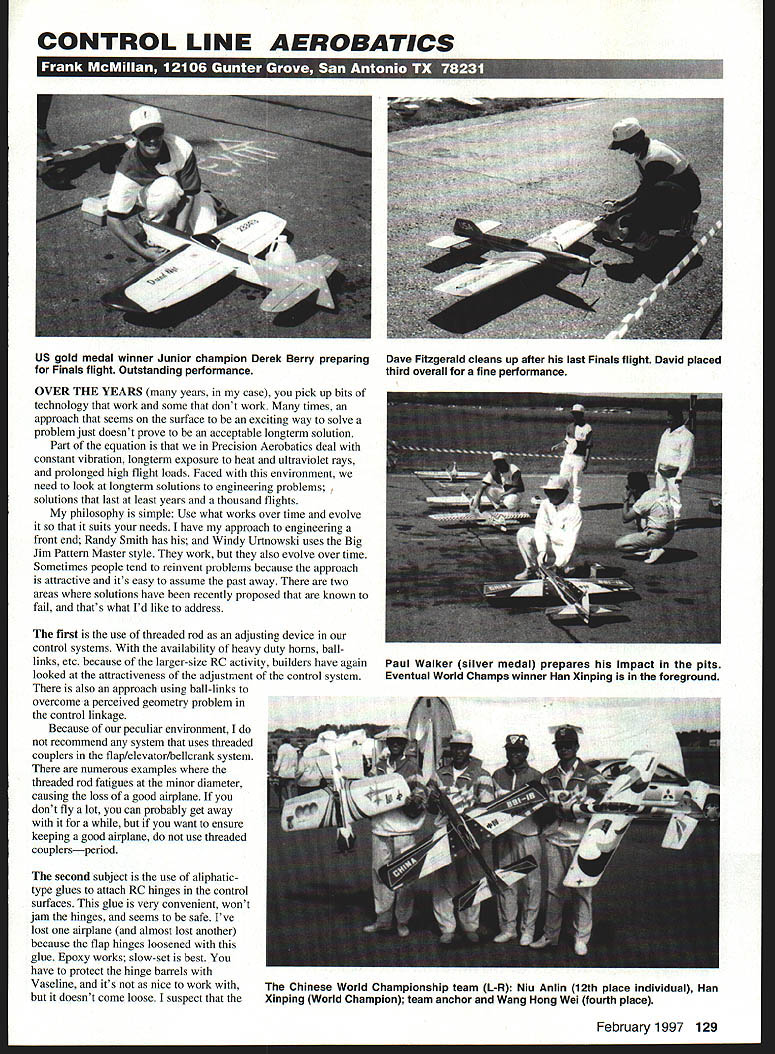
CONTROL LINE AEROBATICS
Frank McMillan
12106 Gunter Grove, San Antonio, TX 78231
Long-term solutions and philosophy
Over the years (many years, in my case) you pick up bits of technology that work and some that don't. Many times an approach that seems on the surface an exciting way to solve a problem just doesn't prove to be an acceptable long-term solution.
Part of the equation is that we in precision aerobatics deal with constant vibration, long-term exposure to heat and ultraviolet rays, and prolonged high flight loads. Faced with this environment, we need to look at long-term solutions to engineering problems — solutions that last at least ten years and a thousand flights.
My philosophy is simple: use what works over time and evolve it so that it suits your needs. I have my approach to engineering a front end; Randy Smith has his; and Windy Urtnowski uses the Big Jim/Pattern Master style. They work, but they also evolve over time. Sometimes people tend to reinvent problems because the approach is attractive and it's easy to assume the past away. There are two areas where solutions have been recently proposed that are known to fail, and that's what I'd like to address.
Two problem areas
- Threaded rod adjusters
The first is the use of threaded rod as an adjusting device in our control systems. With the availability of heavy-duty horns, ball-links, etc., because of larger-size RC activity, builders have again looked at the attractiveness of adjustable control systems. There is also an approach using ball-links to overcome a perceived geometry problem in the control linkage.
Because of our peculiar environment, I do not recommend any system that uses threaded couplers in the flap/elevator/bellcrank system. There are numerous examples where the threaded rod fatigues at the minor diameter, causing the loss of a good airplane. If you don't fly a lot, you can probably get away with it for a while, but if you want to ensure keeping a good airplane, do not use threaded couplers — period.
- Aliphatic-type glues for RC hinge installation
The second subject is the use of aliphatic-type glues to attach RC hinges in control surfaces. This glue is very convenient, won't jam the hinges, and seems to be safe. I've lost one airplane (and almost lost another) because the flap hinges loosened with this glue. Epoxy works; slow-set is best. You have to protect the hinge barrels with Vaseline, and it's not as nice to work with, but it doesn't come loose. I suspect that the aliphatic glue hardens over time after exposure to heat, vibration, etc. Again, these are instances from personal experience.
Engine evaluations
Several months ago I mentioned two new engines under test/evaluation — the PA .61 and the Jett .50. Both are intended for competition using tuned pipes, a similar concept using AAC (aluminum/chrome) cylinder/piston design based on .40-size origins. The concept is to pack as much displacement into the smallest size that will work for precision aerobatics applications because engines are highly stressed racing units that want controlled power in the lightest package.
Both were flown in known airplanes and equipment. A big advantage to this is it provides a working environment to evaluate specific engine performance under actual competition-like conditions. Models were flown in varying conditions including exceptionally good air and moderate-to-severe turbulence. Pipe/prop combinations used give a good comparison with what I've been flying.
- PA .61
The PA .61 is exactly what I hoped — powerful. I flew the .61 in two airplanes: an SV-12 XL and a Number 3 Caudron. The Caudron is the real challenge — 780 square inches and 62 ounces — and flew very well. As might be expected, the additional displacement showed up when turning a three-blade prop and in other loading conditions. The airplane just went precisely where pointed, held lines and maneuvers, and cornered with a smooth, steady feel. Once you have the combination, it changes your outlook: raw power, smoothness, and exceptionally steady speed up, down and sideways — it just stays on its track and drives. Those package characteristics are what I discussed and the impressions formed: the airplane was very good and the engine gave a friendly feel with unsurpassed pure bolt-on power.
What about ST-60 copies and how they stack up? I have extensive experience with the ST-60 small engines. The bottom line is to run what you can make work well. However, my preference on the road of life is the PA .61 until something better comes along — and isn't that an exciting prospect?
Contact for PA .61:
- Randy Smith, Aero Products, 1880 Scenic Hwy., Snellville, GA 30078; Tel.: (770) 979-2035.
(PA .61 placed first and second at the Dallas fall contest — an auspicious start.)
- Jett .50
The next engine I tested was the Jett .50 — also an AAC design, based on a .40-size engine. It is slightly lighter than the PA .61 at 11.1 ounces.
Since this was the prototype, some of the initial flights were devoted to finding the correct head shape, deck height, and venturi shape and orifice area. Even in the early test stages, the engine was docile, linear, and very predictable. The test prop was a 12-1/4 x 3.9 Bolly two-blade, which has become one of the standard .50-size props.
My overall assessment is that this is a very good engine. It is powerful and flat in the midrange like a stunt engine, exhibiting very predictable characteristics in varying conditions. It does not wind up in heavy power and powers through turbulence. Because of excellent tolerances, it is very consistent, flight after flight.
Contact for Jett .50:
- George Aldrich, Aldrich Models, 12822 Tarrytown, San Antonio, TX 78233; Tel.: (210) 656-2021.
Videos and media
- Robin's View Productions (Bob Hunt)
It seems that every month there are new videos being produced by Robin's View Productions. Those who follow precision aerobatics know Bill Werwage and the superb designs he has created over the many years he has been competing. Many know that he still has virtually all of his airplanes at his house. For years I've wanted to visit but never had the opportunity. Now, on tape, Bob visits with Bill and discusses the lineage of many of the world-famous designs, such as the USA-1. This is wonderful, historic entertainment and should be the first of many interviews with famous personalities that will preserve the non-public part of our history. Of great interest are portions of the future Nationals interviews, with Bill showing his new, more scale-like Retract P-47 — wow!
Contact Robin's View Productions: Box 68, Stockton, CA 95208; Tel.: (610) 746-0106.
- Windy Urtnowski construction videos
Another contributor to the expanding video market has certainly been there for many years. Windy Urtnowski's construction videos have long been a source of valuable information and technology to modelers.
This year's production is quite comprehensive — more than 20 tapes dealing with the construction of Windy's award-winning Spitfire. Among the subjects covered during the completion of this project are scale paint schemes, color mixing, tailors' tips, metal finishing, glassing, resin casting, jigging, and all sorts of small hints and tricks that are a master craftsman's dream.
Windy also has superb plans and accessories available for the Spitfire, including five-bladed carbon propellers that worked very well with the Big Jim ST-60 at the Nationals.
Contact Windy Urtnowski: 93 Elliot Pl., Rutherford, NJ 07070; Tel.: (201) 896-8740.
Transcribed from original scans by AI. Minor OCR errors may remain.

