

CONTROL LINE AEROBATICS
Frank McMillan, 12106 Gunter Grove, San Antonio TX 78231
Introduction
There's always discussion about how well individual engines run: "They two-cycle/four-cycle well," "they hold a constant speed," "they run smoothly," etc. But the real question is: did I really communicate what a good stunt run is all about?
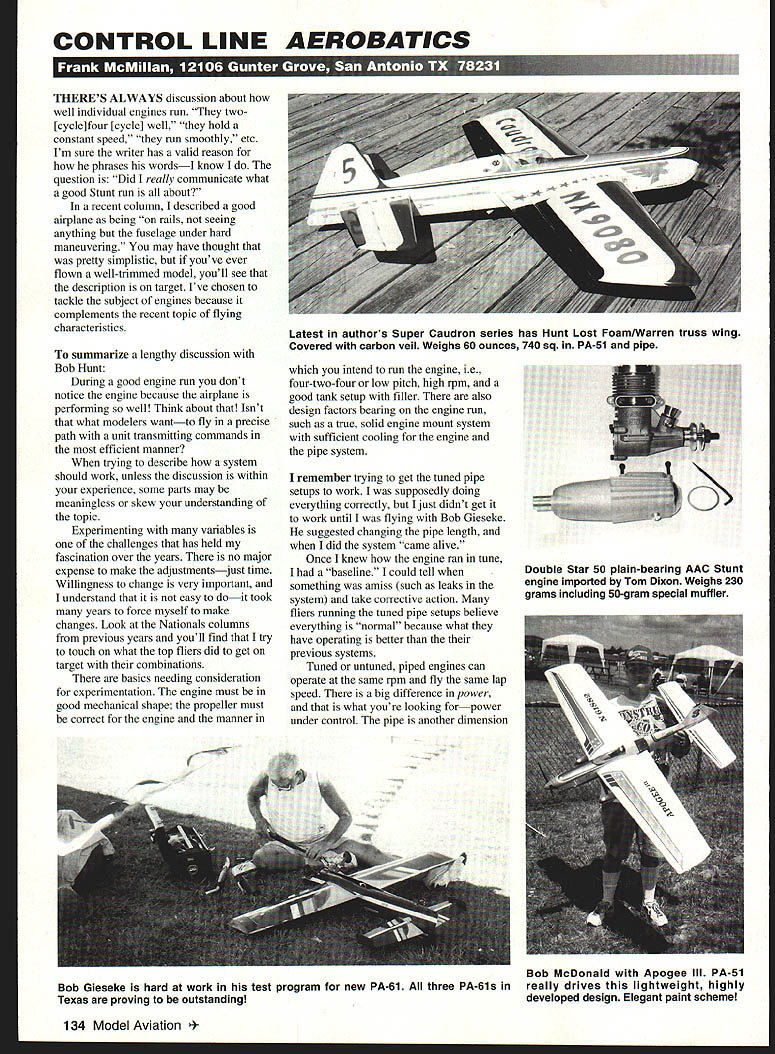
A well-trimmed model that flies "on rails" — where you notice only the fuselage during hard maneuvering — is the ideal. I'm tackling engines because they complement the topic of flying characteristics.
Engines and the "on rails" airplane
During a good engine run you don't notice the engine because the airplane is performing so well. Think about that: modelers want precise flight with a unit transmitting commands in the most efficient manner. When trying to describe how a system should work, parts of the discussion can be meaningless or misleading if they're outside your experience.
Experimenting with many variables is one of the challenges that has held my fascination. It costs little except time. Willingness to change is important — it took me years to force myself to make changes. Review Nationals columns from previous years and you'll see what top fliers did to get their combinations on target.
Baseline and experimentation
After flying with others I learned to establish a "baseline." For example, when Bob Gieseke suggested changing pipe length, the system came alive. Once you know how the engine runs in tune, you can tell when something is amiss (such as leaks) and take corrective action. Many fliers think their tuned pipe systems are normal simply because they're better than what they had before.
Tuned or untuned, piped engines can operate at the same RPM and fly the same lap speed. The big difference is power — power under control. The pipe is another dimension.
Basics to consider
Before experimenting, ensure these basics are correct:
- The engine must be in good mechanical shape.
- The propeller must be correct for the engine and the intended running style (e.g., four-two-four or low pitch, high RPM).
- A good tank setup with a reliable filler is required.
- A true, solid engine mount system and sufficient cooling for the engine and pipe system are important.
Tuned pipes vs. untuned
The addition of a tuned exhaust changes the character of the run and must be matched to the airframe and installation. It complicates the engine run, but once pipe length is set to a primary node, it tends to provide power, control, and a braking effect.
- Too far from a primary node: engine may hit late and hold the break (too long), making precise flying difficult.
- Too short: engine will hit very hard.
- Secondary/tertiary node (long): engine tones softer but is less broad on the needle and more susceptible to falling off tune with temperature swings.
A good visual analysis of pipe behavior is in Frank Williams' column in Stunt News (PAMPA newsletter).
Leaks, couplers and pipe care
Details matter; don't assume anything is correct until you check. Leaks will destroy tuning.
- Periodically check carbon pipes for leaks after long usage.
- Replace silicon couplers after about 200 flights.
- Use tie-wraps on coupler ends with the ends offset.
- Beware of pipes collapsing at the front; this can be caused by concentrated tie-wrap pressure. A reinforced turned-aluminum insert can help.
Header joint seal and flatness
The header joint seal must be perfect. The engine side/header surface is usually machined, but competitors suggest checking header flatness.
- Lap the header on a flat plate with fine wet-or-dry paper and oil.
- Clean the surface with thinner and apply your preferred sealing method.
- Once sealed, don't break or disturb the seal unless necessary.
The classic four-two-four "break"
The classic four-two-four "break" is often credited to the Fox .35, whose low compression/timing produced a noticeable break. Many assumptions are made about where and how this break should occur.
Reasonable characteristics of a four-two-four break:
- In level flight the engine holds solidly in four-cycle.
- You may see a hint of the break at the tops of loops and at quick-break high-drag points.
- In cornering maneuvers there is a quick break at high-drag points.
- It's necessary to get into two-cycle quickly as drag is sensed, and out just as quickly when the extra power is no longer needed.
The key is extra power essentially on demand. If it occurs properly it greatly improves flight performance. Many interrelated factors are affected by the particular airplane and engine installation.
Tank and fuel system
The first focus should be the tank. Though it's been fashionable to offset the run with the inverted slightly faster (say 0.05 sec.), I prefer the upright/inverted run even. This is especially important with pipe setups.
- I prefer a uniflow tank design.
- I usually run unpressurized on pipe airplanes and muffler-pressurized on non-pipe airplanes.
- Try both pressurized and unpressurized — strange things can happen. An engine/tank/muffler/prop can run beautifully on the bench but fail in a particular airframe.
- Moving the tank up or down adjusts engine speed; moving it side-to-side also has an effect. Tank fore-and-aft location affects the break: the further back the tank is from the engine, the slower the break and the longer it is sustained.
Venturi, compression and other adjustments
There are several ways to affect how quickly the engine breaks:
- Venturi length: A short venturi encourages a quicker break; a long venturi tends to break more slowly and hold it longer.
- Venturi diameter: Opening the venturi gives more power, but if opened too far the engine may break hard and not return to four-cycle. Reducing diameter softens power and lengthens the run up to a point; at the edge the run can become abnormally long.
- Compression (head shims): Changes compression and timing, affecting break behavior.
As with every adjustment, there is a range where changes are linear and end points where bad things happen.
Listening, conditions and compromise
Listening to an engine run can be deceiving unless you fly the airplane. You can soften an engine to have wonderful characteristics while severely reducing power. The trick is finding the right compromise between good power and good characteristics — it's all in the model setup.
Engine settings are optimized for particular climatic conditions. Changing location or temperature affects engine power and characteristics. Settings that are wonderful in the cool of the morning can become rich as temperature rises. All settings are a compromise; understanding the factors and their effects lets you make the appropriate changes.
Summary
I've blurred the distinction between tuned pipes and conventionally aspirated engines intentionally. I don't care what you consider best — what's important is making your combination perform correctly and reliably. The key to enjoyment is getting to where the engine essentially disappears and your focus is on the airplane.
Transcribed from original scans by AI. Minor OCR errors may remain.

