
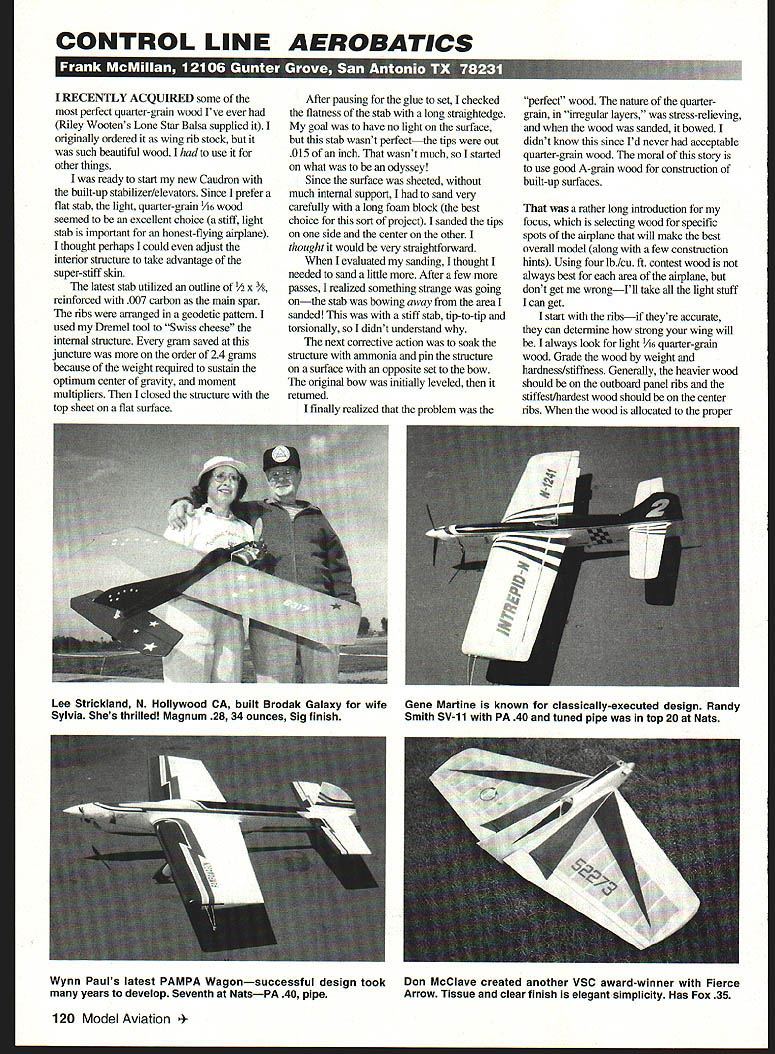
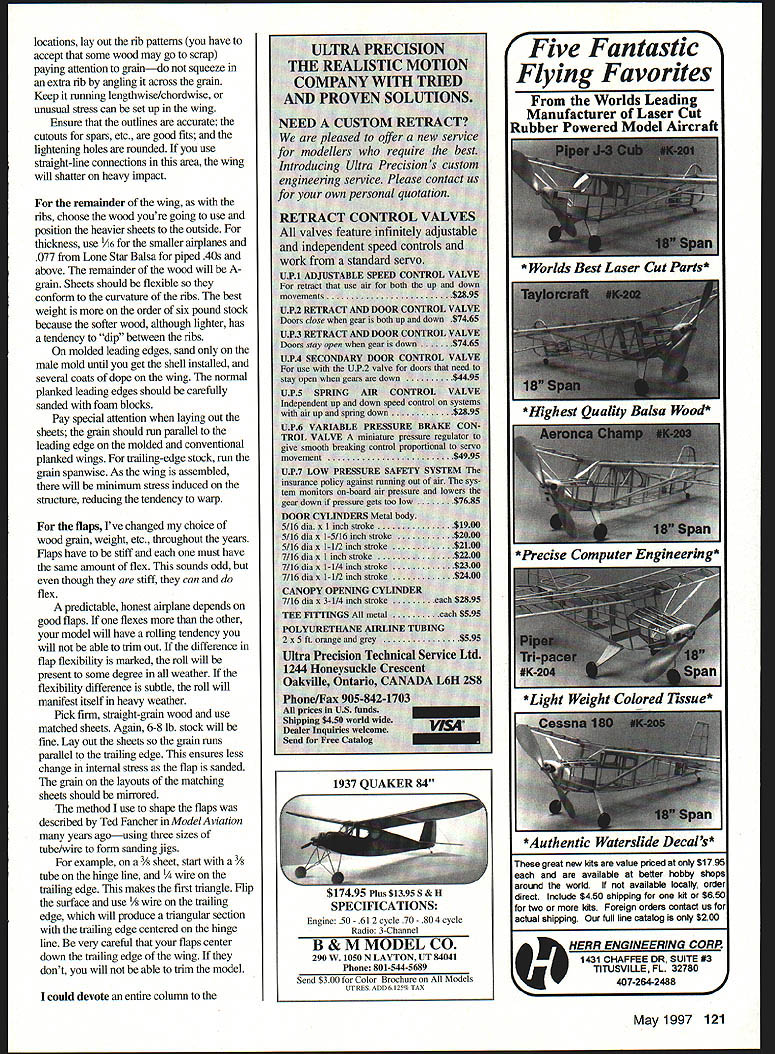
CONTROL LINE AEROBATICS
Frank McMillan, 12106 Gunter Grove, San Antonio TX 78231
Introduction
Recently I acquired some of the most perfect quarter-grain wood I've ever had (Riley Wooten's Lone Star Balsa supplied it). I originally ordered it as wing rib stock, but it was such beautiful wood I had to use it for other things.
I was ready to start my new Caudron with built-up stabilizer/elevators. Since I prefer a flat stab, the light, quarter-grain A6 wood seemed an excellent choice (a stiff, light stab is important for an honest-flying airplane). I thought perhaps I could even adjust the interior structure to take advantage of the super-stiff skin.
Stabilizer construction and problems encountered
The latest stab utilized an outline of 1/2 x 3/8, reinforced with .007 carbon as the main spar. The ribs were arranged in a geodetic pattern. I used my Dremel tool to "Swiss cheese" the internal structure. Every gram saved at this juncture was more on the order of 2.4 grams because of the weight required to sustain the optimum center of gravity and moment multipliers. Then I closed the structure with top sheet on a flat surface.
After pausing for the glue to set, I checked the flatness of the stab with a long straightedge. My goal was to have no light on the surface, but this stab wasn't "perfect" — the tips were out .015 of an inch. That wasn't much, so I started on what was to be an odyssey.
Since the surface was sheeted, without much internal support, I had to sand very carefully with a long foam block (the best choice for this sort of project). I sanded the tips on one side and the center on the other. I thought it would be very straightforward.
When I evaluated my sanding, I thought I needed to sand a little more. After a few more passes, I realized something strange was going on — the stab was bowing away from the area I sanded! This was with a stiff stab, tip-to-tip and torsionally, so I didn't understand why.
The next corrective action was to soak the structure with ammonia and pin the structure on a surface with an opposite set to the bow. The original bow was initially leveled, then it returned.
I finally realized that the problem was the "perfect" wood. The nature of the quarter-grain, in irregular layers, was stress-relieving, and when the wood was sanded, it bowed. I hadn't known this since I'd never had acceptable quarter-grain wood. The moral of this story is to use good A-grain wood for construction of built-up surfaces.
Wood selection philosophy
That was a rather long introduction for my focus, which is selecting wood for specific spots of the airplane that will make the best overall model (along with a few construction hints). Using four lb./cu. ft. contest wood is not always best for each area of the airplane, but — don't get me wrong — I'll take all the light stuff I can get.
I start with the ribs — if they're accurate, they can determine how strong your wing will be. I always look for light 1/16 quarter-grain wood. Grade the wood by weight and hardness/stiffness. Generally:
- Heavier wood should be outboard panel ribs.
- Stiffest/hardest wood should be center ribs.
When the wood is allocated to the proper locations, lay out the rib patterns (accept that some wood may go to scrap), paying attention to grain — do not squeeze in an extra rib by angling it across the grain. Keep it running lengthwise/chordwise or unusual stress can be set up in the wing.
Ensure that the outlines are accurate; the cutouts for spars, etc., are good fits; and the lightening holes are rounded. If you use straight-line connections in this area, the wing will shatter on heavy impact.
Wing sheeting and leading/trailing edges
For the remainder of the wing, as with the ribs, choose the wood you're going to use and position the heavier sheets to the outside. For thickness, use 1/16 for the smaller airplanes and .077 (from Lone Star Balsa) for .40s and above. The remainder of the wood will be A-grain. Sheets should be flexible so they conform to the curvature of the ribs. The best weight is more on the order of six-pound stock because the softer wood, although lighter, has a tendency to "dip" between the ribs.
On molded leading edges, sand only on the male mold until you get the shell installed, and several coats of dope on the wing. Normal planked leading edges should be carefully sanded with foam blocks.
Pay special attention when laying out the sheets; the grain should run parallel to the leading edge on molded and conventional planked wings. For trailing-edge stock, run the grain spanwise. As the wing is assembled, there will be minimum stress induced on the structure, reducing the tendency to warp.
Flaps — selection and shaping
For the flaps, I've changed my choice of wood, grain, weight, etc., throughout the years. Flaps have to be stiff and each one must have the same amount of flex. This sounds odd, but even though they are stiff, they can and do flex.
A predictable, honest airplane depends on good flaps. If one flexes more than the other, your model will have a rolling tendency you will not be able to trim out. If the difference in flap flexibility is marked, the roll will be present to some degree in all weather. If the flexibility difference is subtle, the roll will manifest itself in heavy weather.
Recommendations:
- Pick firm, straight-grain wood and use matched sheets. 6–8 lb. stock will be fine.
- Lay out the sheets so the grain runs parallel to the trailing edge. This ensures less change in internal stress as the flap is sanded.
- The grain on the layouts of the matching sheets should be mirrored.
The method I use to shape the flaps was described by Ted Fancher in Model Aviation many years ago — using three sizes of tube/wire to form sanding jigs. For example, on a 3/8" sheet:
- Start with a 3/8" tube on the hinge line, and 1/4" wire on the trailing edge to make the first triangle.
- Flip the surface and use 1/8" wire on the trailing edge, which will produce a triangular section with the trailing edge centered on the hinge line.
Be very careful that your flaps center down the trailing edge of the wing. If they don't, you will not be able to trim the model.
Fuselage construction
I could devote an entire column to the fuselage sides and building a stiff fuselage, but it would still only cover a few approaches. As with each part of the airplane, the fuselage should be true, light, and stiff.
For built-up fuselages, 1/8" sheet has served well for many years. Unless you're going to build a 3.5-size aircraft, you will need sheets longer than the standard 36 inches and wider than the standard 3 inches. However, with the use of modern adhesives, satisfactory sizes can be made with careful splicing. Rather than quarter-grain wood, I usually look for 4–5 lb./cu. ft. A-grain that is flat and straight.
Accuracy is critical; never assume that a straight edge will remain straight after you cut it. Cut each long edge with a straightedge to relieve stress, then lay out the sides — matching sheets are ideal, as with the flaps. Before you do the layout, check the weight of the blanks end-to-end and put the heavy end to the front.
Double-check the dimensions of the wood. I've had really good wood that was just short or not wide enough, and I concluded that a little splicing in the right spot was acceptable. My length adjustment is always in the front, right on the plywood doubler. This is essentially a filler area, heavily contoured and reinforced with glass or carbon. The good wood is out by itself serving a more useful purpose.
Fuselage stiffness and reinforcement
I've seen various approaches to stiffen the fuselage from the rear of the wing back. The external "ladder" approach certainly made a rigid structure. There was also genius positioning of the formers, and significantly increasing the number of formers. These are effective, but they increase the parts count and weight.
After contemplating the construction of the Aldrich Magnum (which is built much like a Free Flight model), I concluded that a very rigid, light structure can be achieved by paying attention to certain details. The key is in the former. Connect them from the top of the fuselage to the bottom, providing a torsionally stable section. Where a crutch is used, be sure to place the formers in the upper and lower fuselage shells (molded or blocks) directly connected to the crutch. This is critical.
Years ago, I thought that if the cross-section in the rear was increased, the stiffness would also increase. It did, but only to a point. One inch at the stabilizer leading edge is a practical limit where the increase of stiffness is not proportional to the increase of weight.
A marked strength increase can be obtained by reinforcing the structure at the stabilizer leading edge; I establish a box section in that area. I use an area doubler of 1/8" plywood, with many lightening holes, that runs the chord of the stab and elevators on the sides. There is a triangular former at the stab leading edge and just ahead of the elevator trailing edge. The mounting plate (1/16" plywood) for the tail wheel locks into the above pieces, forming a rigid box.
Conclusion and next column
In the next column, I'll continue with construction techniques and look at how to build light structure.
Transcribed from original scans by AI. Minor OCR errors may remain.

