
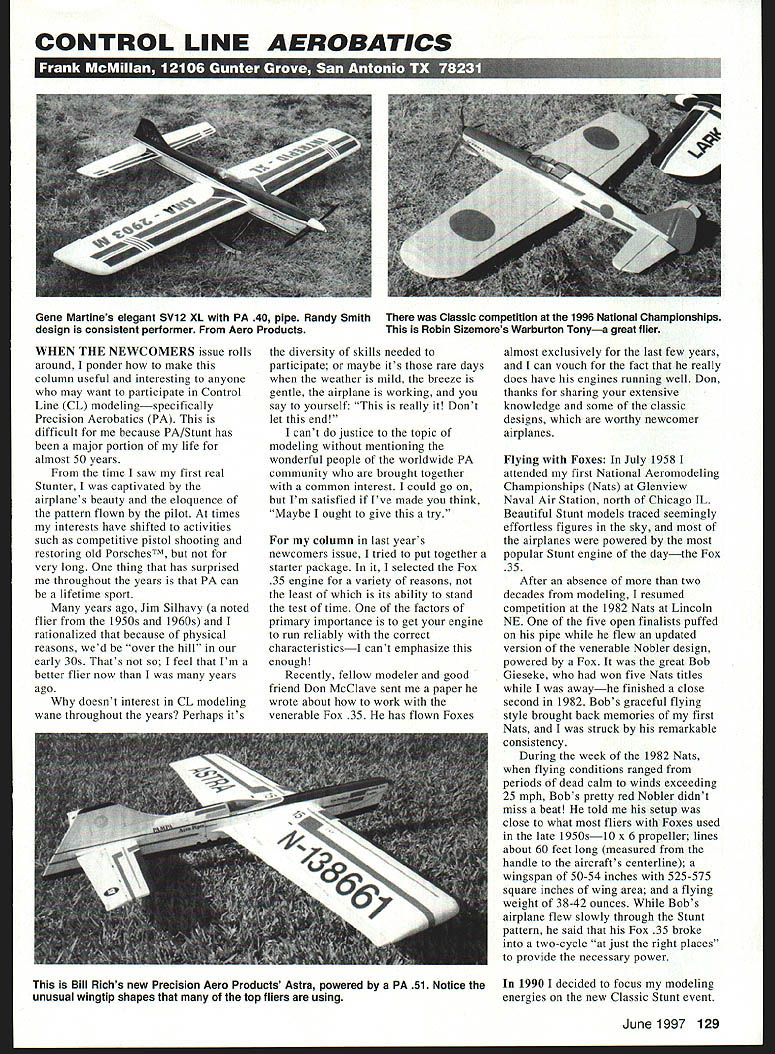
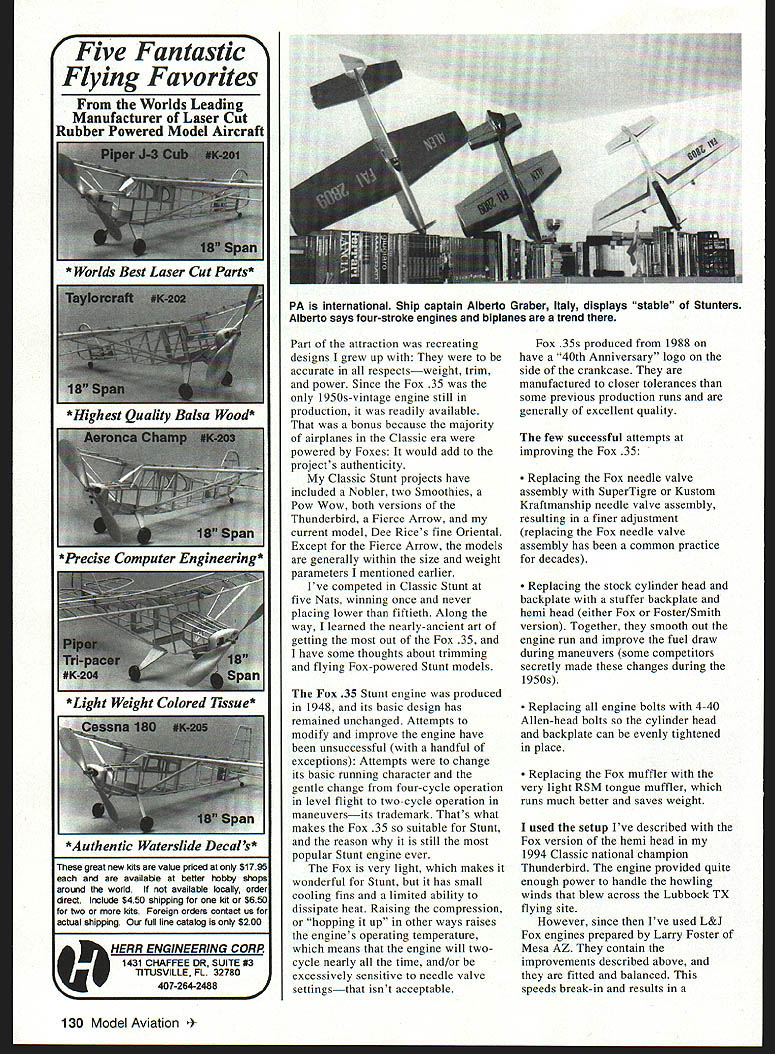
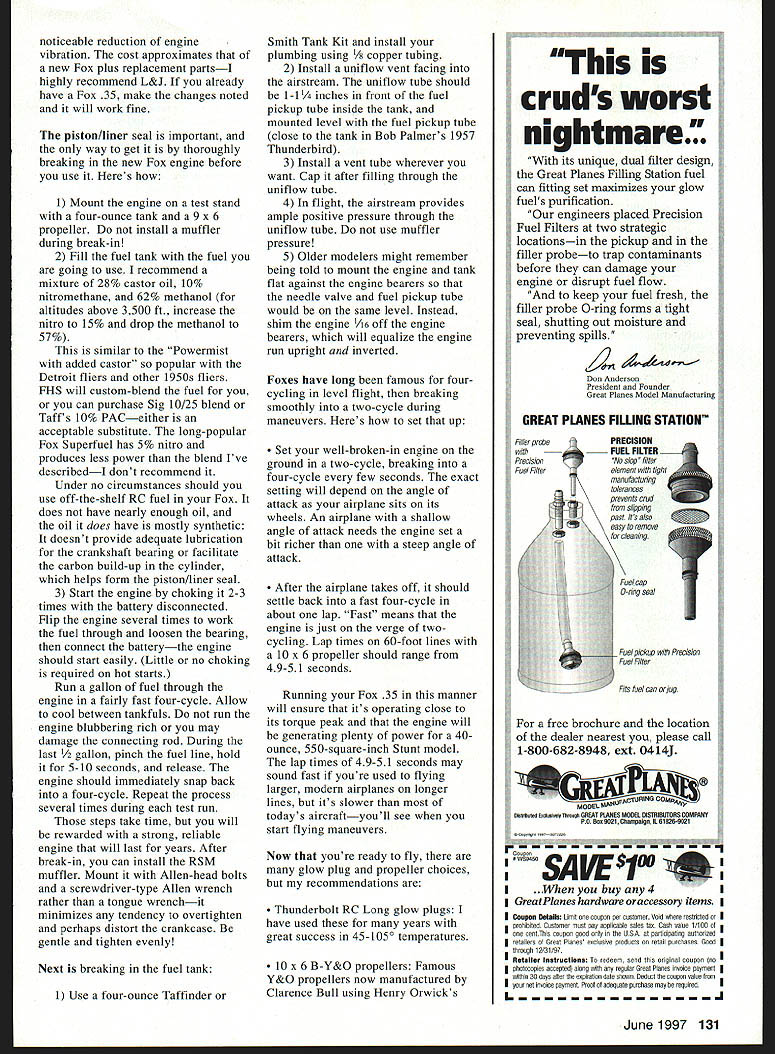
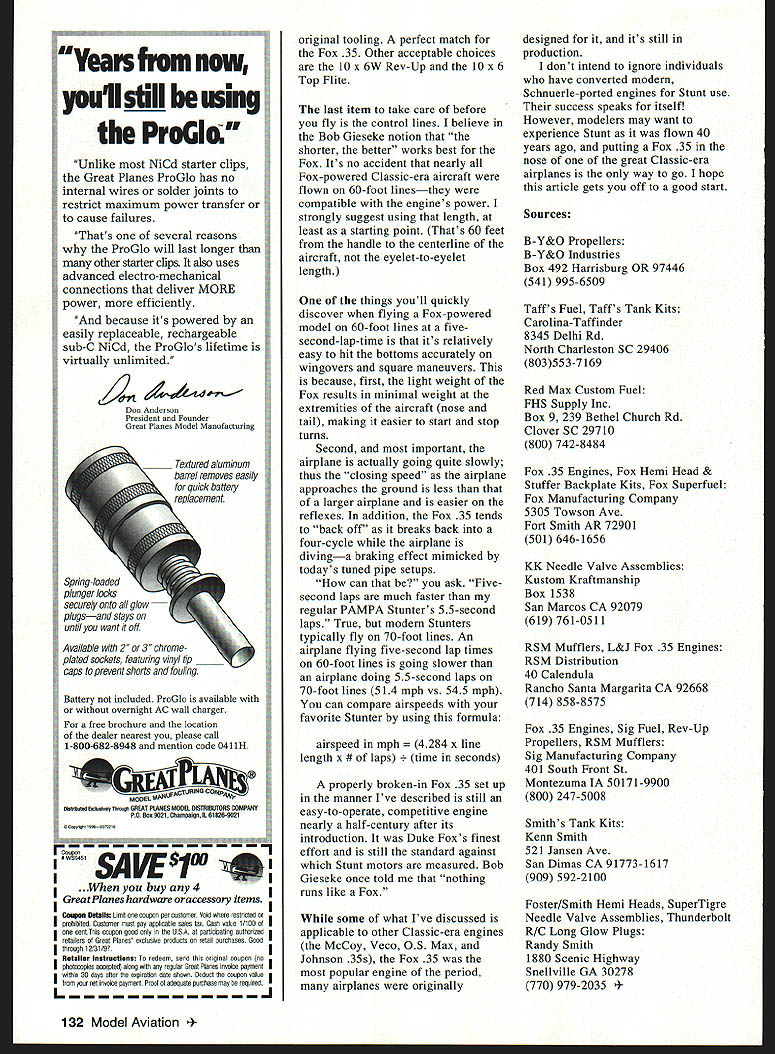
CONTROL LINE AEROBATICS
Frank McMillan, 12106 Gunter Grove, San Antonio TX 78231
When the newcomers issue rolls around, I ponder how to make this column useful and interesting to anyone who may want to participate in Control Line (CL) modeling—specifically Precision Aerobatics (PA). This is difficult for me because PA/Stunt has been a major portion of my life for almost 50 years.
From the time I saw my first real Stunter, I was captivated by the airplane's beauty and the eloquence of the pattern flown by the pilot. At times my interests have shifted to activities such as competitive pistol shooting and restoring old Porsches™, but not for very long. One thing that has surprised me throughout the years is that PA can be a lifetime sport.
Many years ago Jim Silhavy, a noted flier from the 1950s and 1960s, rationalized that because of physical reasons we'd be "over the hill" in our early 30s. That's not so; I feel that I'm a better flier now than I was many years ago.
Why doesn't interest in CL modeling wane throughout the years? Perhaps it's the diversity of skills needed to participate; or maybe it's the rare days when the weather is mild, the breeze is gentle, the airplane is working, and you say to yourself: "This is really it! Don't let this end!"
I can't do justice to the topic of modeling without mentioning the wonderful people of the worldwide PA community who are brought together with a common interest. I could go on, but I'm satisfied if I've made you think, "Maybe I ought to give this a try."
For my column in last year's newcomers issue I tried to put together a starter package. In it I selected the Fox .35 engine for a variety of reasons, not the least of which is its ability to stand the test of time. One of the factors of primary importance is to get your engine to run reliably with the correct characteristics—I can't emphasize this enough!
Recently, fellow modeler and good friend Don McClave sent me a paper he wrote about how to work with the venerable Fox .35. He has flown Foxes almost exclusively for the last few years, and I can vouch for the fact that he really does have his engines running well. Don, thanks for sharing your extensive knowledge and some of the classic designs, which are worthy newcomer airplanes.
Flying with Foxes
In July 1958 I attended my first National Aeromodeling Championships (Nats) at Glenview Naval Air Station, north of Chicago IL. Beautiful Stunt models traced seemingly effortless figures in the sky, and most of the airplanes were powered by the most popular Stunt engine of the day—the Fox .35.
After an absence of more than two decades from modeling, I resumed competition in the 1982 Nats at Lincoln NE. One of the five open finalists puffed on his pipe while he flew an updated version of the venerable Nobler design, powered by a Fox .35. It was the great Bob Gieseke, who had won five Nats titles while I was away—he finished a close second in 1982. Bob's graceful flying style brought back memories of my first Nats, and I was struck by remarkable consistency.
During the week of the 1982 Nats, when flying conditions ranged from periods of dead calm to winds exceeding 25 mph, Bob's pretty red Nobler didn't miss a beat! He told me his setup was close to what most fliers with Foxes used in the late 1950s:
- 10 x 6 propeller
- Lines about 60 feet long (measured from the handle to the aircraft's centerline)
- Wingspan of 50–54 inches with 525–575 square inches of wing area
- Flying weight of 38–42 ounces
While Bob's airplane flew slowly through the Stunt pattern, he said that his Fox .35 broke into a two-cycle "at just the right places" to provide the necessary power.
In 1990 I decided to focus my modeling energies on the new Classic Stunt event. Part of the attraction was recreating designs I grew up with: they were to be accurate in all respects—weight, trim, and power. Since the Fox .35 was the only 1950s-vintage engine still in production, it was readily available. That was a bonus because the majority of airplanes in the Classic era were powered by Foxes; it added to the project's authenticity.
My Classic Stunt projects have included a Nobler, two Smoothies, a Pow Wow, both versions of the Thunderbird, a Fierce Arrow, and my current model, Dee Rice's fine Oriental. Except for the Fierce Arrow, the models are generally within the size and weight parameters I mentioned earlier.
I've competed in Classic Stunt at five Nats, winning once and never placing lower than fifth. Along the way I learned the nearly-ancient art of getting the most out of the Fox .35, and I have some thoughts about trimming and flying Fox-powered Stunt models.
About the Fox .35
The Fox .35 Stunt engine was produced in 1948, and its basic design has remained unchanged. Attempts to modify and improve the engine have been unsuccessful (with a handful of exceptions) when the intent was to change its basic running character and the gentle change from four-cycle operation in level flight to two-cycle operation in maneuvers—its trademark. That's what makes the Fox .35 so suitable for Stunt, and the reason why it is still the most popular Stunt engine ever.
The Fox is very light, which makes it wonderful for Stunt, but it has small cooling fins and a limited ability to dissipate heat. Raising the compression, or "hopping it up" in other ways, raises the engine's operating temperature, which means that the engine will two-cycle nearly all the time and/or be excessively sensitive to needle-valve settings—that isn't acceptable.
Fox .35s produced from 1988 on have a "40th Anniversary" logo on the side of the crankcase. They are manufactured to closer tolerances than some previous production runs and are generally of excellent quality.
Successful modifications
The few successful attempts at improving the Fox .35 include:
- Replacing the Fox needle valve assembly with SuperTigre or Kustom Kraftmanship needle valve assemblies, resulting in finer adjustment (this has been common practice for decades).
- Replacing the stock cylinder head and backplate with a stuffer backplate and hemi head (either Fox or Foster/Smith versions). Together they smooth out the engine run and improve fuel draw during maneuvers (some competitors made these changes secretly in the 1950s).
- Replacing all engine bolts with 4-40 Allen-head bolts so the cylinder head and backplate can be evenly tightened in place.
- Replacing the Fox muffler with the very light RSM conique muffler, which runs much better and saves weight.
I used the setup described above with the Fox version of the hemi head in my 1994 Classic national champion Thunderbird. The engine provided quite enough power to handle the howling winds that blew across the Lubbock, TX, flying site.
Since then I've used L&J Fox engines prepared by Larry Foster of Mesa, AZ. They contain the improvements described above and are fitted and balanced. This speeds break-in and results in a noticeable reduction of engine vibration. The cost approximates that of a new Fox plus replacement parts—I highly recommend L&J. If you already have a Fox .35, make the changes noted and it will work fine.
Breaking in a new Fox .35 (piston/liner seal)
The piston/liner seal is important, and the only way to get it is by thoroughly breaking in the new Fox engine before you use it. Here's how:
- Mount the engine on a test stand with a four-ounce tank and a 9 x 6 propeller. Do not install a muffler during break-in.
- Fill the fuel tank with the fuel you are going to use. I recommend a mixture of:
- 62% methanol
- 28% castor oil
- 10% nitromethane
(For altitudes above 3,500 ft., increase the nitro to 15% and drop the methanol to 57%.) This is similar to the Powermist blend with added castor oil, popular with Detroit fliers and other 1950s fliers. FHS will custom-blend the fuel for you, or you can purchase Sig 10/25 blend or Taff's 10% PAC—either is an acceptable substitute. The long-popular Fox Superfuel has 5% nitro and produces less power than the blend I've described—I don't recommend it.
Under no circumstances should you use off-the-shelf RC fuel in your Fox. It does not have nearly enough oil, and the oil it does have is mostly synthetic; it doesn't provide adequate lubrication for the crankshaft bearing or facilitate the carbon build-up in the cylinder, which helps form the piston/liner seal.
- Start the engine by choking it 2–3 times with the battery disconnected. Flip the engine several times to work the fuel through and loosen the bearing, then connect the battery—the engine should start easily. (Little or no choking is required on hot starts.)
Run a gallon of fuel through the engine in a fairly fast four-cycle. Allow the engine to cool between tankfuls. Do not run the engine "blubbering rich" or you may damage the connecting rod. During the last half-gallon, pinch the fuel line, hold it for 5–10 seconds, and release. The engine should immediately snap back into a four-cycle. Repeat the process several times during each test run.
Those steps take time, but you will be rewarded with a strong, reliable engine that will last for years. After break-in, you can install the RSM muffler. Mount it with Allen-head bolts and a screwdriver-type Allen wrench rather than a tongue wrench—it minimizes any tendency to overtighten and perhaps distort the crankcase. Be gentle and tighten evenly.
Breaking in the fuel tank
- Use a four-ounce Taffinder or Smith Tank Kit and install your plumbing using 1/8" copper tubing.
- Install a uniflow vent facing into the airstream. The uniflow tube should be 1-1/4" in front of the fuel pickup tube inside the tank, and mounted level with the fuel pickup tube (close to the tank as in Bob Palmer's 1957 Thunderbird).
- Install a vent tube wherever you want. Cap it after filling through the wing fuel tube.
- In flight, the airstream provides ample positive pressure through the uniflow tube. Do not use muffler pressure.
- Older modelers might remember being told to mount the engine and tank flat against the engine bearers so that the needle valve and fuel pickup tube would be on the same level. Instead, shim the engine 1/16" off the engine bearers, which will equalize the engine run upright and inverted.
Setting the four-cycle / two-cycle behavior
Foxes have long been famous for four-cycling in level flight, then breaking smoothly into a two-cycle during maneuvers. Here's how to set that up:
- Set your well-broken-in engine on the ground to run in two-cycle, breaking into a four-cycle every few seconds. The exact setting will depend on the angle of attack as your airplane sits on its wheels. An airplane with a shallow angle of attack needs the engine set a bit richer than one with a steep angle of attack.
- After the airplane takes off, it should settle back into a fast four-cycle in about one lap. "Fast" means that the engine is just on the verge of two-cycling. Lap times on 60-foot lines with a 10 x 6 propeller should range from 4.9–5.1 seconds.
Running your Fox .35 in this manner will ensure that it's operating close to its torque peak and that the engine will be generating plenty of power for a 40-ounce, 550-square-inch Stunt model. The lap times of 4.9–5.1 seconds may sound fast if you're used to flying older, larger, modern airplanes on longer lines, but it's slower than most of today's aircraft—you'll see when you start flying maneuvers!
One of the things you'll quickly discover when flying a Fox-powered model on 60-foot lines at a five-second lap time is that it's relatively easy to hit the bottoms accurately on wingovers and square maneuvers. This is because:
- The light weight of the Fox results in minimal weight at the extremities of the aircraft (nose and tail), making it easier to start and stop turns.
- The airplane is actually going quite slowly; thus the "closing speed" as the airplane approaches the ground is less than that of a larger airplane and is easier on the reflexes.
- The Fox .35 tends to "back off" as it breaks back into a four-cycle while the airplane is diving—a braking effect mimicked by today's tuned-pipe setups.
You may ask, "How can that be? Five-second laps are much faster than my regular PAMPA Stunter's 5.5-second laps." True, but modern Stunters typically fly on 70-foot lines. An airplane flying five-second lap times on 60-foot lines is going slower than an airplane doing 5.5-second laps on 70-foot lines (5.14 mph vs. 5.4 mph). You can compare airspeeds with your favorite Stunter by using this formula:
airspeed in mph = (4.284 x line length x # of laps) / (time in seconds)
A properly broken-in Fox .35 set up in the manner I've described is still an easy-to-operate, competitive engine nearly a half-century after its introduction. It was Duke Fox's finest effort and is still the standard against which stunt motors are measured. Bob Gieseke once told me that "nothing runs like a Fox."
While some of what I've discussed is applicable to other Classic-era engines (the McCoy, Veco, O.S. Max, and Johnson .35s), the Fox .35 was the most popular engine of the period, many airplanes were originally designed for it, and it's still in production.
I don't intend to ignore individuals who have converted modern, Schnuerle-ported engines for Stunt use. Their success speaks for itself. However, modelers may want to experience Stunt as it was flown 40 years ago, and putting a Fox .35 in the nose of one of the great Classic-era airplanes is the only way to go. I hope this article gets you off to a good start.
Recommended plugs, propellers, and lines
- Glow plugs:
- Thunderbolt RC Long glow plugs: I have used these for many years with great success in 45–105° temperatures.
- Propellers:
- 10 x 6 B-Y&O propellers: Famous Y&O propellers now manufactured by Clarence Bull using Henry Orwick's original tooling—a perfect match for the Fox .35.
- Other acceptable choices: 10 x 6W Rev-Up and 10 x 6 Top Flite.
- Control lines:
- I believe in the Bob Gieseke notion that "the shorter, the better" for the Fox. Nearly all Fox-powered Classic-era aircraft were flown on 60-foot lines—they were compatible with the engine's power. I strongly suggest using that length, at least as a starting point. (That's 60 feet from the handle to the centerline of the aircraft, not the eyelet-to-eyelet length.)
Sources
B-Y&O Propellers: B-Y&O Industries Box 492 Harrisburg OR 97446 (541) 995-6509
Taff's Fuel, Taff's Tank Kits: Carolina-Taffinder 8345 Delbi Rd. North Charleston SC 29406 (803) 553-7169
Red Max Custom Fuel: FHS Supply Inc. Box 9, 239 Bethel Church Rd. Clover SC 29710 (800) 742-8484
Fox .35 Engines, Fox Hemi Head & Stuffer Backplate Kits, Fox Superfuel: Fox Manufacturing Company 5305 Towson Ave. Fort Smith AR 72901 (501) 646-1656
KK Needle Valve Assemblies: Kustom Kraftmanship Box 1538 San Marcos CA 92079 (619) 761-0511
RSM Mufflers, L&J Fox .35 Engines: RSM Distribution 40C Candelaria Rancho Santa Margarita CA 92688 (714) 858-8575
Fox .35 Engines, Sig Fuel, Rev-Up Propellers, RSM Mufflers: Sig Manufacturing Company 401 South Front St. Montezuma IA 50171-9900 (800) 247-5008
Smith's Tank Kits: Keen Smith 521 Jansen Ave. San Dimas CA 91773-1617 (909) 592-2100
Foster/Smith Hemi Heads, SuperTiger Needle Valve Assemblies, Thunderbolt R/C Long Glow Plugs: Randy Smith 1880 Scenic Highway Snellville GA 30278 (770) 979-2035
Transcribed from original scans by AI. Minor OCR errors may remain.

