
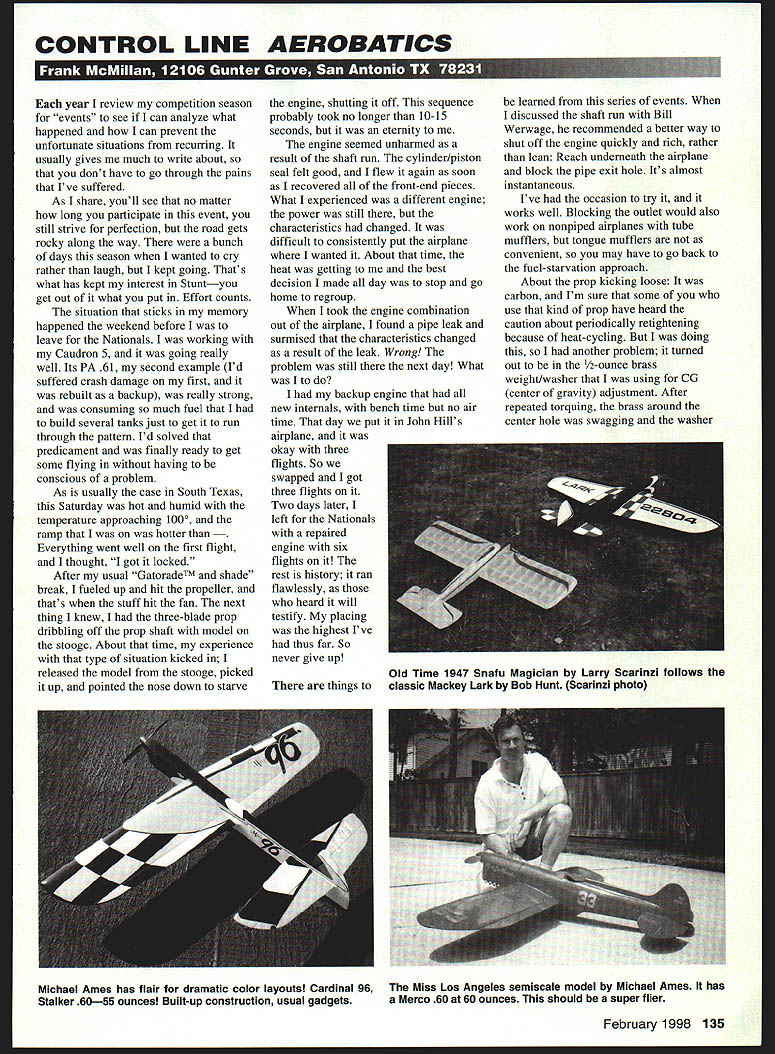

Control Line: Aerobatics
Frank McMillan 12106 Gunter Grove, San Antonio, TX 78231
Season review
Each year I review my competition season for "events" to see what happened and how to prevent unfortunate situations from recurring. No matter how long you participate, you still strive for perfection, and the road gets rocky along the way. There were days this season I wanted to cry rather than laugh, but I kept going. Stunt gives you back what you put in — effort counts.
A last-minute engine scare
The situation that sticks in my memory happened the weekend before I left for the Nationals. I was working with my Caudron 5 powered by a VP PA .61 — my second example after a crash-damaged first engine was rebuilt as a backup. The engine was strong and thirsty; I had to build several fuel tanks just to get through the pattern. After solving that, I finally felt ready.
It was a typical hot, humid South Texas Saturday (near 100°F). Everything went well on the first flight; I thought I had it locked. After a Gatorade-and-shade break I fueled up and hit the prop — and that’s when things went bad. The three-blade prop began to slip off the prop shaft while the model was on the stooge. I released the model, picked it up, pointed the nose down to starve the engine, and shut it off. The sequence probably took 10–15 seconds but felt like an eternity.
The engine seemed unharmed by the shaft run — cylinder/piston sealing felt good — and I flew again after recovering the front-end pieces. However, the engine’s characteristics had changed: power was there but it was hard to consistently put the airplane where I wanted. Heat was getting to me, so I quit for the day and went home to regroup.
I removed the engine and found a pipe leak and assumed that was the cause. The next day the problem persisted. I installed my backup engine (new internals, bench time but no air time) in John Hill’s airplane; it was fine for three flights, so we swapped it into mine and I got three flights. Two days later I left for the Nationals with a repaired engine that had six flights on it — and it ran flawlessly at the meet. The placing was my best so far, so never give up.
Quick shutoff technique
When I discussed the shaft run with Bill Werwage, he recommended a faster, safer shutdown method that richens the mixture rather than leaning it: reach underneath the airplane and block the pipe exit hole. It’s almost instantaneous.
- This works well on piped airplanes and on non-piped airplanes with tube-type mufflers.
- Tongue mufflers are less convenient for this method, so you may have to rely on fuel starvation there.
I’ve tried this technique and can confirm it works.
Prop and CG washer issue
About the prop kicking loose: carbon props are commonly used and require periodic retightening because heat cycling can loosen them. In my case the culprit wasn’t the prop alone but a 1/2-ounce brass weight/washer used for CG adjustment. After repeated torquing the brass around the center hole swaged, preventing adequate pressure on the hub and allowing the prop to kick off after a few runs.
Recommendations:
- Examine washers for signs of wear or swaging.
- Use steel washers/weights (for example, commercially available Prather weights) instead of brass.
- Lubricate the surface the prop adapter bears on to reduce wear.
Be aware this situation can occur and check hardware regularly.
Safety procedures
Be extremely conscious when running carbon props — they are thin and sharp, which is what makes them effective, but flesh is much softer. Develop and analyze procedures to stay out of the prop arc.
- Don’t reach around a spinning prop.
- Don’t let anyone be in the arc while the engine is running.
- Use additional procedures for setup: some fliers run the engine primed before hooking up flight lines or stooges.
- A simple PVC stand is a necessity for safety — it’s much easier to stabilize the airplane on a stand than to hold it by hand.
I’ll continue the discussion of keeping the prop out of the arc in the next column and cover heat control and control-system hints.
Nationals — engines and results
Looking back on the competition season, a new star emerged among top competitors’ engine choices: the PA .61. As I’ve noted before, engine quality and competitor skill have improved dramatically over the years; at the Nationals it was hard to find a bad run.
Highlights:
- The PA .61 by Randy Smith proved to be the “horse” this year. Many different setups worked well, which speaks to the engine’s power and flexibility.
- National champion David Fitzgerald ran his PA .61 with an Eather three-blade carbon prop at a launch rpm of 9,600 and a pipe length of 17½ inches.
- Ted Fancher, who finished second, arrived with a well-running O.S. .46 VF but that engine lacked power at the Muncie site. David and Bill Fitzgerald installed David’s VP PA .61 with their settings, and Ted flew the Nats with that setup and did well.
- Bill Werwage had fuel problems at the Nationals but still managed solid runs and finished third. With fuel issues solved he performed exceptionally at the team trials and won. Bill’s setup ran a pipe length of 16¾ inches and he experimented with various props, occasionally using David’s backup Eather prop.
- The top four finishers and the tenth-place finisher used PA .61s. Japanese competitors used O.S. FSRs and VFs (placing seventh through ninth) and reportedly took home about eight PA .61s.
Nobody really cares what you run — only that it performs. The availability of reliable engines and competing fliers’ increasing skill is good for the hobby.
New plans and designs
New plans are available for some of the best competition designs, including Windy Urtnowski’s latest Spitfire variant, the Seafire, another Concours winner. Windy’s plans are high quality and show many technical details — worth the price to see how features are engineered. Windy also offers detail products like “Canopies by Midgey,” molded exhaust stacks, molded balsa shells, and more.
Contact: Pro Stunt Products, 93 Elliott Pl., Rutherford, NJ 07070.
Prior to his success with semiscale P-47s, Bill Werwage campaigned the GEO/XL series designs, which evolved from Junior lineage. These designs are outstanding performers, incorporating the latest aerodynamics and pipe technology. The GEO wing is relatively thin (just over 2½ inches) and flies a wide speed range (my GEO wing flies at 5.5–5.6 inches).
Carefully built, these are about 55-ounce airplanes that use minimum material to hold down weight. With Bill’s help, Bob Hunt produced excellent plans. Contact: Robin’s View Productions, Box 68, Stockertown, NJ 18083.
Transcribed from original scans by AI. Minor OCR errors may remain.

