
CONTROL LINE AEROBATICS
Frank McMillan, 12106 Gunter Grove, San Antonio TX 78231
It's been 10 years since the first Vintage Stunt Championships. The spirit of the event has grown, as has the number of days (from one to four), but a new venue has surfaced with equal potential to achieve legend status.
This Labor Day weekend there will be a contest/gathering at the Experimental Aircraft Association (EAA) site in Oshkosh, Wisconsin. PAMPA (Precision Aerobatics Model Pilots Association) has been invited to work with the EAA and the Academy of Model Aeronautics (AMA) to run a major event; the thrust will be to coordinate the EAA and AMA youth programs with a Control Line Stunt theme.
Although still in the planning stage, there will be PAMPA skill classes, with emphasis on the Youth Beginner and Classic and Old Time. The EAA will give its full support and access to all of its facilities, with hangar availability, access via buses to the EAA museum, Ford Tri-Motor rides, and building demonstrations and flying instruction for newcomers. I'll include more details in future columns.
Kit Review
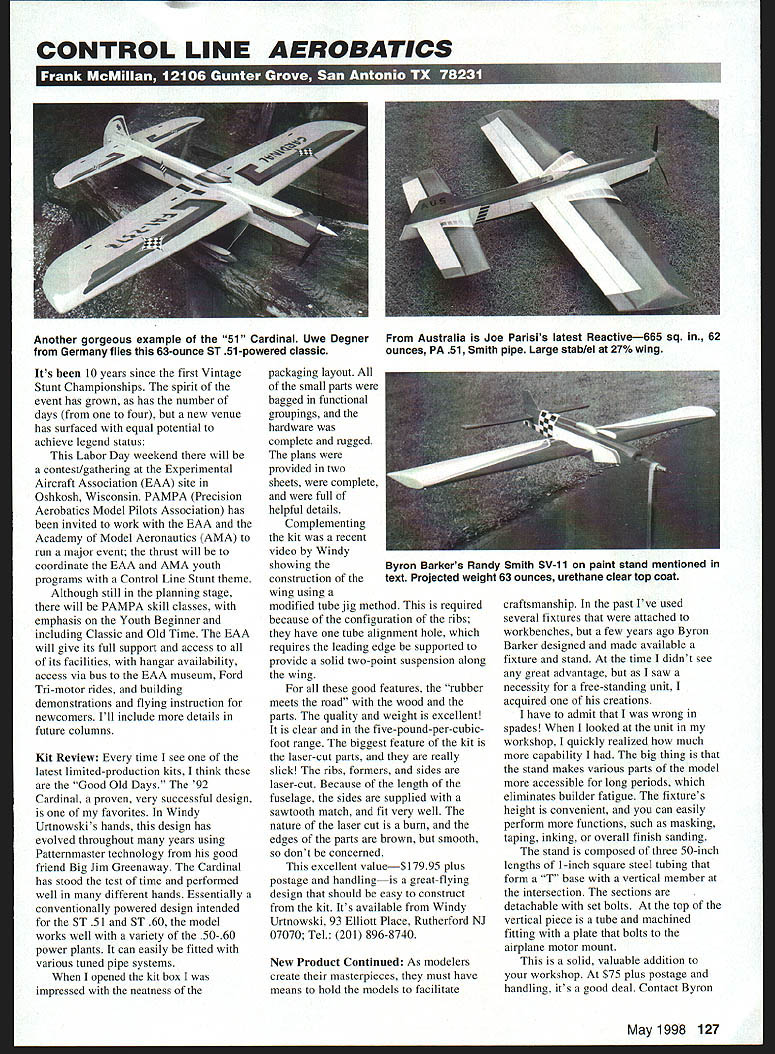
Every time I see one of the latest limited-production kits, I think these are the "Good Old Days." The '92 Cardinal, a proven, very successful design, is one of my favorites. In Windy Urtnowski's hands, this design has evolved throughout many years using Patternmaster technology from his good friend Big Jim Greenaway. The Cardinal has stood the test of time and performed well in many different hands. Essentially a conventionally powered design intended for the .51 and .60, the model works well with a variety of .50–.60 power plants. It can easily be fitted with various tuned pipe systems.
When I opened the kit box I was impressed with the neatness of the packaging layout. All of the small parts were bagged in functional groupings, and the hardware was complete and rugged. The plans were provided in two sheets, were complete, and were full of helpful details.
Complementing the kit was a recent video by Windy showing the construction of the wing using a modified tube jig method. This is required because of the configuration of the ribs; they have one tube alignment hole, which requires the leading edge to be supported to provide a solid two-point suspension along the wing.
For all these good features, the "rubber meets the road" with the wood and the parts. The quality and weight are excellent. It is clearly in the five-pound-per-cubic-foot range. The biggest feature of the kit is the laser-cut parts, and they are really slick: the ribs, formers, and sides are laser-cut. Because of the length of the fuselage, the sides are supplied with a sawtooth match, and fit very well. The nature of the laser cut is a burn, and the edges of the parts are brown but smooth, so don't be concerned.
This excellent value—$179.95 plus postage and handling—is a great-flying design that should be easy to construct from the kit. It's available from Windy Urtnowski, 93 Elliott Place, Rutherford NJ 07070; Tel.: (201) 896-8740.
New Product Continued
As modelers create their masterpieces, they must have means to hold the models to facilitate craftsmanship. In the past I've used several fixtures attached to workbenches, but a few years ago Byron Barker designed and made available a fixture and stand. At the time I didn't see any great advantage, but as I saw a necessity for a free-standing unit, I acquired one of his creations.
I have to admit that I was wrong in spades. When I looked at the unit in my workshop, I quickly realized how much more capability I had. The big thing is that the stand makes various parts of the model accessible for long periods, which eliminates builder fatigue. The fixture's height is convenient, and you can easily perform more functions, such as masking, taping, inking, or overall finish sanding.
The stand is composed of three 50-inch lengths of 1-inch square steel tubing that form a "T" base with a vertical member at the intersection. The sections are detachable with set bolts. At the top of the vertical piece is a tube and a machined fitting with a plate that bolts to the airplane motor mount. This is a solid, valuable addition to your workshop. At $75 plus postage and handling, it's a good deal. Contact Byron Barker, CF Slattery Co., 2101 Logan Ave., New Albany IN 47150.
SAFETY
When this column hits the streets, the weather will be changing and the "flying bug" is going to bite hard, so it will be time to think hard about getting ready for the new season. I'm going to focus on the flying system — lines, handles, connectors, and reels. Flying lines and handle cable are consumables; they all — solids or cable — have a finite lifespan and should be changed regularly. Now the question becomes, how frequently should they be changed, and why?
The handle is easy for me; I replace the cable every season on all handles that I use. I use an aircraft-coated control cable (.062), which is available from a few sources. Do not use the thinner leadout cable; it will not stand up to the flexing and will eventually fatigue (you should carefully flare the holes in the handle to prevent fatigue points). No matter how convenient, no cable obtained from a bicycle source is satisfactory; it's usually too thick, and more importantly, will fatigue quickly in the application because of the metallurgy.
Another consideration is the thickness/stiffness of the cable, which can affect the quality of the control input. It tends to make it on/off rather than a desired smooth input. It's also desirable to keep the length of the cable from the handle from being too long—say, two inches or less. Although it's difficult to define, the feeling is a vagueness in the control input. The opposite end of the spectrum would be the handle that Paul Walker uses, in which the lines are connected directly to handle fixtures for the ultimate "touch."
For flying lines, there are the "no-brainer" reasons to replace them. Many fliers who advocate using cable do so because it's "friendly" — especially when flying at less-than-perfect sites. However, cable can snag, and any spot that looks similar to a bend indicates that the set should be replaced.
Flying lines should be inspected carefully as you run the lines out every flight. Several Nationals past, I was setting up in the pits for an official flight and as I cleaned the lines, I was astonished to find several broken strands on one of them. I replaced the set, but it's a good example that "stuff happens." There was no visible problem on the previous flight.
Solids or single-strand lines are stronger and fly "cleaner," but have their own set of problems. They are much less flexible, and they are more susceptible to snagging on grass or rocks, which can easily kink or bend them. I've had new sets ruined that way, and by being stepped on. It happens, and you must replace them.
This also presents an area that requires careful attention: the ends. Wrapping them can hide a multitude of sins or bends. Particular care in fabricating the ends is mandatory, as is using round-nose pliers to shape them. Practice making the ends on scraps. Make up your mind not to use any end where there is a bend.
Thus far I've discussed the major physical problems on lines, but there is another sector to look at: the need to replace lines from wear. Sometimes it's difficult to quantify, but there are a few things I look for.
Strange as it sounds, if the lines (cable or solids) are difficult to clean, pick up dirt easily, or feel rough as you run them out, it's time to think about a new set. After a period of time, lines wear where they rub together during the pattern; there is a drag at that point, and control smoothness will be affected. I have commented before that the lines could be swapped end-for-end to forestall replacement, but I would recommend this only as an interim measure.
While not purely safety related, good contest strategy dictates that you start the flying season with new line sets, and they should be fitted and adjusted prior to the major contests. You should have a backup set of lines, flown and handle-adjusted.
Lines, handle cables, and connectors should be replaced regularly to maintain performance and prevent accidents. If you don't act when necessary, it'll cost you!
Transcribed from original scans by AI. Minor OCR errors may remain.

