
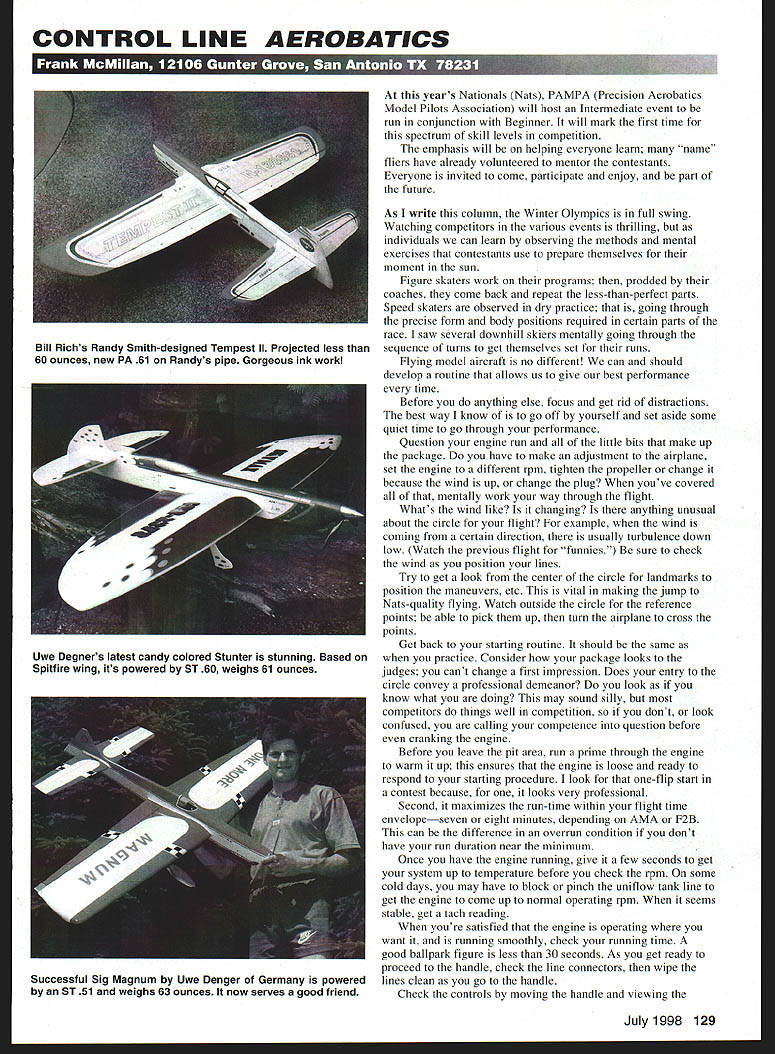
CONTROL LINE AEROBATICS
Frank McMillan, 12106 Gunter Grove, San Antonio TX 78231
PAMPA Intermediate at the Nats
At this year's Nationals (Nats), PAMPA (Precision Aerobatics Model Pilots Association) will host an Intermediate event to be run in conjunction with Beginner. It will mark the first time this spectrum of skill levels is included in the competition.
The emphasis will be on helping everyone learn; many "name" fliers have already volunteered to mentor the contestants. Everyone is invited to come, participate, enjoy, and be part of the future.
Mental Preparation and Routine
As I write this column, the Winter Olympics are in full swing. Watching competitors in the various events is thrilling, but as individuals we can learn by observing the methods and mental exercises contestants use to prepare themselves for their moment in the sun.
Figure skaters work on their programs; then, prodded by their coaches, they repeat the less-than-perfect parts. Speed skaters are observed in dry practice—going through the precise form and body positions required in certain parts of the race. I saw several downhill skiers mentally going through the sequence of turns to get themselves set for their runs.
Flying model aircraft is no different. We can and should develop a routine that allows us to give our best performance every time.
Before you do anything else, focus and get rid of distractions. The best way I know of is to go off by yourself and set aside some quiet time to go through your performance.
Question your engine run and all the little bits that make up the package. Do you have to make an adjustment to the airplane, set the engine to a different rpm, tighten the propeller or change it because the wind is up, or change the plug? When you've covered all of that, mentally work your way through the flight.
What's the wind like? Is it changing? Is there anything unusual about the circle for your flight? For example, when the wind is coming from a certain direction there is usually turbulence down low. (Watch the previous flight for "funnies.") Be sure to check the wind as you position your lines.
Try to get a look from the center of the circle for landmarks to position the maneuvers. This is vital in making the jump to Nats-quality flying. Watch outside the circle for reference points; be able to pick them up, then turn the airplane to cross the points.
Get back to your starting routine. It should be the same as when you practice. Consider how your package looks to the judges; you can't change a first impression. Does your entry to the circle convey a professional demeanor? Do you look as if you know what you are doing? This may sound silly, but most competitors do things well in competition, so if you don't, or look confused, you are calling your competence into question before even cranking the engine.
Preflight and Starting Routine
Before you leave the pit area, run a prime through the engine to warm it up; this ensures the engine is loose and ready to respond to your starting procedure. I look for that one-flip start in a contest because, for one, it looks very professional.
Second, it maximizes the run-time within your flight-time envelope—seven or eight minutes, depending on AMA or F2B. This can be the difference in an overrun condition if you don't have your run duration near the minimum.
Once you have the engine running, give it a few seconds to get your system up to temperature before you check the rpm. On some cold days, you may have to block or pinch the uniflow tank line to get the engine to come up to normal operating rpm. When it seems stable, get a tach reading.
When you're satisfied the engine is operating where you want it and is running smoothly, check your running time. A good ballpark figure is less than 30 seconds. As you get ready to proceed to the handle, check the line connectors, then wipe the lines clean as you go to the handle.
Check the controls by moving the handle and viewing the corresponding movement of the airplane's control surfaces. Get set, adopt a good body position and a quick mental collection, and signal for release.
All of the above should be part of a carefully practiced routine that is precise and polished.
You should have planned options throughout the routine in the event of difficulties. Loose propellers can be prevented by retightening prior to an official flight, and glow plugs can be checked with batteries during the warmup run prior to each flight. But even having gone through all the checks, stuff happens.
How long do you try to fix a situation? That depends on your engine run duration. If it is normally more than several minutes in AMA, I would consider an attempt of 30+ seconds. In general, it's best to get a clean start than to get rushed into a situation that carries through the entire pattern. Get a good routine and stay in it!
Airflow Check Tip
Several columns back I discussed troubles I'd experienced with engine system cooling, and how I used a hair dryer as a source of air to check internal fuselage airflow.
One of the problems I encountered was getting a good indication of where and how strong the airflow was at a point. I had an indication by feel, but asked for a better method.
National champion David Fitzgerald called and shared that he had experienced similar problems and had evolved much the same solution. He came up with an ingenious visual sensor/prop—a pipe cleaner with the cleaning fibers removed except for the tip, with the end fibers sensitive to the airflow. Thanks, David! I've tried it and it works quite well.
I recommend this investigation to serious fliers. It can help you avoid major problems.
EAA Contest Plans
In my last column I mentioned an effort to develop a major contest at the Experimental Aircraft Association (EAA) Headquarters in Oshkosh, Wisconsin. The initial target date was the upcoming Labor Day weekend, and the thought was to have it on alternating years with the F2B team trials at Muncie, Indiana.
In cooperation with EAA and AMA, PAMPA is going to host the contest, which will have the major Precision Aerobatics classes, plus Classic and Old Time. Ideas are evolving that will make this a "must-attend happening." As the plan develops, the scope of the event is limited only by what can be done realistically. The hosts are backing this with full support and access to all facilities.
PAMPA Hall of Fame members Bob Gialdini and Jim Krueger are heading the development effort. Both met several times with Sean Elliott of the EAA and discussed the resources necessary to support such an undertaking. As they looked at where they would get the backing, they realized the majority of it would have to be from the clubs in that area.
It seemed that coordinating this effort would take longer than the time between now and Labor Day weekend; therefore, a conservative approach has been taken, and the start of this contest series has been delayed until the year 2000. This affords more time to qualify and prepare the proper support, and to properly publicize the nature of the event.
New Products
While I was building a plastic working heart for my wife's kindergarten class, I ran across an interesting plastic cement: Testors Clear Parts Cement and Window Maker #3515. According to the bottle, you can actually build windows with it. I used it to build fillets around the windows, and it did a nice job, drying crystal clear.
There have been occasions when I would have drilled into a canopy to release humidity and air, or to repair a component that came loose. With this product you can effect a neat, almost invisible fix. I can also visualize making small hoods for running lights by creating small molds and casting this with the bulb. It's a neat product. Give it a try.
Transcribed from original scans by AI. Minor OCR errors may remain.

