
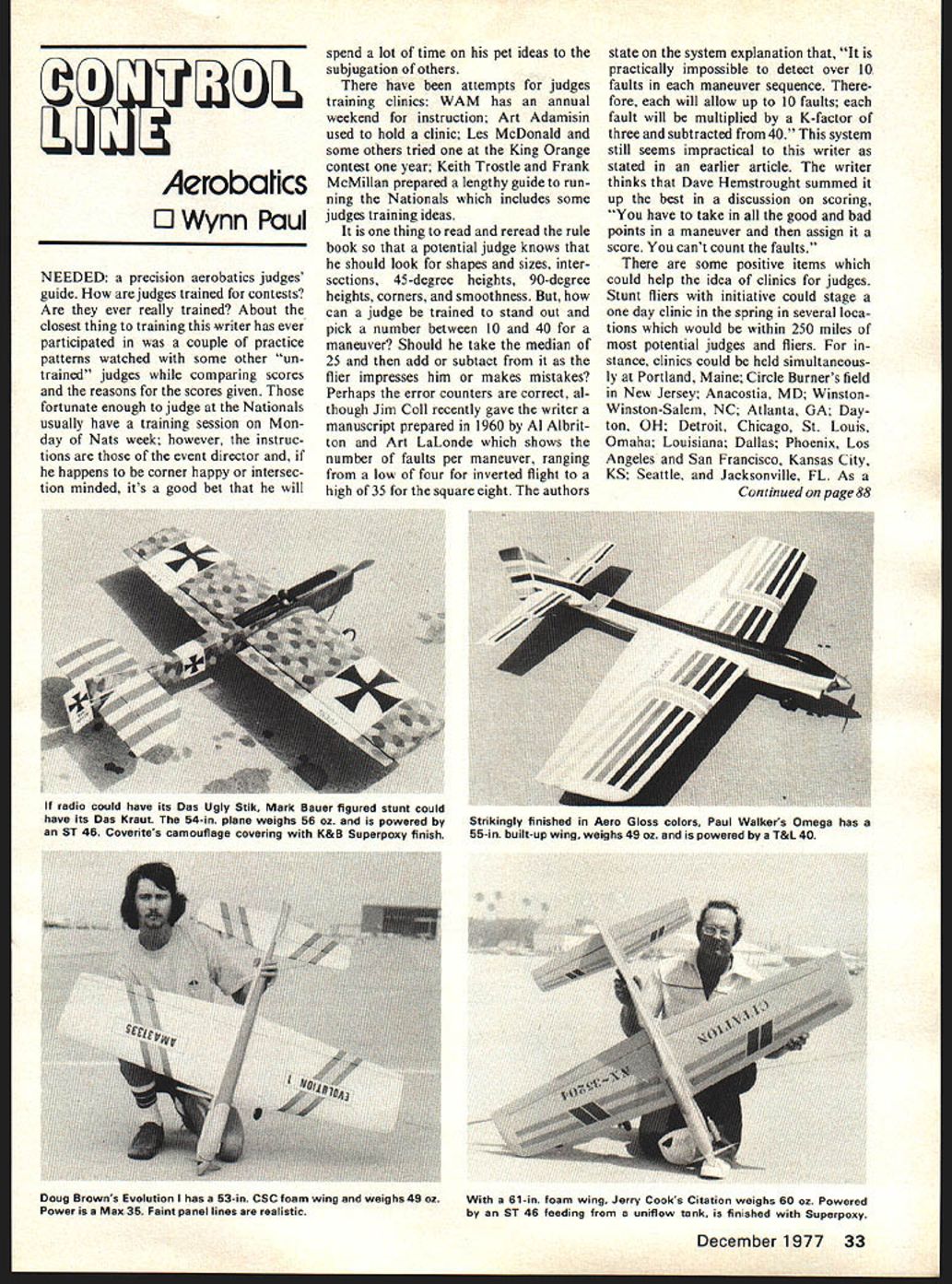
CONTROL LINE: Aerobatics
■ Wynn Paul
NEEDED: a precision aerobatics judges' guide. How are judges trained for contests? Are they ever really trained? About the closest thing to training this writer has ever participated in was a couple of practice patterns watched with some other "untrained" judges while comparing scores and the reasons for the scores given. Those fortunate enough to judge at the Nationals usually have a training session on Monday of Nats week; however, the instructions are those of the event director and, if he happens to be corner happy or intersection minded, it's a good bet that he will spend a lot of time on his pet ideas to the subjugation of others.
There have been attempts for judges training clinics: WAM has an annual weekend for instruction; Art Adamisin used to hold a clinic; Les McDonald and some others tried one at the King Orange contest one year; Keith Trostle and Frank McMillan prepared a lengthy guide to running the Nationals which includes some judges training ideas.
It is one thing to read and reread the rule book so that a potential judge knows that he should look for shapes and sizes, intersections, 45-degree heights, 90-degree heights, corners, and smoothness. But, how can a judge be trained to stand out and pick a number between 10 and 40 for a maneuver? Should he take the median of 25 and then add or subtract from it as the flier impresses him or makes mistakes? Perhaps the error counters are correct, although Jim Coil recently gave the writer a manuscript prepared in 1960 by Al Albritton and Art LaLonde which shows the number of faults per maneuver, ranging from a low of four for inverted flight to a high of 35 for the square eight. The authors state on the system explanation that, "It is practically impossible to detect over 10 faults in each maneuver sequence. Therefore, each will allow up to 10 faults; each fault will be multiplied by a K-factor of three and subtracted from 40." This system still seems impractical to this writer as stated in an earlier article. The writer thinks that Dave Hemstrought summed it up best in a discussion on scoring, "You have to take in all the good and bad points in a maneuver and then assign it a score. You can't count the faults."
There are some positive items which could help the idea of clinics for judges. Stunt fliers with initiative could stage a one day clinic in the spring in several locations which would be within 250 miles of most potential judges and fliers. For instance, clinics could be held simultaneously at Portland, Maine; Circle Burner's field in New Jersey; Anacostia, MD; Winston-Salem, NC; Atlanta, GA; Dayton, OH; Detroit; Chicago; St. Louis; Omaha; Louisiana; Dallas; Phoenix; Los Angeles; San Francisco; Kansas City, KS; Seattle; and Jacksonville, FL. matter of fact, perhaps two weekends could be set up in April so that potential judges and fliers could attend two clinics. PAMPA members and fliers should give one day's time to attend and help at a clinic. More of the top fliers (by this the writer means those who usually qualify in the Nationals, or who are very close to this) and those who are semi-retired from active competition should pitch in and give something back to the hobby which has given them satisfaction for years.
Lucky Pyatt and Mike Keville of California have volunteered to take over the reins of the Judges' Committee of PAMPA. Perhaps they can come up with an experimental judges' guide to judging and some idea for a National Precision Aerobatics Clinic day in the spring of each year.
Seen at the Nationals: More clunk tanks than ever before. Third place Bob Baron, who has been running clunkers for years, buzzed right along with his Sullivan 6-oz. tank used with pressure off a Du-Bro muffler. Norman Whittle (9th), Jim Armour (12th), Tom Lay (19th) and Steve McCann (20th) also used clunk tanks. Speaking of tanks, manufacturers take note: of the nine ST46 engines used in the finals of the 1977 Nats two had commercial Pylon clunk tanks and the other seven had to rely on home-made or custom fuel tanks. Does this say something about the needs for fuel tanks in stunt? Oh yes, there were four Max 35's, three T & L 40's, two Fox 35's (2nd and 13th), one each OS 40 and ST40, in addition to the 46's for those of you who like to count up what engine is doing what.
Prop Talk at the Nats: When you can get them, the Rev-Ups seem to be the most popular prop of the Nats qualifiers. There were 14 qualifiers with Rev-Ups, all the way from Gieseke's 10-6W to McMillan and Paul's 12-6's. The new Zinger prop from California was used on four airplanes. The Zingers are exceptionally well made but come only in the 10- and 11-in. sizes. Two Top Flites and one Cristobaler rounded out the field. Dick Mathis was using a Grish on his Fox 35, probably because the plane was very light with very little ground clearance.
Paint Notes from the Nats: There was still lots of Sig and Aero-Gloss paint on the stunt planes, but eight of the Nats qualifiers used epoxy-type paints, including winner Al Rabe and third place (tie) Bob Baron. And, two planes (3rd and 10th) had Monokote; don't scoff, Gary McClellan's Monokoted plane with Superpoxy fuselage and tail tied for third highest appearance with 16 points.
Miss Poppy Kits: The winning Junior airplane at the 1977 Nats was the Miss Poppy kit, which unfortunately is now out of production. However, Lucky Pyatt has 32 of these kits available (the last ones) with the original Control Specialties Company foam core wings. These kits need to have the plastic top block and cowl replaced by wood to make a competitive weight airplane but otherwise they can be a pretty good kit when used with the ST46. These kits are priced at $35 each and you can write Lucky at 15438 Alicante Road, La Mirada, CA 90638; tel: 213-947-1253.
Help for Beginners in Stunt: The writer very seldom receives a letter from Bob Gieseke or Bill Werwage (never!) asking for help on their new stunt ships; however, letters are always received from those novices asking how to get started in stunt and where to find help. If there is no local flying field or no local hobby shop, then the novice could be in for some difficulty. This writer suggests joining AMA and subscribing to Model Aviation. With the contest calendar you could find a contest within reasonable driving range and then attend that contest with notebook in hand.
Dick Mathis wrote a very good booklet called "How to Fly U-Control," at $2.95,
Control Line: Aerobatics
Wynn Paul
NEEDED: a precision aerobatics judges' guide. Are judges trained for contests? Are we ever really trained? About the closest thing to training the writer has ever participated in was a couple of practice patterns, watching some other untrained judges, and comparing scores and the reasons scores were given. If fortunate enough to judge Nationals, there is usually a training session on Monday of Nats week; however, if the instructions event director happens to be corner‑happy and intersection‑minded, it's a good bet he will spend a lot of time peddling his ideas.
Attempts at judges' training clinics have been made. WAM has an annual weekend instruction; Art Adamisin used to hold a clinic. Les McDonald and some others tried at King Orange contest years. Keith Trostle and Frank McMillan prepared a lengthy guide for running Nationals that includes some judges' training ideas. One thing to do is read and reread the rule book. A potential judge should know what to look for: shapes, sizes, intersections, 45‑degree heights, 90‑degree heights, corners, smoothness.
A trained judge can stand out. Pick a number between 10 and 40 maneuvers — take the median, 25; add or subtract if the flier impresses you or makes mistakes. Perhaps error counters can correct; although Jim Coil recently gave the writer a manuscript prepared in 1960 by Al Albritton and Art LaLonde that shows a number of faults per maneuver ranging low (four for inverted flight) to high (35 for square eight). The authors state the system is practically impossible to explain — detect over 10 faults per maneuver sequence; therefore it will allow up to 10 faults, each fault multiplied by a K‑factor of three and subtracted from 40. The system still seems impractical.
As the writer stated in an earlier article, Dave Hemstrought summed up the best discussion on scoring: you have to take the good and bad points of a maneuver and assign a score — you can't just count faults. Some positive items could help.
One idea for clinics: stunt fliers and judges could take the initiative and stage a day clinic in spring. Several locations could be within 250 miles of potential judges and fliers. These stance clinics could be held simultaneously — Portland, Maine; Circle Burners field, New Jersey; Anacostia, Md.; Winston‑Salem, N.C.; Atlanta, Ga.; Dayton, Ohio; Detroit; Chicago; St. Louis; Omaha; Louisiana; Dallas; Phoenix; Los Angeles; San Francisco; Kansas City, Kans.; Seattle; Jacksonville, Fla.
Transcribed from original scans by AI. Minor OCR errors may remain.

