
CONTROL LINE AEROBATICS
Frank McMillan 12106 Gunter Grove, San Antonio TX 78231
Refinish project — Caudron No. 4 and Brodak butyrate dope
Several columns ago I discussed the value of refinishing a good-flying airplane. I decided to refinish my number-four Caudron and use it as a test project for the new Brodak butyrate dope.
In a previous column I described how to strip the airplane down to bare wood. From there I started preparing the bare structure for refinish. With any refinish, there are always areas that require repair prior to recovering.
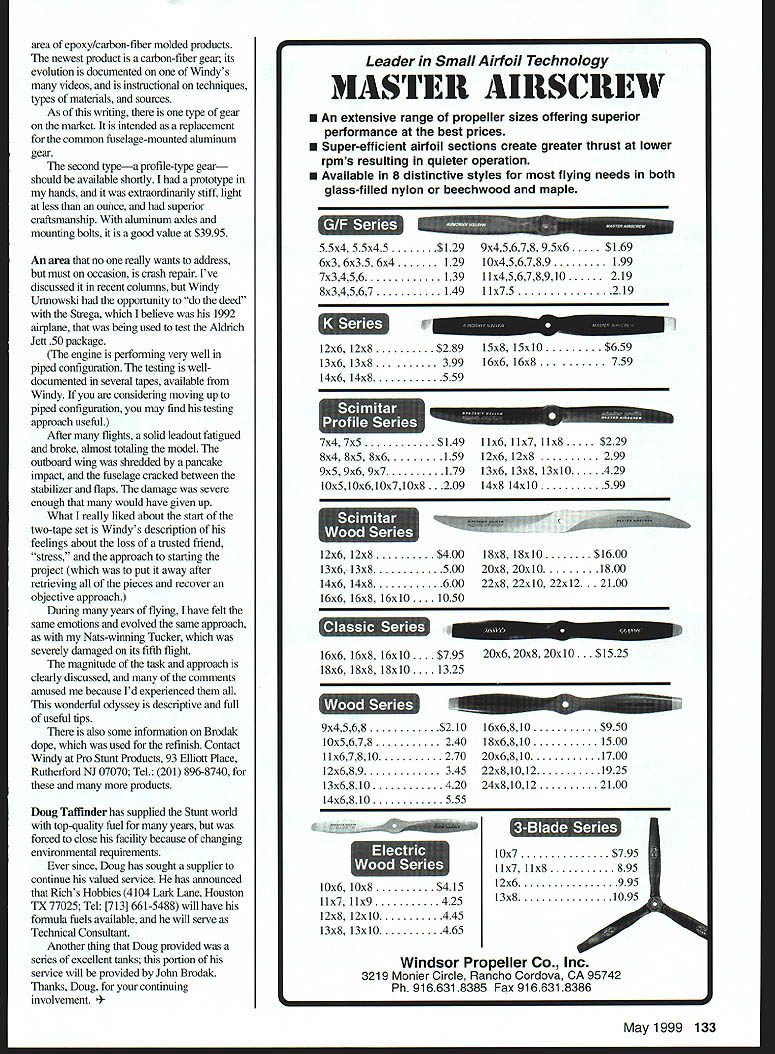
After I block-sanded everything carefully, I restored the surfaces. This is the easiest point in the process to make the lightest repairs. It is easy to add unwanted weight by taking a "quickie" approach to repair; you must plan carefully and maintain discipline to keep the weight on target.
With the bare wood repaired, I continued with my normal finishing procedure. After wiping the bare wood free of dust, I sprayed on several coats of 50/50 clear butyrate dope. After a light sanding, I added more sprayed coats until the surface had a light gloss.
The spray approach controls the amount of material used. The light gloss ensured there was sufficient dope on the surface for good adhesion of the covering material. I covered the basic airframe, less the wing, with 2-ounce carbon veil; the wing was covered with medium-weight silkspan.
Then I brushed on two coats of the same 50/50 butyrate/thinner mixture. A light sanding was followed by two more coats, then additional coats until there was again a light gloss.
At this point I sprayed on a sanding sealer composed of Aero Products zinc stearate and the 50/50 butyrate dope. Nice features of the zinc stearate are that it self-levels, sands wonderfully, and is very light. The filler coat was worked until the first coat was as good as I could get it. This coat is repaired as many times as necessary, using touchups with more sanding sealer. I then used a blocking coat of Polar Gray, worked as I did the sealer to take care of all imperfections.
When I was satisfied, I sprayed a coat of white as the base coat for the trim colors. As of this writing, I'm laying out colors and waiting for delivery of the remaining colors.
At this point in the finishing process I have used the clear and two colors. Overall, I'm impressed. The material is friendly and predictable. The clear is a non-tautening type, but for my purposes it does have sufficient shrink for covering materials. It has high solids so it fills quickly, and in combination with the Brodak thinner, powders wonderfully when dry.
An interesting characteristic of the clear dope is that if you brush it you can recoat almost immediately without noticeable brush marks. The colors I've used, gray and white, cover uniformly in one sprayed coat, and not a heavy one at that. They were mixed at one part color to one part thinner. I've sanded the white in a few places, and the overall finish looked excellent.
This is a very high-quality product that I highly recommend. It is initially available from Brodak Manufacturing.
- Brodak Manufacturing
Carmichaels PA 15320 Tel: (724) 966-5975 Fax: (724) 966-5670 www.brodak.com
Engines — Double Star .60 and ST .60 notes
In my Nationals report I mentioned that Bob Baron was using an ST .60. I received a letter from Tom Dixon pointing out that he was actually using a Double Star prototype .60. I thought the engine ran extremely well.
Tom said the engine, which looks like an ST .60, is of AAC (aluminum, aluminum, chrome) construction and features a ringed setup. The addition of the ring, he says, is to support heavy-duty back-to-back practice in hot weather because it restarts more easily. These new versions should be available shortly. Tom will also have cylinder/piston sets available for conversions.
Tom is considering a rear-exhaust Double Star .60 that could be used with or without a pipe. Performance numbers are being developed on a Double Star .60 by an Australian flier.
- Tom Dixon
Box 671166, Marietta GA 30066 Tel./Fax: (770) 973-9238
Robin's View Productions and Stunt Flyer Video Magazine (SFVM)
There has been interesting activity at Robin's View Productions. Bob Hunt has been producing the high-quality Stunt Flyer Video Magazine for several years. The latest issue, Vol. 3 No. 1, contains several valuable subjects:
- Power-unit variables and how to tune a stunt engine for optimum performance
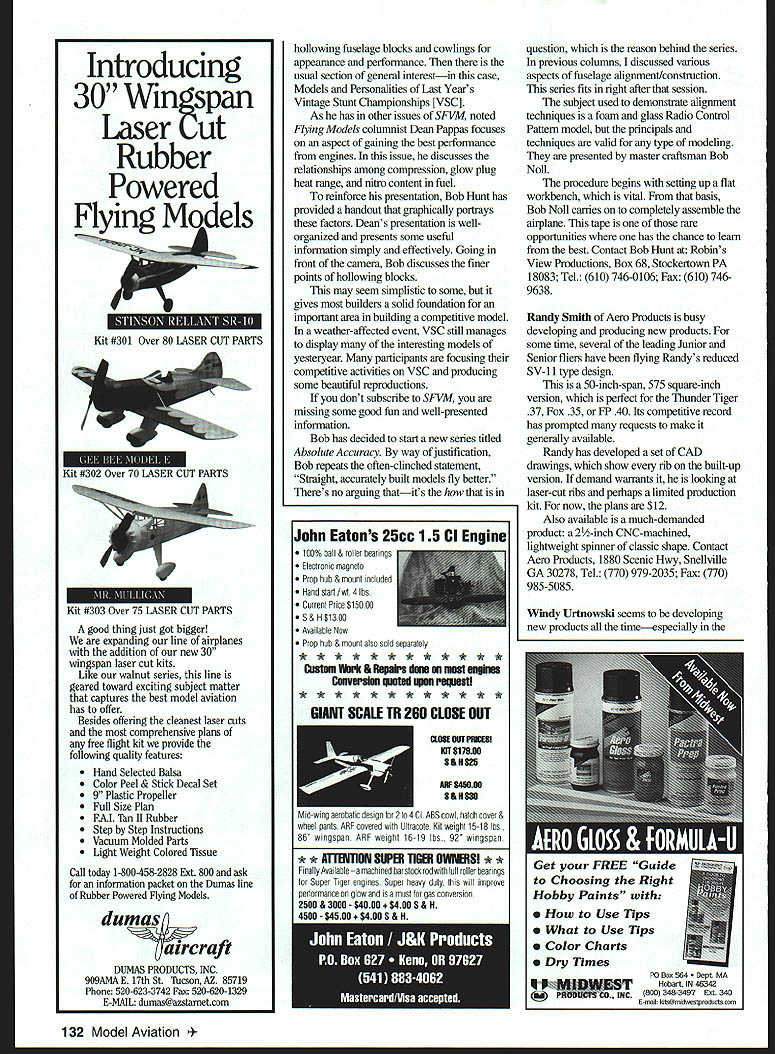
- An approach to nose construction
- Hollowing fuselage blocks and cowlings for appearance and performance
- Models and Personalities of Last Year’s Vintage Stunt Championships (VSC)
As in other issues, noted Flying Models columnist Dean Pappas focuses on gaining the best performance from engines; in this issue he discusses the relationships among compression, glow-plug heat range, and nitro content in fuel. To reinforce his presentation, Bob Hunt has provided a handout that graphically portrays these factors. Dean’s presentation is well organized and presents useful information simply and effectively.
Bob also goes in front of the camera to discuss finer points of hollowing blocks. This may seem simplistic to some, but it gives most builders a solid foundation for an important area in building a competitive model. VSC continues to display many interesting models of yesteryear; many participants focus their competitive activities on VSC and produce beautiful reproductions.
If you don’t subscribe to the Stunt Flyer Video Magazine, you are missing good fun and well-presented information.
Bob has started a new series titled Absolute Accuracy. By way of justification, Bob repeats the often-claimed statement, “Straight, accurately built models fly better.” There’s no arguing that — it’s the how that is in question, which is the reason behind the series.
The subject used to demonstrate alignment techniques is a foam-and-glass radio-control pattern model, but the principles and techniques are valid for any type of modeling. They are presented by master craftsman Bob Noll. The procedure begins with setting up a flat workbench, which is vital. From that basis, Bob Noll carries on to completely assemble the airplane. This video is a rare opportunity to learn from the best.
- Robin’s View Productions
Box 68, Stockertown PA 18083 Tel.: (610) 746-0106 Fax: (610) 746-9638
Aero Products — Randy Smith and the reduced SV-11 design
Randy Smith of Aero Products is developing and producing new products. Several leading Junior and Senior fliers have been flying Randy’s reduced SV-11-type design. This is a 50-inch-span, .575 square-inch version, which is perfect for the Thunder Tiger .37, Fox .35, or FP .40. Its competitive record has prompted many requests to make it more generally available.
Randy has developed a set of CAD drawings showing every rib on the built-up version. If demand warrants, he is considering laser-cut ribs and perhaps a limited production kit. For now, the plans are $12.
Also available is a much-demanded product: a 2-1/4-inch CNC-machined, lightweight spinner of classic shape.
- Aero Products
1880 Scenic Hwy, Snellville GA 30278 Tel.: (770) 979-2035 Fax: (770) 985-5085
Windy Urtnowski — carbon-fiber gears, crash repair tapes, and more
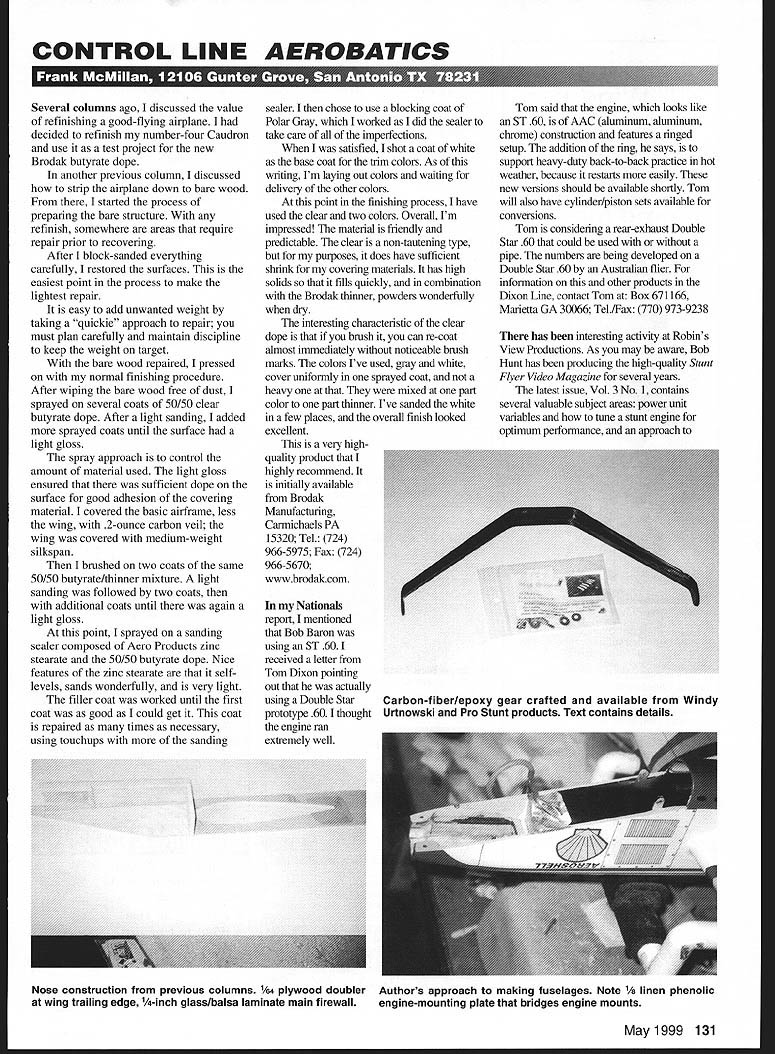
Windy Urtnowski continues developing epoxy/carbon-fiber molded products. The newest product is a carbon-fiber gear; its evolution is documented on one of Windy's videos and is instructional on techniques, types of materials, and sources.
As of this writing, one type of gear is on the market intended as a replacement for the common fuselage-mounted aluminum gear. A second type — a profile-type gear — should be available shortly. I handled a prototype and found it extraordinarily stiff, light at less than an ounce, and of superior craftsmanship. With aluminum axles and mounting bolts, it is a good value at $39.95.
An area no one wants to address but must on occasion is crash repair. Windy had the opportunity to "do the deed" with the Strega (I believe his 1992 airplane) that was being used to test the Aldrich .50 package. The engine is performing very well in piped configuration; the testing is well-documented in several tapes available from Windy. If you are considering moving up to piped configuration, his testing approach may be useful.
After many flights, a solid leadout fatigued and broke. The outboard wing was shredded by a pancake impact, and the fuselage cracked between the stabilizer and flaps. The damage was severe enough that many would have given up.
What I liked about the start of the two-tape set is Windy's description of his feelings about the loss of a trusted friend, the "stress," and his approach to starting the project (which was to put it away after retrieving all pieces and recover an objective approach). During many years of flying I have felt the same emotions and evolved the same approach, as with my Nats-winning Tucker, which was severely damaged on its fifth flight. The magnitude of the task and approach is clearly discussed, and many of the comments amused me because I'd experienced them all. This is a wonderful odyssey, descriptive and full of useful tips. There is also some information on Brodak dope used for the refinish.
- Pro Stunt Products (Windy Urtnowski)
93 Elliott Place, Rutherford NJ 07070 Tel.: (201) 896-8740
Fuel and tanks — Doug Taffinder and Rich's Hobbies
Doug Taffinder supplied the stunt world with top-quality fuel for many years but was forced to close his facility because of changing environmental requirements. Since then Doug has sought a supplier to continue his valued service. He has announced that Rich's Hobbies will have his formula fuels available, and he will serve as Technical Consultant.
Another thing Doug provided was a series of excellent tanks; this portion of his service will be provided by John Brodak. Thanks to Doug for his contribution and involvement.
- Rich's Hobbies
4104 Lark Lane, Houston TX 77025 Tel.: (713) 661-5488
Transcribed from original scans by AI. Minor OCR errors may remain.

