
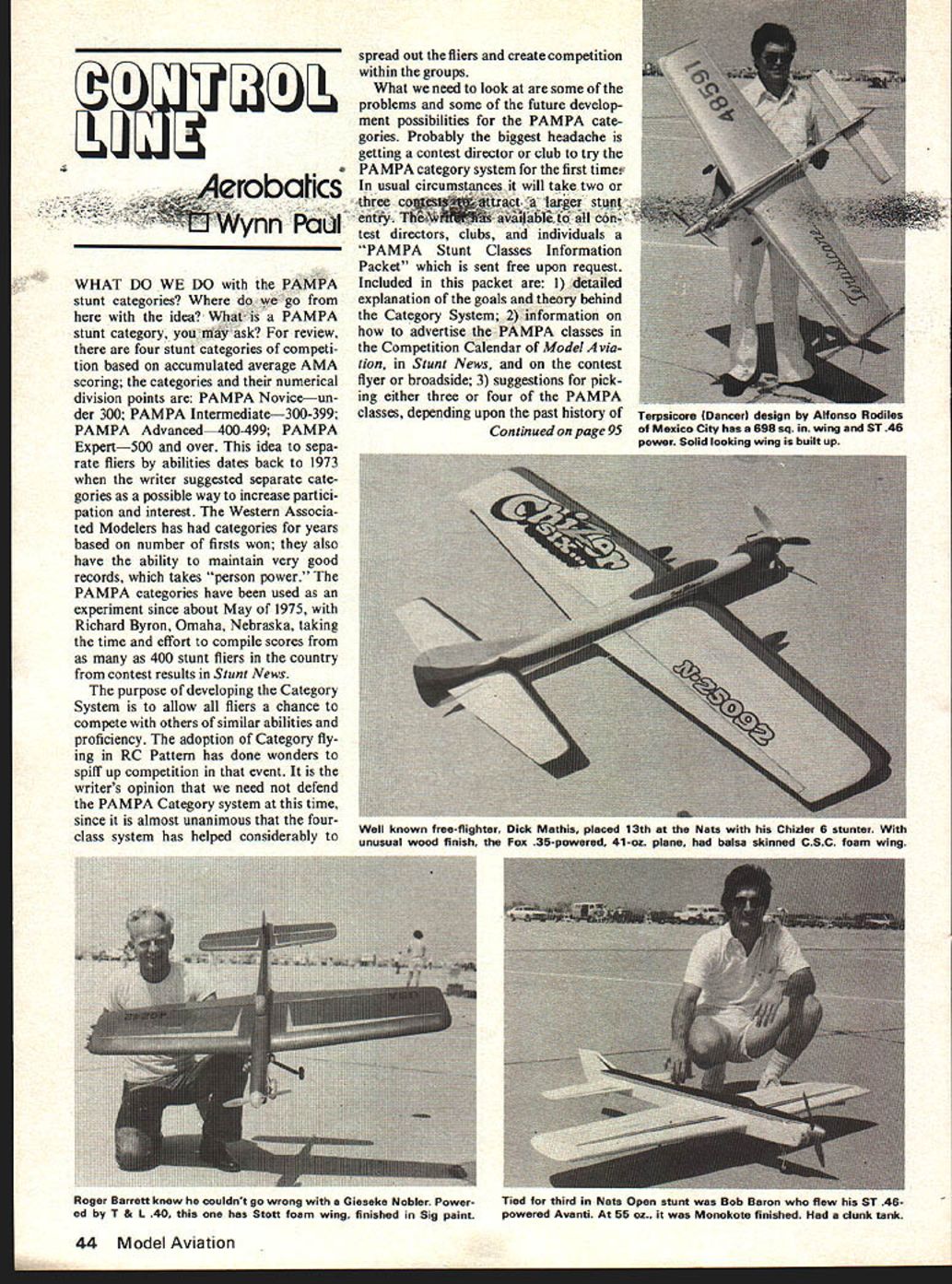
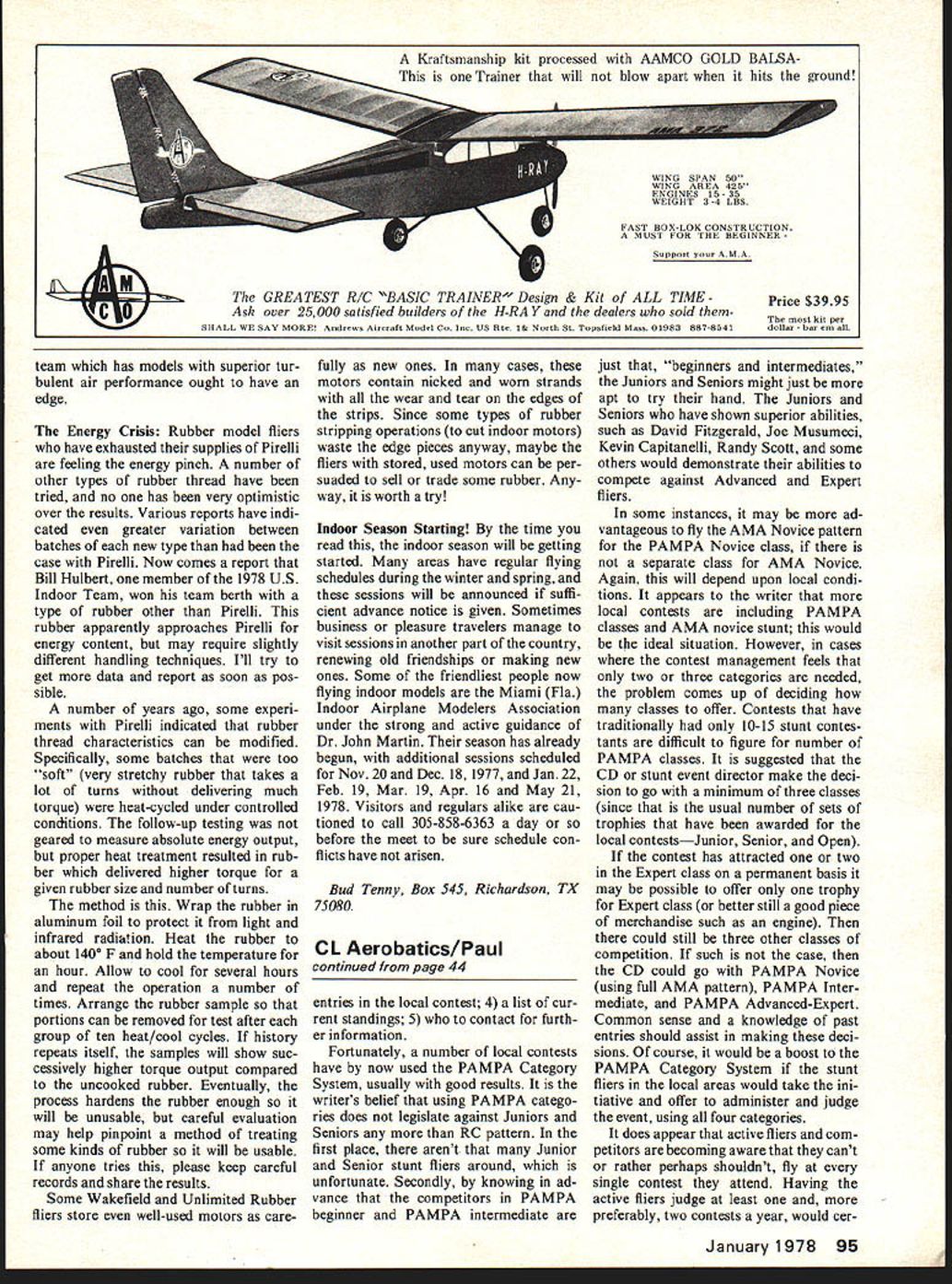
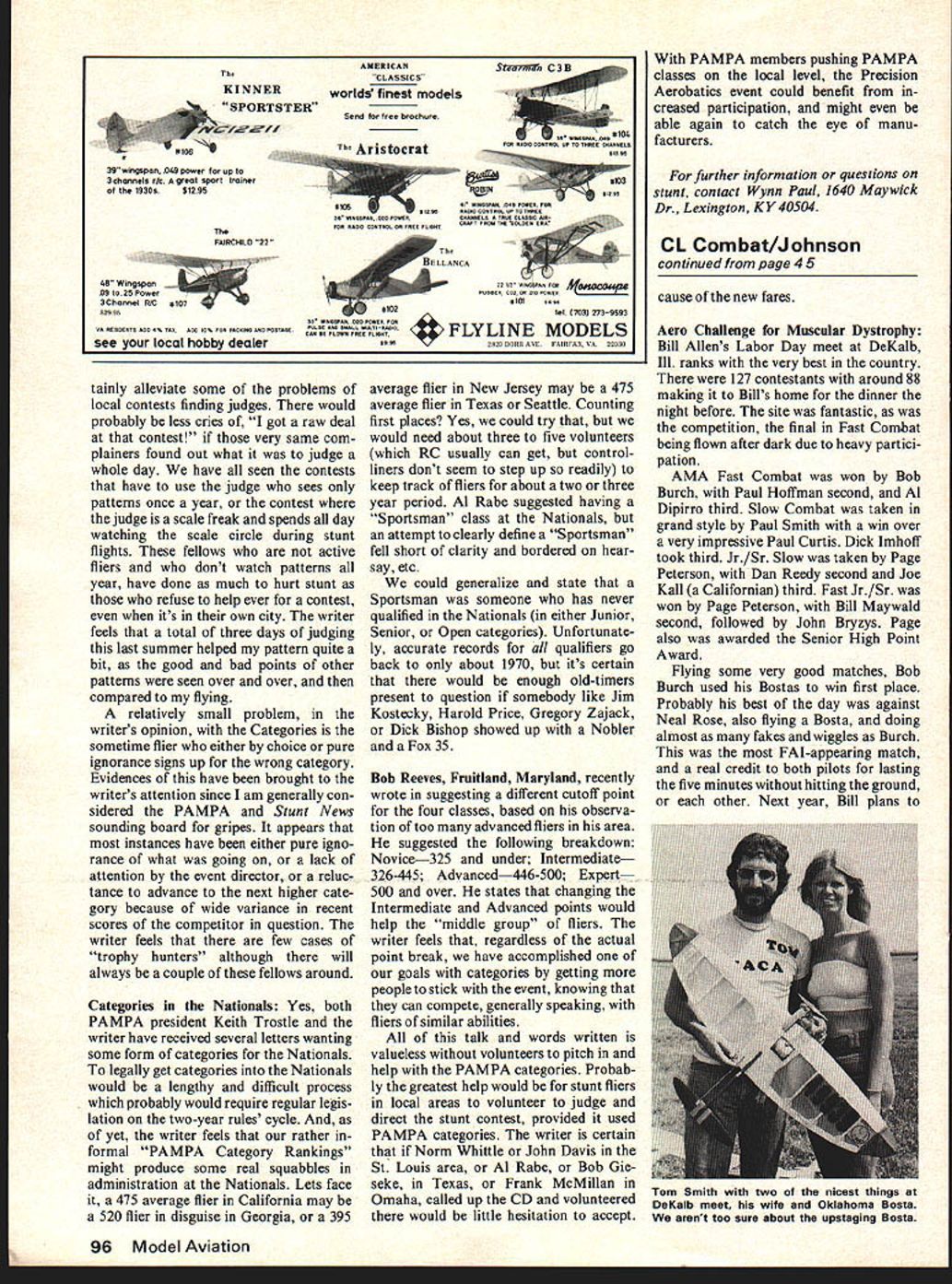
Control Line: Aerobatics
Wynn Paul
WHAT DO WE DO with the PAMPA stunt categories? Where do we go from here with the idea? What is a PAMPA stunt category, you may ask? For review, there are four stunt categories of competition based on accumulated average AMA scoring; the categories and their numerical division points are: PAMPA Novice—under 300; PAMPA Intermediate—300-399; PAMPA Advanced—400-499; PAMPA Expert—500 and over. This idea to separate fliers by abilities dates back to 1973 when the writer suggested separate categories as a possible way to increase participation and interest. The Western Associated Modelers has had categories for years based on number of firsts won; they also have the ability to maintain very good records, which takes "person power." The PAMPA categories have been used as an experiment since about May of 1975, with Richard Byron, Omaha, Nebraska, taking the time and effort to compile scores from as many as 400 stunt fliers in the country from contest results in Stunt News.
The purpose of developing the Category System is to allow all fliers a chance to compete with others of similar abilities and proficiency. The adoption of Category flying in RC Pattern has done wonders to spiff up competition in that event. It is the writer's opinion that we need not defend the PAMPA Category system at this time, since it is almost unanimous that the four-class system has helped considerably to spread out the fliers and create competition within the groups.
What we need to look at are some of the problems and some of the future development possibilities for the PAMPA categories. Probably the biggest headache is getting a contest director or club to try the PAMPA category system for the first time. In usual circumstances it will take two or three contests to attract a larger stunt entry. The writer has available, to all contest directors, clubs, and individuals a "PAMPA Stunt Classes Information Packet" which is sent free upon request. Included in this packet are: 1) detailed explanation of the goals and theory behind the Category System; 2) information on how to advertise the PAMPA classes in the Competition Calendar of Model Aviation, in Stunt News, and on the contest flyer or broadside; 3) suggestions for picking either three or four of the PAMPA classes, depending upon the past history of
CL Aerobatics/Paul
continued from page 44
entries in the local contest; 4) a list of current standings; 5) who to contact for further information.
Fortunately, a number of local contests have by now used the PAMPA Category System, usually with good results. It is the writer's belief that using PAMPA categories does not legislate against Juniors and Seniors any more than RC pattern. In the first place, there aren't that many Junior and Senior stunt fliers around, which is unfortunate. Secondly, by knowing in advance that the competitors in PAMPA Beginner and PAMPA Intermediate are just that, "beginners and intermediates," the Juniors and Seniors might just be more apt to try their hand. The Juniors and Seniors who have shown superior abilities, such as David Fitzgerald, Joe Musumeci, Kevin Capitanelli, Randy Scott, and some others would demonstrate their abilities to compete against Advanced and Expert fliers.
In some instances, it may be more advantageous to fly the AMA Novice pattern for the PAMPA Novice class, if there is not a separate class for AMA Novice. Again, this will depend upon local conditions. It appears to the writer that more local contests are including PAMPA classes and AMA novice stunt; this would be the ideal situation. However, in cases where the contest management feels that only two or three categories are needed, the problem comes up of deciding how many classes to offer. Contests that have traditionally had only 10-15 stunt contestants are difficult to figure for number of PAMPA classes. It is suggested that the CD or stunt event director make the decision to go with a minimum of three classes (since that is the usual number of sets of trophies that have been awarded for the local contests — Junior, Senior, and Open).
If the contest has attracted one or two in the Expert class on a permanent basis it may be possible to offer only one trophy for Expert class (or better still a good piece of merchandise such as an engine). Then there could still be three other classes of competition. If such is not the case, then the CD could go with PAMPA Novice (using full AMA pattern), PAMPA Intermediate, and PAMPA Advanced-Expert. Common sense and a knowledge of past entries should assist in making these decisions. Of course, it would be a boost to the PAMPA Category System if the stunt fliers in the local area would take the initiative and offer to administer and judge the event, using all four categories.
It does appear that active fliers and competitors are becoming aware that they can't or rather perhaps shouldn't, fly at every single contest they attend. Having the active fliers judge at least one and, more preferably, two contests a year, would cer- tainly alleviate some of the problems of local contests finding judges. There would probably be less cries of, "I got a raw deal at that contest!" if those very same complainers found out what it was to judge a whole day. We have all seen the contests that have to use the judge who sees only patterns once a year, or the contest where the judge is a scale freak and spends all day watching the scale circle during stunt flights. These fellows who are not active fliers and who don't watch patterns all year, have done as much to hurt stunt as those who refuse to help ever for a contest, even when it's in their own city. The writer feels that a total of three days of judging this last summer helped my pattern quite a bit, as the good and bad points of other patterns were seen over and over, and then compared to my flying.
A relatively small problem, in the writer's opinion, with the Categories is the sometime flier who either by choice or pure ignorance signs up for the wrong category. Evidences of this have been brought to the writer's attention since I am generally considered the PAMPA and Stunt News sounding board for gripes. It appears that most instances have been either pure ignorance of what was going on, or a lack of attention by the event director, or a reluctance to advance to the next higher category because of wide variance in recent scores of the competitor in question. The writer feels that there are few cases of "trophy hunters" although there will always be a couple of these fellows around.
Categories in the Nationals: Yes, both PAMPA president Keith Trostle and the writer have received several letters wanting some form of categories for the Nationals. To legally get categories into the Nationals would be a lengthy and difficult process which probably would require regular legislation on the two-year rules' cycle. And, as of yet, the writer feels that our rather informal "PAMPA Category Rankings" might produce some real squabbles in administration at the Nationals. Let's face it, a 475 average flier in California may be a 520 flier in disguise in Georgia, or a 395 average flier in New Jersey may be a 475 average flier in Texas or Seattle. Counting first places? Yes, we could try that, but we would need about three to five volunteers (which RC usually can get, but control-liners don't seem to step up so readily) to keep track of fliers for about a two or three year period. Al Rabe suggested having a "Sportsman" class at the Nationals, but an attempt to clearly define a "Sportsman" fell short of clarity and bordered on hearsay, etc.
We could generalize and state that a Sportsman was someone who has never qualified in the Nationals (in either Junior, Senior, or Open categories). Unfortunately, accurate records for all qualifiers go back to only about 1970, but it's certain that there would be enough old-timers present to question if somebody like Jim Kostecky, Harold Price, Gregory Zajack, or Dick Bishop showed up with a Nobler and a Fox 35.
Bob Reeves, Fruitland, Maryland, recently wrote in suggesting a different cutoff point for the four classes, based on his observation of too many advanced fliers in his area. He suggested the following breakdown: Novice—325 and under; Intermediate—326-445; Advanced—446-500; Expert—500 and over. He states that changing the Intermediate and Advanced points would help the "middle group" of fliers. The writer feels that, regardless of the actual point break, we have accomplished one of our goals with categories by getting more people to stick with the event, knowing that they can compete, generally speaking, with fliers of similar abilities.
All of this talk and words written is valueless without volunteers to pitch in and help with the PAMPA categories. Probably the greatest help would be for stunt fliers in local areas to volunteer to judge and direct the stunt contest, provided it used PAMPA categories. The writer is certain that if Norm Whittle or John Davis in the St. Louis area, or Al Rabe, or Bob Gieseke, in Texas, or Frank McMillan in Omaha, called up the CD and volunteered there would be little hesitation to accept.
With PAMPA members pushing PAMPA classes on the local level, the Precision Aerobatics event could benefit from increased participation, and might even be able again to catch the eye of manufacturers.
For further information or questions on stunt, contact Wynn Paul, 1640 Maywick Dr., Lexington, KY 40504.
Transcribed from original scans by AI. Minor OCR errors may remain.

