
CONTROL LINE AEROBATICS
Frank McMillan 12106 Gunter Grove, San Antonio TX 78231
Forum and contest (DMAA, President's Day weekend)
On President's Day weekend, the Dallas Model Aircraft Association (DMAA) hosted a Stunt (Precision Aerobatics) Forum and contest. After many years of envying the wonderful forums hosted by the Garden State Circle Burners club, I really looked forward to this inaugural event.
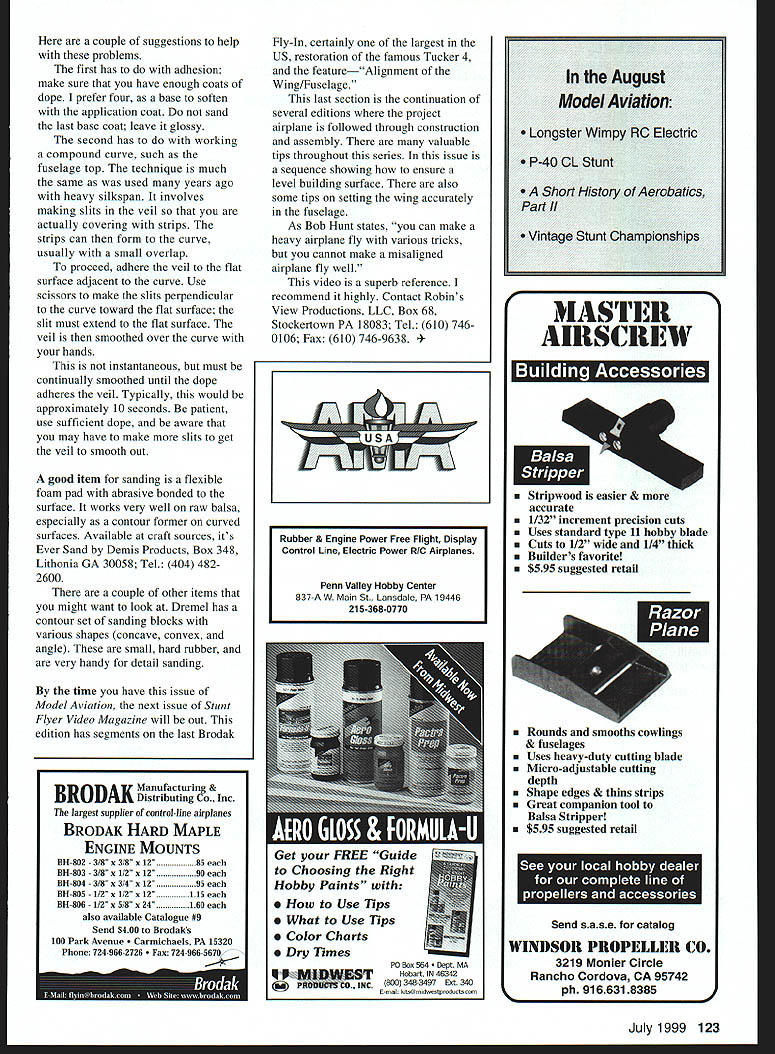
I'd seen several of the Windy Urtnowski tapes on the Garden State Circle Burners forums, enjoyed them, and I recommend them.
Chief organizer Tom Niebuhr, with DMAA President Mike Scott, did a superb job of organizing the presentations and keeping the proceedings moving throughout the day.
The list of forum topics was varied, ranging from:
- designing a semiscale Stunter
- designing a Stunt paint scheme
- various construction tips and tools
Since I can't recount all of the presentations, I'll pass on some of the tips that I thought were of value.
Don Hutchinson — semiscale Stearman Stunters
Don Hutchinson builds some of the most gorgeous semiscale Stearman Stunters, and he had his latest, in primer, for display. With shock gear and tail skid it was unbelievably light. The craftsmanship was beautiful.
Finish and materials:
- Nitrate dope on medium silkspan, with white added in later coats.
- The finish was sanded with steel wool (0000) because of the open-bay construction.
- This version had almost-full-span flaps on the lower wing. Don tried coupled flaps on both wings, but that didn't help the turn; it probably blanked the elevators.
Tools and techniques: Don's presentation focused on the many small special-purpose tools he uses. Mike Scott noted surprise at the lack of major tools in Don's workshop, which makes his craftsmanship all the more impressive.
As I've said many times, if you know how to use sandpaper, you can build good models. Don demonstrated many special-shaped sanding blocks—specific shapes for specific purposes:
- thin, sharply angled plates with holding pieces to reach corners
- radiused blocks (concave and convex) for curved surfaces
One almost-essential item Don showed was a distance indicator.
Distance indicator
The device is simple but effective for ensuring consistent dimensions at various points and stages of construction:
- A steel block, approximately two inches on a side, with a true flat bottom.
- A hole drilled into the back to support a vertical shaft; the shaft can be any material to which you can affix a pointer.
- The pointer must be height-adjustable but fixed once set (Don used a thin wire pointer on a slider).
- Use: indicate a set distance from a reference plane (such as your building table). For wing alignment, set to the wing centerline at the leading edge, then move around the wing edges to check incidence.
Once you use a device like this, you may wonder how you built accurately without one.
Radio Shack Thermometer/Hygrometer
One thing that really caught my attention was a Radio Shack Thermometer/Hygrometer, #63-867. This instrument gives real-time temperature and humidity. I've been looking for this capability to help with painting and to decide when and how to use paint.
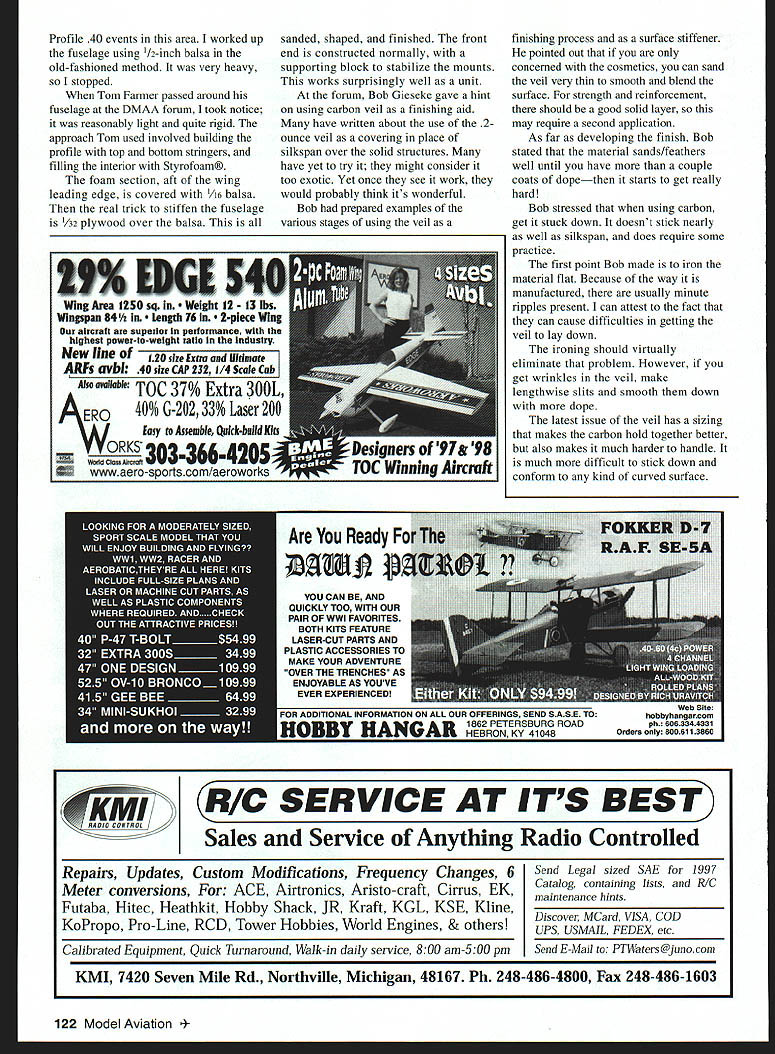
Television weather is simply not responsive enough to tell me the conditions in my garage; clear skies, by visual inspection, also don't suffice. This seemed to be the solution. I got one for $29.95 and have used it almost every day since while painting my refinished Caudron.
Other uses include performance testing on engines, propellers, etc. I'm going to start using it when I fly to collect more accurate data.
Rigid profile airplane construction (Tom Farmer)
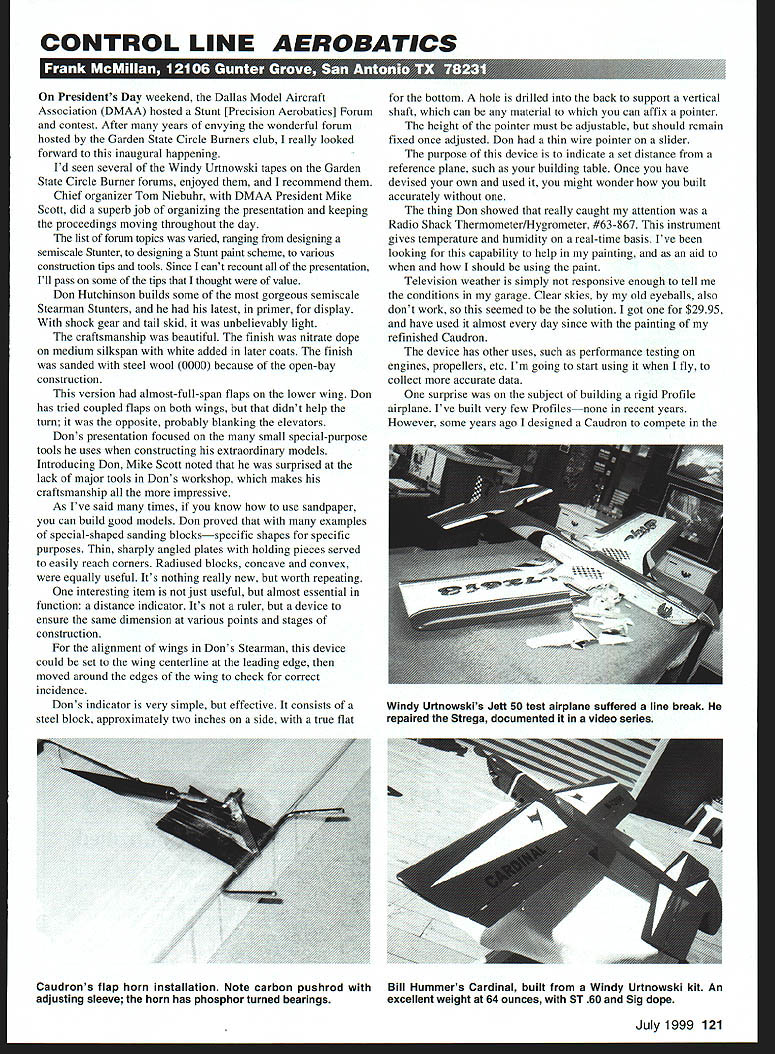
One surprise was a method for building a rigid profile airplane. I have built very few Profiles and none in recent years. Some years ago I designed a Caudron for Profile 40 events using 1/2-inch balsa, and it was very heavy. Tom Farmer passed around a fuselage at the DMAA forum that was reasonably light and quite rigid.
Tom's approach:
- Build profile top and bottom stringers.
- Fill the interior with Styrofoam sections aft of the wing leading edge.
- Cover with 1/16 balsa.
- Stiffen the fuselage with 1/32 plywood over balsa, then sand, shape, and finish.
- The front end is constructed normally on a supporting block to stabilize mounts.
The unit works surprisingly well.
Carbon veil finishing (Bob Gieseke)
Bob Gieseke gave a helpful presentation on using carbon veil as a finishing aid. I've written about the use of 2-ounce veil covering placed under silkspan over solid structures. Bob prepared examples showing the stages of using the veil as a finishing process and as a surface stiffener.
Key points and tips:
- If you're only concerned with cosmetics, sand the veil very thin to smooth and blend the surface.
- For strength and reinforcement, apply a solid layer; this may require a second application.
- The veil sands/feathers well until you have more than a couple coats of dope—after that it gets very hard.
- Carbon doesn't stick nearly as well as silkspan and requires practice to get it stuck down.
- Iron the material flat first to remove minute ripples produced in manufacture; ripples can make it difficult for the veil to lay down.
- If you get wrinkles, make lengthwise slits and smooth them down with more dope.
- Newer veil has sizing that makes the carbon hold together better but also makes it harder to handle and stick down.
Practical procedure for compound curves:
- Ensure you have enough base coats of dope; Bob prefers four as a base and does not sand the last base coat—leave it glossy.
- For a curved fuselage top, make slits in the veil so you are covering with strips; strips form to the curve, usually with a small overlap.
- Adhere the veil to the flat surface adjacent to the curve.
- Make slits perpendicular to the curve toward the flat surface; the slit must extend to the flat.
- Smooth the veil over the curve by hand until the dope adheres—typically about 10 seconds. Be patient and use sufficient dope; you may need more slits to get a smooth laydown.
Sanding and finishing tools
- A flexible foam pad with abrasive bonded to the surface is excellent for sanding raw balsa and as a contour former on curved surfaces. Available at craft sources as Ever Sand by Demis Products, Box 348, Lithonia GA 30058; Tel.: (404) 482-2600.
- Dremel offers a contour set of small hard rubber sanding blocks (concave, convex, and angle) that are handy for detail sanding.
Video recommendation
By the time you have this issue of Model Aviation, the next issue of Stunt Flyer Video Magazine will be out. This edition has segments on the last Brodak Fly-In (one of the largest in the U.S.), restoration of the famous Tucker 4, and the feature "Alignment of the Wing/Fuselage."
The last section continues a series following a project airplane through construction and assembly, with many valuable tips, including how to ensure a level building surface and setting the wing accurately in the fuselage.
As Bob Hunt states, "you can make a heavy airplane fly with various tricks, but you cannot make a misaligned airplane fly well."
This video is a superb reference. I recommend it highly. Contact: Robin's View Productions, LLC, Box 68, Stockertown PA 18083; Tel.: (610) 746-0106; Fax: (610) 746-9638.
Transcribed from original scans by AI. Minor OCR errors may remain.

