
CONTROL LINE AEROBATICS
By
Frank McMillan 12106 Gunter Grove, San Antonio, TX 78231
When I started modeling in the late 1940s, we builders didn't think too much about what to paint our airplanes with; it was nitrate-based dope with butyrate dope over it for fuel-proofing. The early brands were Testors, Speed-o-Laq, AeroGloss, and other locally produced or packaged materials. Most brands worked reasonably well as long as you kept the butyrate over the nitrate; they worked well enough so that the process was just "there," working.
The advent of many high-performance automotive materials made them the "in" finishes; they were self-leveling, highly fuel-resistant, and beautiful. However, they did not come without potential problems—most were multipart and highly toxic. They required that the user wear protective garments and a special mask with an outside air source. Many users ignored these warnings and have had episodes. That problem has not gone away, so be careful!
For the past building season, I've been working with and reporting on a refinishing project using the new Brodak dope. I have finished all of the trim, inking, and dry-transfer work, so the clear overcoat is the next step. Below are my general impressions on working the dope, summarized from the project start.
Brodak Dope: Refinishing Project
Across the board, the Brodak dope is an honest, predictable product that does exactly what it is supposed to, and does it very well. It is extremely high-quality and consistent. The dope is manufactured expressly for John Brodak by the Randolph Corporation, a longtime respected manufacturer of aircraft finishes.
From the clear to the nine colors I worked with, the dope worked best when thinned one to one, whether sprayed or brushed. At the start of the finishing process, I thinned the clear a bit more than 50/50 to get good presentation on the first two coats. From then on, it was 50/50.
On the initial clear coats, flow-out and coverage were excellent. No brush marks were evident. When I achieved a slight shine, I added some zinc stearate as a filler and sprayed the coats, sanding well in between. The second layer was a spot-coat to touch up flaws. A blocking coat of Polar Gray to show flaws was next.
Although the gray covers wonderfully, I'm going to revert to silver for the next finish to get a comparison. Dings and dry spots were worked prior to spotting the gray to perfection. The philosophy was to work the one coat to perfection without completely recoating. If done right, this should provide the lightest base for color.
White was next on the schedule. White is not an easy cover, so I was very interested in seeing how good this dope really is. I'd been told that coverage was one of the development focuses—especially with the white, red, and yellow. Extra pigment was added—an expensive but necessary approach. The white flowed on perfectly; coverage was excellent in one coat. I was very pleased.
I was anxious about one feature of the dope: for years I've experienced layer separation when I have pulled up masking tape in the trim process. On this airplane, I used seven trim colors—plain and metallic—and not once did I pull up the base color. The more I worked the trim, the more respect I had for this product.
The colors are solid and vibrant, and each covers extremely well. I airbrushed the trim, which I recommend rather than using a touch-up gun. You may have to thin the paint a bit more than 50/50, but you'll get a feel for that as you go. I really like how easily the airbrush application could be controlled.
I decided to put more detail into the eagle on the side of my model's fuselage; using stencils, the shading was smooth and effective. It was easy to achieve proper coverage, yet keep the application relatively dry.
As I used the dope, I noticed a few things. This is a butyrate dope, so it has characteristics common to the type. When humidity gets high, it will blush or trap moisture. When brushed, the dope will tolerate a higher humidity before blushing—approximately 70%. When sprayed, the humidity should be less than 50%.
This characteristic can be mitigated with the addition of some Brodak retarder, but use only enough to stop the blushing. The best approach is to wait for a more desirable day.
The Brodak dope lives up to its fast-growing reputation. It is easy to use—much like taking a trip back in time. I will be using this product from now on.
- Brodak, 100 Park Ave., Carmichaels, PA 15320; Tel: (724) 966-2726
New Jett .60 Engine
By the time you read this, the new Jett .60 will be available from George Aldrich. Following the success of the piped Jett .50, George developed an enlarged version using the same case as the .50; banding the lower end provides increased stroke. Externally the .60 is the same as the .50 and will drop into the currently popular engine mounts and should be a good engine.
- George Aldrich Models, 12822 Tarrytown, San Antonio, TX 78233; Tel: (210) 656-2021
Carbon/Epoxy Molded Parts
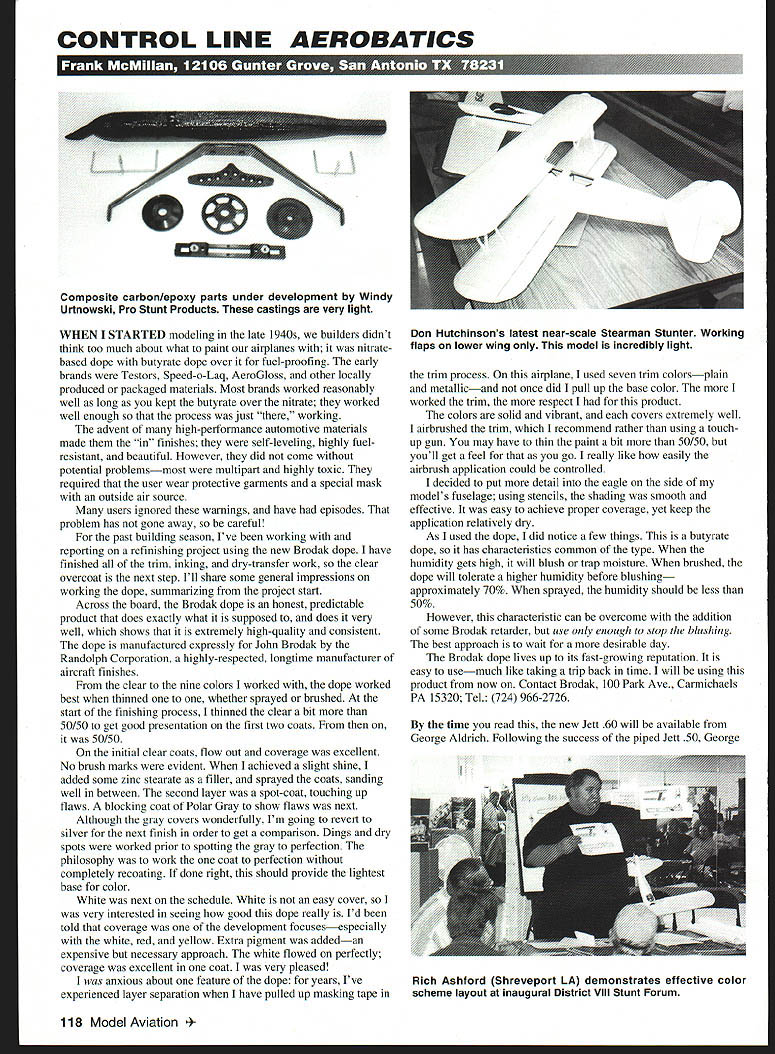
Spurred by carbon-fiber molding success on a composite one-beam Spitfire, Windy Urtnowski is branching out with carbon/epoxy molded parts under development. There is a substitute for the standard aluminum versions used in many popular kits, at half the weight.
Also available are Windy's carbon/epoxy backplates for many of the popular spinner sizes used on modern stunters. These are very nice, very light castings.
- Pro Stunt Products (Windy Urtnowski), 93 Elliott Pl., Rutherford, NJ 07070; Tel: (201) 896-8740
Transcribed from original scans by AI. Minor OCR errors may remain.

