
CONTROL LINE AEROBATICS
Frank McMillan 12106 Gunter Grove, San Antonio, TX 78231
While I was participating in the annual contest lunch at the Memorial Day Houston contest, I was asked to put more in the column for the up-and-coming flier.
In the past, I have run the gamut of topics, from flying to building—many subjects prompted by personal "adventures." My orientation has been to share technologies, sometimes in a series of columns, with the thought that readers could use what applied to them. Meanwhile, they were exposed to other information.
Reflecting on that discussion in Houston, I've decided to periodically focus columns on the new fliers to help them get off to a good start. Suggestions for topics are welcome, as are pictures.
The best place for beginners to start is to read everything available. It sounds elementary, but there has been an explosion of published information during the last 10–15 years. The best place for information, in addition to MA and Flying Models, is Stunt News, a publication of PAMPA (Precision Aerobatics Model Pilots Association), the AMA Special Interest Group. Stunt News is a magazine unto itself (published six times a year) that is well worth the annual PAMPA membership fee of $20. For information, contact Shareen Fancher, 158 Flying Cloud Isle, Foster City, CA 94404; Tel: (650) 345-0130; Fax: (650) 578-8454. Back issues and a myriad of information sets are available.
I have a few observations on developing what some of the top fliers refer to as "the program." I'll call it a path to improvement, or a plan.
Each person has a different goal. Some impose a lofty aim of national or world championships, which is in reach of very few who are willing to pay the high price in pursuit of the dream. Most simply want to gain the skills, and enjoy the sheer joy of flying the beautiful creations.
Flying precision aerobatics ultimately requires that you learn how to build. Just as flying improves with repetition, so does building. Assuming that you work at it, the more you build, the better you'll get.
The basic tenets are the same for any model that you want to perform well:
- It must be built accurately.
- It must be light.
- It must be sufficiently strong.
Practicing building gives you the facility and capability to continually improve. Learning how to sand balsa and what materials to use is one important factor. I'll discuss this more in later columns.
You can't expect to improve without doing the tasks required to put airplanes together. I learn that with each new project I have to get reacquainted with selected skills.
Not long ago, I was asked which designs to build in the context of growing in flying Stunt. There are many, one of which is the Flite Streak series kitted by Brodak Manufacturing and Distributing Co., 100 Park Ave., Carmichaels, PA 15320; Tel: (724) 966-2726. Brodak has an excellent catalog crammed with helpful hints. The Flite Streak design series serves the basic needs, from the rugged trainer through the later stages, which are capable of the full Stunt pattern.
The latest-and-greatest design may not serve your needs. Jumping from one design to another won't necessarily serve your needs. My recommendation is to start with a kit that will require that you do more than you can. Stick with that design until your capability has caught up. Do what you have to do to keep the airplane flying—repair, rebuild, or build another. Do the same for the next step.
When you get to the point of starting to fly well, pick a popular proven design and stick with it. Learn how to trim, tune your engine, and build accurately and light. By keeping the design constant, you can see what improvements you make. The currently available good designs, properly built and trimmed, will fly well enough to get you into the top 10.
Items of Interest
If you're a modeler who has pride in your work, you might want molding balsa components for precision aerobatics projects. They have long been part of Stunt technology.
In the early 1950s, Testors Corp. had an early Stunter kit that used molded fuselage shells. Top Flite used shells in more than one control line kit, such as the Aldrich Peacemaker. Al Rabe used the technique successfully in his semiscale series, and took the technology to another level by adding techniques to complex moldings with balsa.
I have written several articles on the molding techniques, including the development of molds. Windy Urtnowski has done video documentation of some well-done, straightforward moldings. Now there is a comprehensive two-tape set from Bob Hunt's Robin's View Productions. Bob teams with master-builder Bill Werwage to give a tour de force of how to do all types of molding. The primary subject of the tape is the development of Bill's new Bearcat design. A picture makes a point as no other medium does. Bill takes viewers from plans to molds to completed fuselage.
What makes this video unique is that this is the first time viewers can see the advanced techniques, where compound curves with major changes in shape are handled. This requires careful wood selection, development of skin shapes, slitting of the wood as it is applied to the mold, etc. And all of it is covered in carefully edited sequences.
After you have seen this video, you will understand how to use these techniques and visualize the benefits. I recommend it highly. Contact Robin's View Productions, LLC, Box 68, Stockertown, PA 18083; Tel: (610) 746-0106.
I'd like to make you aware of several items that go back to the old days of Stunt and ignition.
For many years, I've wanted to build a competitive ignition Old-Timer. At the Dallas symposium/clinic in February, Don Hutchinson had his Madman, with which he has been very successful. I've wondered why, because the old-timers that I talked to said the Madman wouldn't do vertical 8s. After picking up the airplane, I knew Don's secret. The weight was 32 ounces, which made the wing loading a little more than 11 ounces per square foot. The original Madman was flown with an Orwick .64 and heavy ignition systems, so it was probably more than a pound heavier.
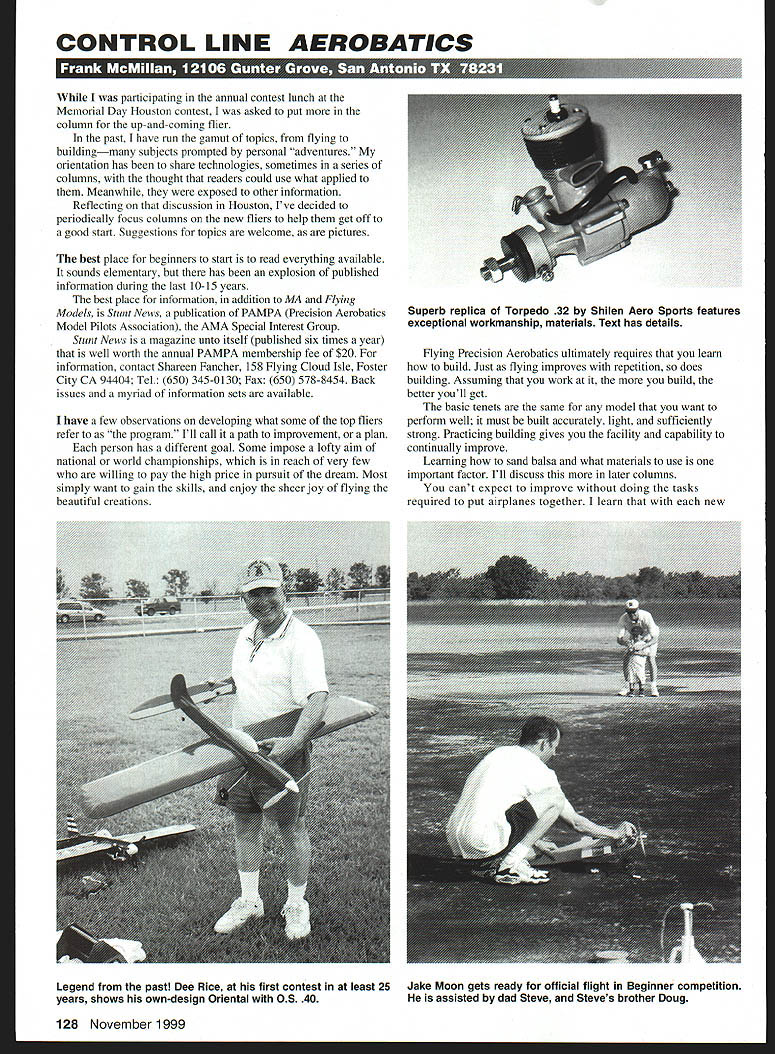
Don used a well-built, light model with a lightweight engine and redesigned ignition system; no wonder his Madman flew well. I've acquired an engine similar to Don's, and plan to use it: a replica Torpedo .32 with ignition, faithfully executed by Shilen Aero Sports, Box 1300, Ennis, TX 75119; Tel: (214) 875-1442. This is top-quality machine work with superb fits. Also available are other-size Torpedoes and an original .19. They can be acquired with ignition points or glow versions.
To go along with the engine is a jewel of an ignition system by Floyd Carter. It weighs three ounces and comes prewired for us dummies. The workmanship is wonderful and incorporates a different principle in the ignition circuit: the system uses a transistor amplifier so that the points only have to switch a very small current. Therefore, no sparking occurs, and the presence of oil or poor contact will not adversely affect the strength of the spark.
Contact Floyd at Aero Ply Research Co., 2029 Crist Dr., Los Altos, CA 94024.
Transcribed from original scans by AI. Minor OCR errors may remain.

