

CONTROL LINE AEROBATICS
Frank McMillan, 12106 Gunter Grove, San Antonio TX 78231
Each Nationals (Nats) has its own character. The contests have a way of defining themselves by the people who come to compete and be part of history.
With a large number of overseas guests in Control Line Precision Aerobatics, this year's Nats had a distinct international flavor. U.S. pilots were challenged at every level of competition. We are one of the few countries that permits competitors from other nations, and this broadens and enriches the week of competition.
Nats Atmosphere and Site
For the Open and Advanced fliers, the guts of the competition week began with qualifying rounds on Wednesday, July 14. All four of the "L-pad" paved circles were filled with competition. Judges worked in teams that saw one round of Open and one round of Advanced fliers.
With the beautiful Muncie site, green grass, and exceptional weather, the fun was in the air. As the scores were posted, pilots congregated around the scoreboards asking, "Who's scoring?" and "How did I stack up to Big Bill or Bob?" Small groups gathered to study scoresheets and figure out "What adjustments do I have to make to score better?" — part of the process of elimination until the national champion is selected.
The qualifying rounds are contests within contests. Each group member vies to be in the top 10 in each circle; pilots must get that one good flight per day. As Randy Smith put it, "everything is survival 'til Friday." The competition was tight: in one circle the difference in the total of two flight scores for places 8–12 was seven points; the other Open circle had equally close groupings.
Open Competition
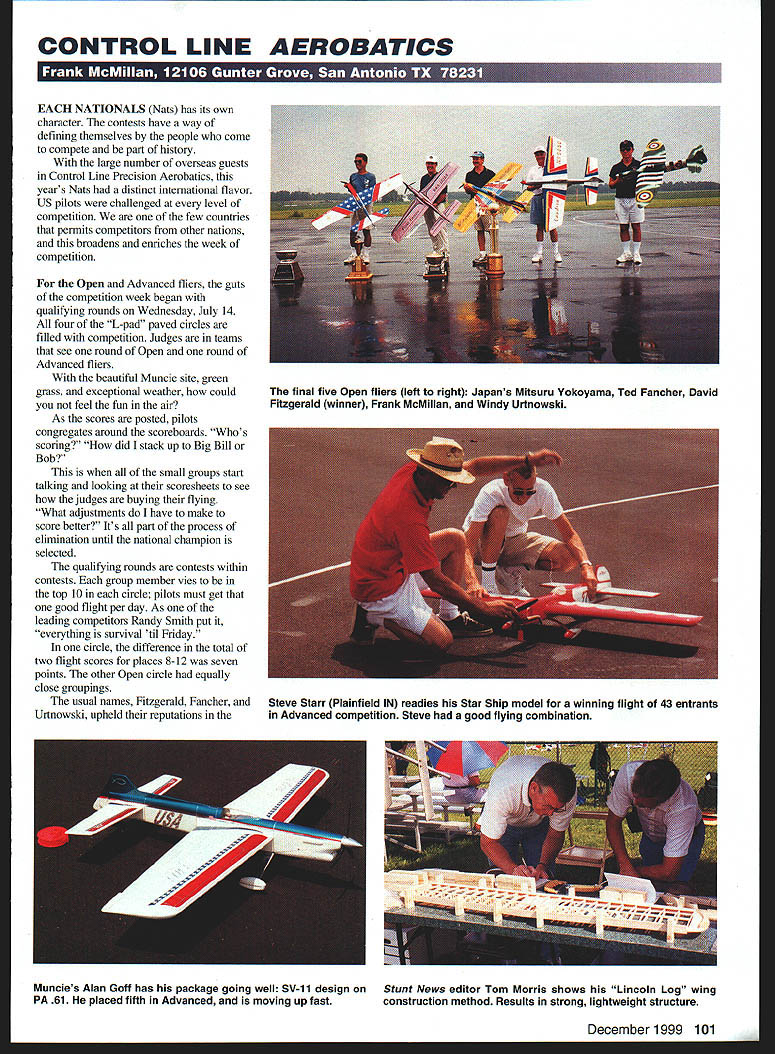
The usual names—Fitzgerald, Fancher, and Urtnowski—upheld their reputations in the Open round. Japanese pilots Kaz Minato and Mitsuru Yokoyama, members of the Japanese F2B team, flew flawless models and were very impressive.
Every year it seems a new flier comes to really compete. This year Curt Contrata made his mark—working hard, always in the air—and eventually earned Rookie of the Year as the highest-placing first-time qualifier (12th). Brett Buck switched to a PA .61 and was scoring well. Bob McDonald brought a version of the Unlimited air-racing P-47 in a Prowler Yellow scheme that looks scalelike and flies beautifully. Allen Brickhaus fielded his latest opus with a PA .61. Jim Lynch of Memphis, TN, returned to the "wars" with a beautiful Geo XL powered PA .61 and pipe; expect him to push the top 10 next year.
Friday Finals and Weather Drama
Friday is the toughest day in Stunt at the Nats—one flight on two circles with no throwaways. Competitors are reduced when sixth- through 20th-place is determined; the top five advance.
As the rounds unfolded, the air changed and clouds darkened, with lightning closing in. Warren Tiahrt called a short break for safety reasons. After the intermission, Ted Fancher flew in cooler, less windy conditions and recorded the high flight of the round. Shortly after Ted's flight the rains came, soaking the field. Windy Urtnowski chose not to risk his solid lines locking up and passed, thus ending the flyoff.
When the scores were tabulated, David Fitzgerald had clearly won. Ted Fancher and Mitsuru Yokoyama completed impressive weeks, and Windy Urtnowski showed excellent squares flying his latest I-beam Spitfire.
Advanced Class
The Advanced class qualification sequence has evolved; the level of flying is beginning to approach that of the Open class. Advanced drew 43 entries and was closely contested.
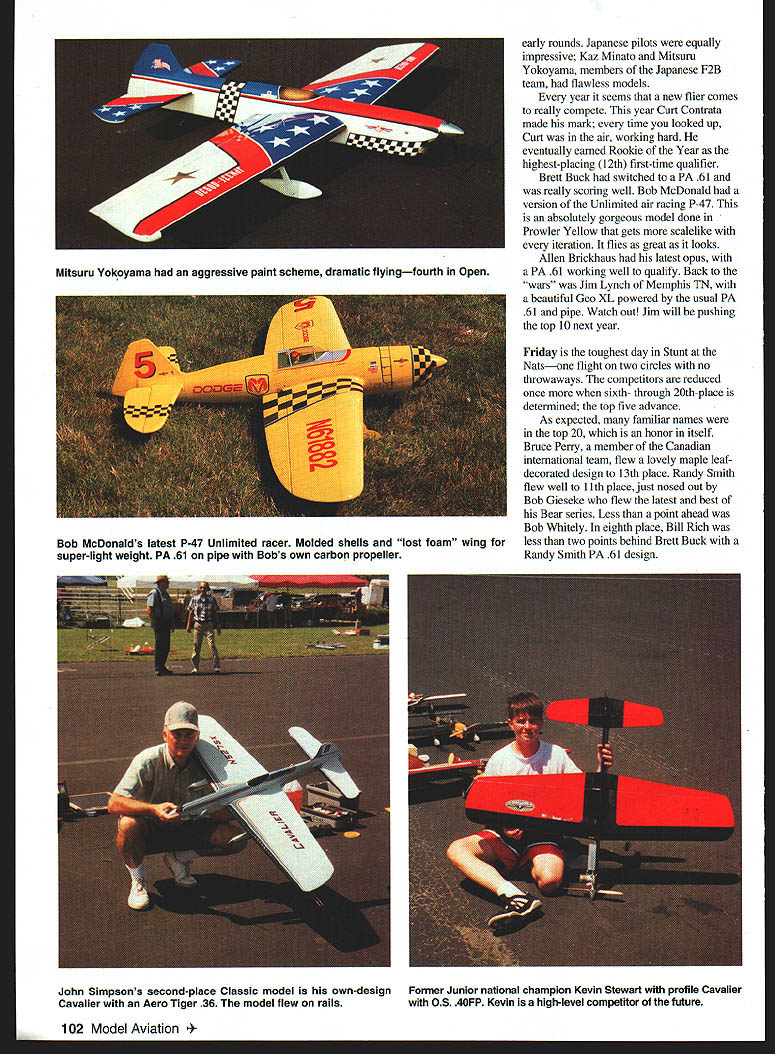
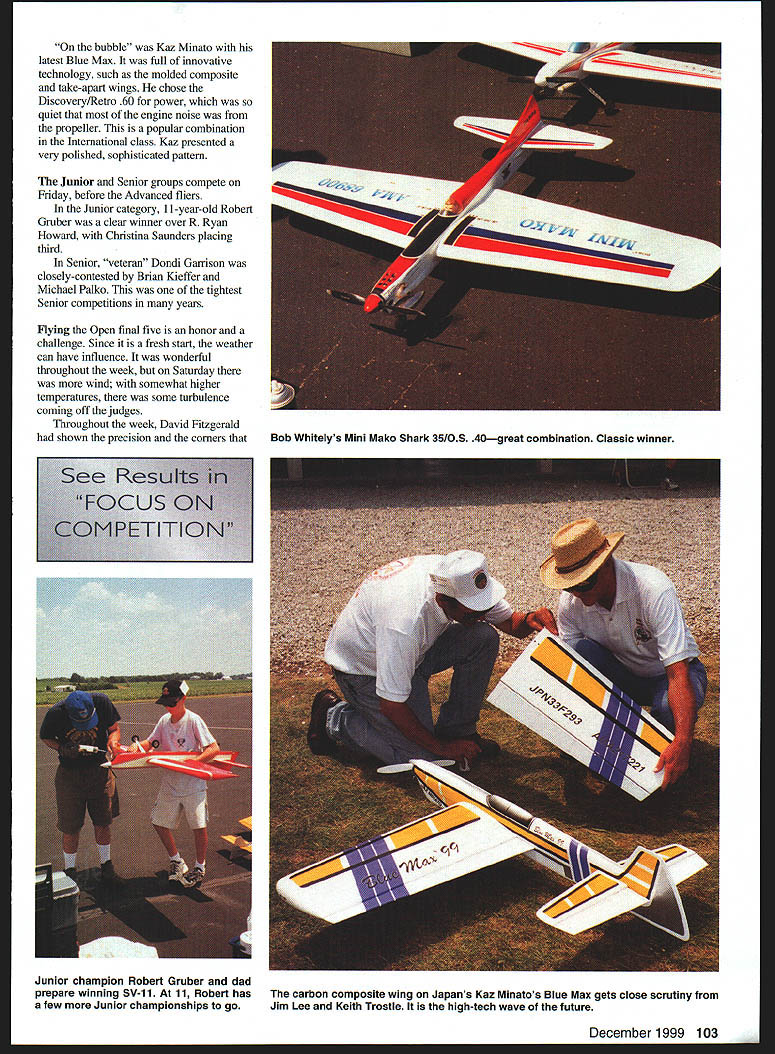
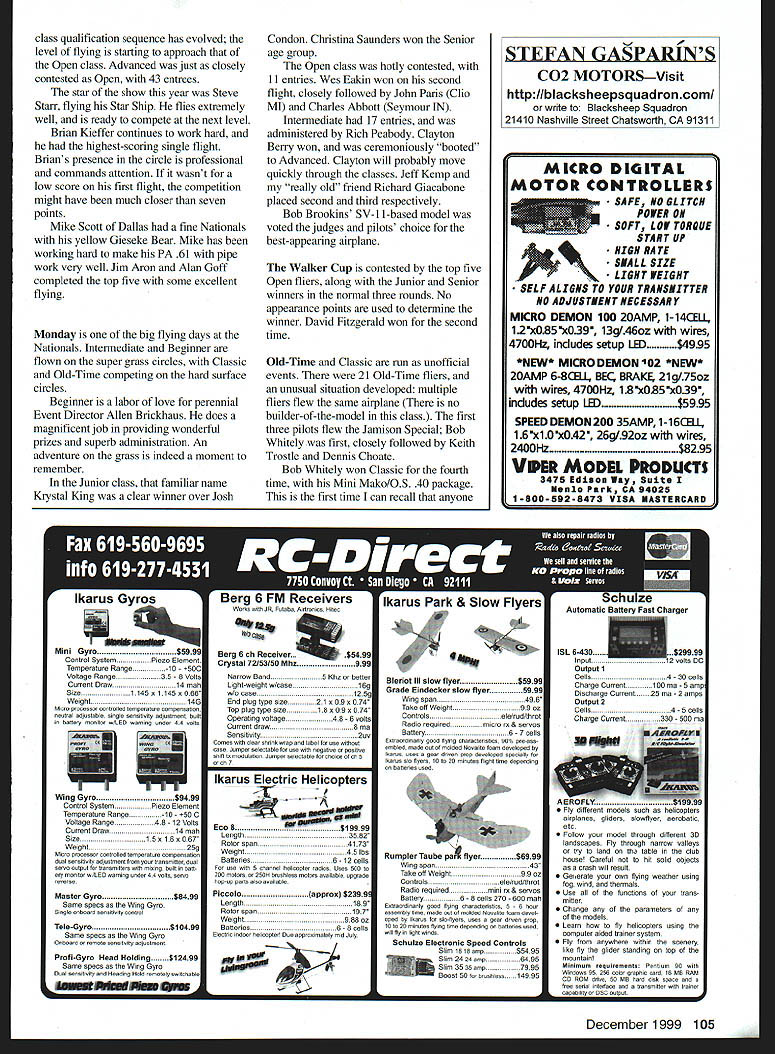
The star of the show was Steve Starr, flying his Star Ship—he flies extremely well and looks ready to move up to the Open level. Brian Kieffer continued to work hard and posted the highest-scoring single flight; if not for a low first flight the competition might have been much closer. Mike Scott of Dallas had a fine Nationals with his yellow Gieseke Bear; Jim Aron and Alan Goff completed the top five with excellent flying. Tom Morris (Stunt News editor) showed a Lincoln-log–wing PA-61 that placed fifth.
Japanese pilots Kaz Minato and Mitsuru Yokoyama again impressed with flawless models. Brett Buck, another first-time qualifier, continued to score well with his PA .61.
Other Classes and Highlights
Monday is a big flying day at the Nationals. Intermediate and Beginner compete on the super grass circles, with Classic and Old-Time on the hard-surface circles.
- Beginner: Event Director Allen Brickhaus puts great effort into Beginner—providing wonderful prizes and superb administration.
- Junior and Senior: Junior and Senior groups competed on Friday and provided tightly contested events across age groups. Reported junior winners include Krystal King (over Josh Condon) and, in another reported Junior contest, 11-year-old Robert Gruber over R. Ryan Howard with Christina Saunders placing third. Christina Saunders was also noted as a Senior age-group winner in other reporting.
- Intermediate: Administered by Rich Peabody, Intermediate had 17 entries. Clayton Berry won and was ceremoniously "booted" to Advanced. Jeff Kemp and Richard Giacobone placed second and third.
- Open class (separate local Open event): One hotly contested Open with 11 entries saw Wess Eakin win on his second flight, closely followed by John Paris (Clio, MI) and Charles Abbott (Seymour, IN).
- Classic and Old-Time (unofficial): There were 21 Old-Time fliers. Multiple pilots flew the Jamison Special; Bob Whitely placed first, followed closely by Keith Trostle and Dennis Choate. Bob Whitely won Classic for the fourth time with his Mini Mako/O.S. .40 package.
- Walker Cup: Contested by the top five Open fliers plus the Junior and Senior winners over three rounds (no appearance points). David Fitzgerald won the Walker Cup for the second time.
- Best-appearing airplane: Bob Brookins' SV-11–based model was voted judges' and pilots' choice for best-appearing airplane.
Other notable airplanes and technology:
- Bob McDonald's Unlimited P-47 used molded shells and a lost-foam wing for super-light weight and a carbon propeller.
- Kevin Stewart flew an Aero Tiger 36 profile with an OS .40 FP, showing high-level potential.
- Kaz Minato's Blue Max featured molded composite take-apart wings and a Discovery/Retro 60 power package for a quiet engine/propeller combination.
Trends and Technology
Trends at this Nationals:
- Engines: In Open competition, 18 of the top 20 pilots flew Precision Aero engines with pipes. The new Jett .60 made a good showing and ran well; the Discovery/Retro .60 also appeared as an interesting package.
- Airframe design: The SV series by Randy Smith was well represented and performed strongly across classes.
- High-tech components: Carbon composite wings (notably by Kaz Minato) generated much discussion. Talk also centered on carbon fuselages (Windy Urtnowski and Tom Morris). Exciting times are ahead as construction and materials evolve.
Each year the level of flying increases. Two factors pushing the envelope are the extraordinary engines and related technologies, and the wealth of shared information among competitors. These are golden years for Stunt.
Volunteers and Acknowledgments
Control Line Precision Aerobatics at the Nationals is run by a dedicated staff of volunteers. That the event runs smoothly is a tribute to much hard work behind the scenes.
- Event Director: Warren Tiahrt
- Head judge: Gary McClellan
- Score display and tabulation: Shaner Fancher and Lila Lee, ably assisted by Cathy Fitzgerald
- Pit boss: Woody Midgey
Thanks to all the other volunteers for their efforts — it wouldn't happen without you.
I also want to recognize individuals who inspired us throughout the week. Their courage and love of the event, despite physical challenges, is an example to us all. Thank you for being there.
Transcribed from original scans by AI. Minor OCR errors may remain.

