

Control Line: Aerobatics
Wynn Paul
WHILE AT THE Nationals in California, this writer had a chance to talk with stunt judge Bill Fitzgerald about balancing props. Bill, from San Mateo, California, is an airline captain, and has borrowed his technique from the "real airplanes." He says that full-size props are balanced in a three-step fashion: tracking, dynamic (horizontal position), and static (vertical position) states. While trying to practice on the March AFB runways, I naturally nicked a prop, so Bill volunteered to balance one of mine so I could watch and report.
The first step in balancing, according to Bill, is to select a prop that is "semi-balanced" as it comes out of the package. Depending upon your pocketbook and your chance to sift through the local hobby shop's supply, you may or may not have an opportunity to pre-select your props. Assuming that you have one that will balance out fairly well on the conventional hand-held prop balancer, then we proceed to the next step.
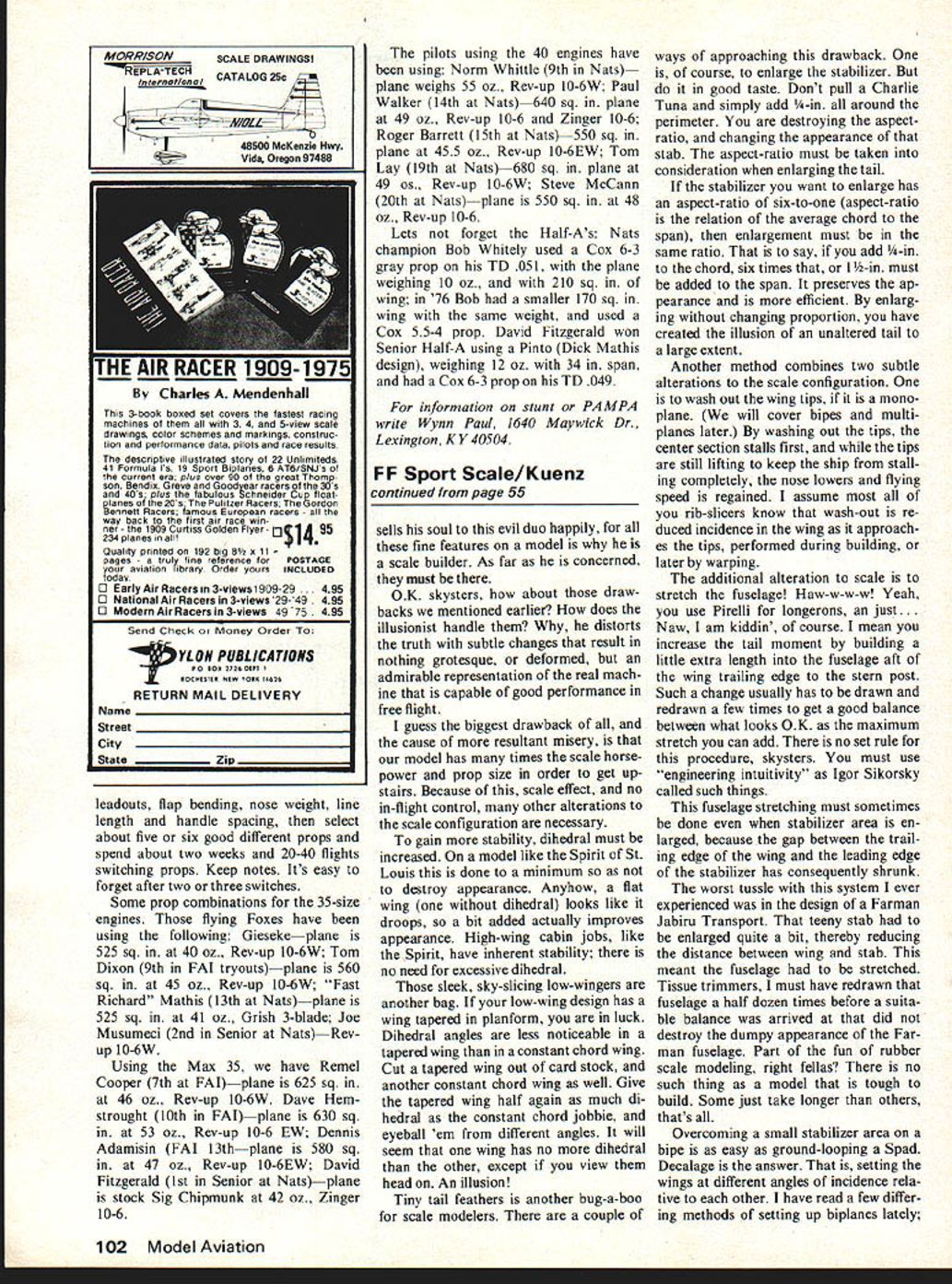
Bill has a homemade gauge (see photo) to check the tracking of the prop tips, which shows if the hub faces are parallel. Basically, he attaches the prop to the hub piece, and then adjusts the movable thumb screw to just touch one blade. After rotating the prop 180 degrees, it can be seen if the other blade touches the point of the thumb screw. If it doesn't (and in most cases it probably won't) then a very light sanding on the flat surface of the inside part of the prop hub is in order. He suggests numbering the blades, or making one, so you don't forget after taking the prop off the jig. A couple of passes with 320 sandpaper is sufficient to alter the tracking.
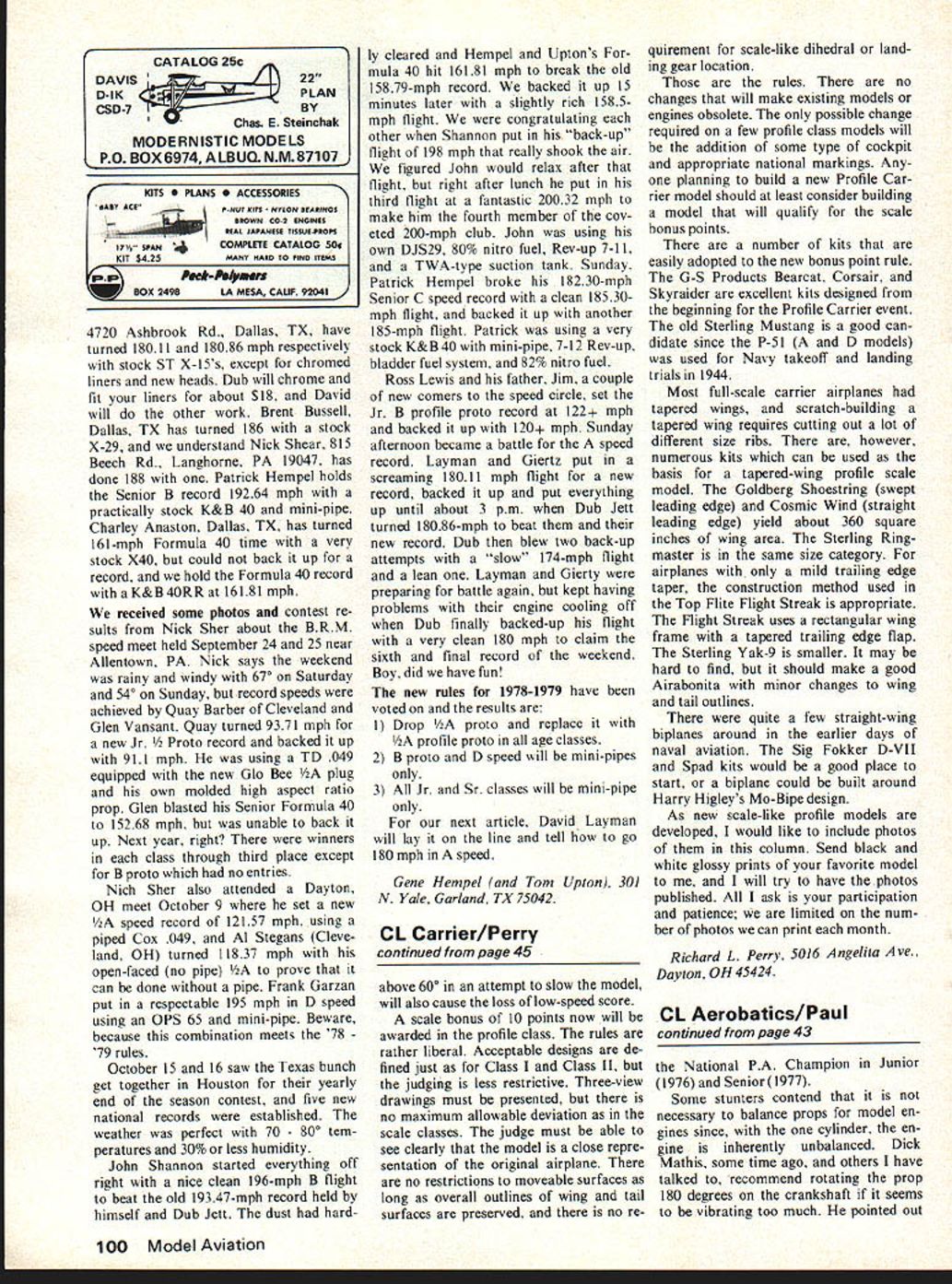
Now that the prop is tracking correctly the next bit of balancing is the more familiar type with two razor blades on an altered Austin-Craft balancer (again, see photos). Make certain that the jig is level before setting to work. Bill has three wood screws in the bottom of the base to adjust, and used a level on the top of the base.
Level the jig in both directions on the razor blades. (I wonder what sort of razor blades they use for the full-size props?) This is the type of balancing most of us have been performing for years: set the prop horizontally and see which side drops. If one side drops, we simply sand off some wood from the back side of the blade until the prop stays horizontal on the balancer. Sand only on the back side of the blades because wood removed from the front side will destroy the airfoil of the blade.
After this operation Bill then balances the prop dynamically (in the vertical position). With the prop on the razor blades in a vertical position (one blade up and one down) he sees if the blade will drop to one side or the other. After more sanding so that neither blade drops, he then checks the static balance again (the horizontal position).
This whole operation took about 30 minutes, probably longer than necessary, since I had to ask a lot of questions. I will say that the prop, after the three-phase balancing, seemed to do a very good job with no vibration at all. With a little time and some ingenuity, the average stunt flier could construct the two jigs needed to balance props this way. Bill has balanced props for Bob Gieseke, Ted Fancher, Gary McClellan, and, of course, his son David.
Control Line: Aerobatics
the National P.A. Champion in Junior (1976) and Senior (1977).
Some stuntters contend that it is not necessary to balance props for model engines since, with the one cylinder, the engine is inherently unbalanced. Dick Mathis, some time ago, and others I have talked to, recommend rotating the prop 180 degrees on the crankshaft if it seems to be vibrating too much. He pointed out that this method counteracts the basic imbalance of the engine with the imbalance of the prop. I can say that on occasions I have tried this and I think that I have detected a slight lessening of vibration coming through the lines.
You say you have a three-bladed propeller. Let me tell you about the time, at the '73 FAI tryouts, when Bill Werwage was convinced that his three-bladed prop needed some sort of balancing. You should have seen the trials and heard the comments flying as Bill, Gieseke, McDonald, Gialdini and a few others tried to figure out how to balance a three-bladed prop. It was hysterical.
A few words in general about propellers. Regarding pitch, the numbers stamped on the blade are usually the measurement at 75 percent of the distance from the hub to the tip. This is about the average pitch since the outer 25 percent of the blade displaces about as much air as the inner 75 percent, at least that's what Harry Higley of carrier and engine fame says. I won't go into measuring pitch for two reasons. I don't have a pitch gauge, and I think the average flier is better off trying several different stock props of varying diameters and pitches and blade thicknesses before trying to customize a prop, other than balancing.
Some basics on diameter and pitch: diameter helps turning ability and maneuverability; pitch helps speed. These are generalities. If you change from a 10-5 to a 10-6 with the same rpm, the plane should go faster. If you switch from a regular blade to a "W" or "EW", you probably will get noticeably more line tension; however, the plane probably will speed up in the round loops. Wider blades will put more load on the engine so, if you have a heavy airplane, you may be more prone to wearing out the engine. However, Les McDonald feels that, generally speaking, with a heavy airplane on a 35 engine, the best prop would be a 10-6W. With the larger 46-size airplane that is heavy (56 to 62 oz.) try the 11-6 EW or a Top Flite 12-6 maple prop. The wide blade at least guarantees more line tension, which can do wonders for your confidence when flying.
Three comments Les made in his recent Model Aviation article on the Stiletto, regarding prop trimming, should be elaborated on a bit. "Sanding in more airfoil at the tips gives some added line tension, but also gives a tendency to speed up in consecutive maneuvers." This is performed by sanding on the back side of the blade with a rolled up piece of sandpaper to create more airfoil. The effect is like adding pitch; it makes the tip bite the air more. "A slight clipness in the tip planform lets the prop unload for a smoother square corner at the expense of some line tension." Rounding the squared-off tips, for instance, the Zinger or Rev-Up prop, keeps the blades from biting so much air, and the plane doesn't jump around the corners so much. "Rounding the leading edge gives vertical power but slows down the model in a tight turn." Sanding the leading edge of the prop will keep it from cutting into the air; there will be more drag on the engine and it will break sooner into the two-cycle, for instance, on the upwind side of the wingover.
Good prop care and feeding. Don't fly with a chipped or ragged prop. I have heard of some fliers who rub epoxy on the tips to keep them from chipping. If you sand off the varnish when balancing, be prepared to have the fuel soak into the wood and again unbalance the prop. After balancing, rub on one or two thin coats of clear, then balance it again. Les, who is a hobby salesman, suggests that if you end up with a prop that is extremely out of balance, take it back to the shop and ask for an exchange. The hobby dealer should return it to the manufacturer.
One sidelight theory of the writer's. One of the main reasons we are getting such better maneuvering airplanes in the last couple of years with the longer span stabilizers and elevators, is that more working surface is out of the propeller slipstream. The slipstream can have a powerful effect on the flight of a model, especially if you have a "super-hog" engine turning that paddle blade.
With the Super Tigre 46 I have seen everything from a 10-6 (right!) to 11-7 Zinger (Bob Baron), to an 11-6 to Rev-Up 12-6, Top Flite 12-6 to a Rev-Up 13-5. I think it's a matter of "you pays your nickel and you takes your choice." If you have an airplane trimmed out with tip weight, leadouts, flap bending, nose weight, line length and handle spacing, then select about five or six good different props and spend about two weeks and 20–40 flights switching props. Keep notes. It's easy to forget after two or three switches.
Some prop combinations for the 35-size engines. Those flying Foxes have been using the following: Gieseke—plane is 525 sq. in. at 40 oz., Rev-up 10-6W; Tom Dixon (9th in FAI tryouts)—plane is 560 sq. in. at 45 oz., Rev-up 10-6W; "Fast Richard" Mathis (13th at Nats)—plane is 525 sq. in. at 41 oz., Grish 3-blade; Joe Musumeci (2nd in Senior at Nats)—Rev-up 10-6W.
Using the Max 35, we have Remel Cooper (7th at FAI)—plane is 625 sq. in. at 46 oz., Rev-up 10-6W; Dave Hemstroughton (10th in FAI)—plane is 630 sq. in. at 53 oz., Rev-up 10-6EW; Dennis Adamisin (FAI 13th)—plane is 580 sq. in. at 47 oz., Rev-up 10-6EW; David Fitzgerald (1st in Senior at Nats)—plane is stock Sig Chipmunk at 42 oz., Zinger 10-6.
The pilots using the 40 engines have been using: Norm Whittle (9th in Nats)—plane weighs 55 oz., Rev-up 10-6W; Paul Walker (14th at Nats)—640 sq. in. plane at 49 oz., Rev-up 10-6 and Zinger 10-6; Roger Barrett (15th at Nats)—550 sq. in. plane at 45.5 oz., Rev-up 10-6EW; Tom Lay (19th at Nats)—680 sq. in. plane at 49 oz., Rev-up 10-6W; Steve McCann (20th at Nats)—plane is 550 sq. in. at 48 oz., Rev-up 10-6.
Let's not forget the Half-A's: Nats champion Bob Whitely used a Cox 6-3 gray prop on his TD .051, with the plane weighing 10 oz., and with 210 sq. in. of wing; in '76 Bob had a smaller 170 sq. in. wing with the same weight, and used a Cox 5.5-4 prop. David Fitzgerald won Senior Half-A using a Pinto (Dick Mathis design), weighing 12 oz. with 34 in. span, and had a Cox 6-3 prop on his TD .049.
For information on stunt or PAMPA write Wynn Paul, 1640 Maywick Dr., Lexington, KY 40504.
Transcribed from original scans by AI. Minor OCR errors may remain.

