
Control Line: Aerobatics
Wynn Paul
HALF-A building Notes: After watching the Half-A stunters at the Nationals for three years, I decided to build one for "fun" this winter, and started off by ordering a foam wing from Control Specialties Company. Received the wing and the best description is a non-technical "cute." Bob Hunt sent an equal panel wing that measures 15 inches for each panel without tips. I'll probably build in about one-half inch difference by using different size tips, simply because I like unequal panels. Each of the sheeted foam flaps measures 12 inches in span, with a root chord of 1 1/2 in. and tip chord of 1 1/4 in. The whole wing, with balsa sheeting and controls in it, weighed a terrifying 2.5 oz.
The wing was joined together with 15-minute epoxy glue, using the bottom parts of the wing packing core for a jig. As Bob recommends, even for the Half-A's, I used fiberglass cloth (light) and epoxy to wrap the wing after joining the halves. A two-inch bellcrank with .018 leadouts was used. I wrapped the leadouts exactly as in the AMA rulebook, and soldered the wrap at the bellcrank end. The bellcrank was bored out to accept a long 6-32 screw that protruded through the sheeting of the wing. One-sixteenth wire was used for the control rod, and a 3.5 in. flap horn was used at the trailing edge of the wing. Contrary to Bob's and Tom Dixon's advice, I bushed the flap and elevator horns with 3/32-in. O.D. brass tubing, although I didn't make the bushing as long as I usually do for the big stunters. A 1/16-in. pushrod with one pushrod guide was used on the rear, and I did bore out the elevator bushing with a No. 49 drill bit, which doesn't leave much bearing meat, but should be enough for the Half-A. There is plenty of "slop" in the elevator now. Fortunately, I had a 2-in. elevator horn for the tail; they are difficult to come by, at least around here. Bob Hunt, of C.S.C., told me that he plans to come out with some Half-A accessories, such as flap and elevator horns, leadout guides, and possibly some gear blocks.
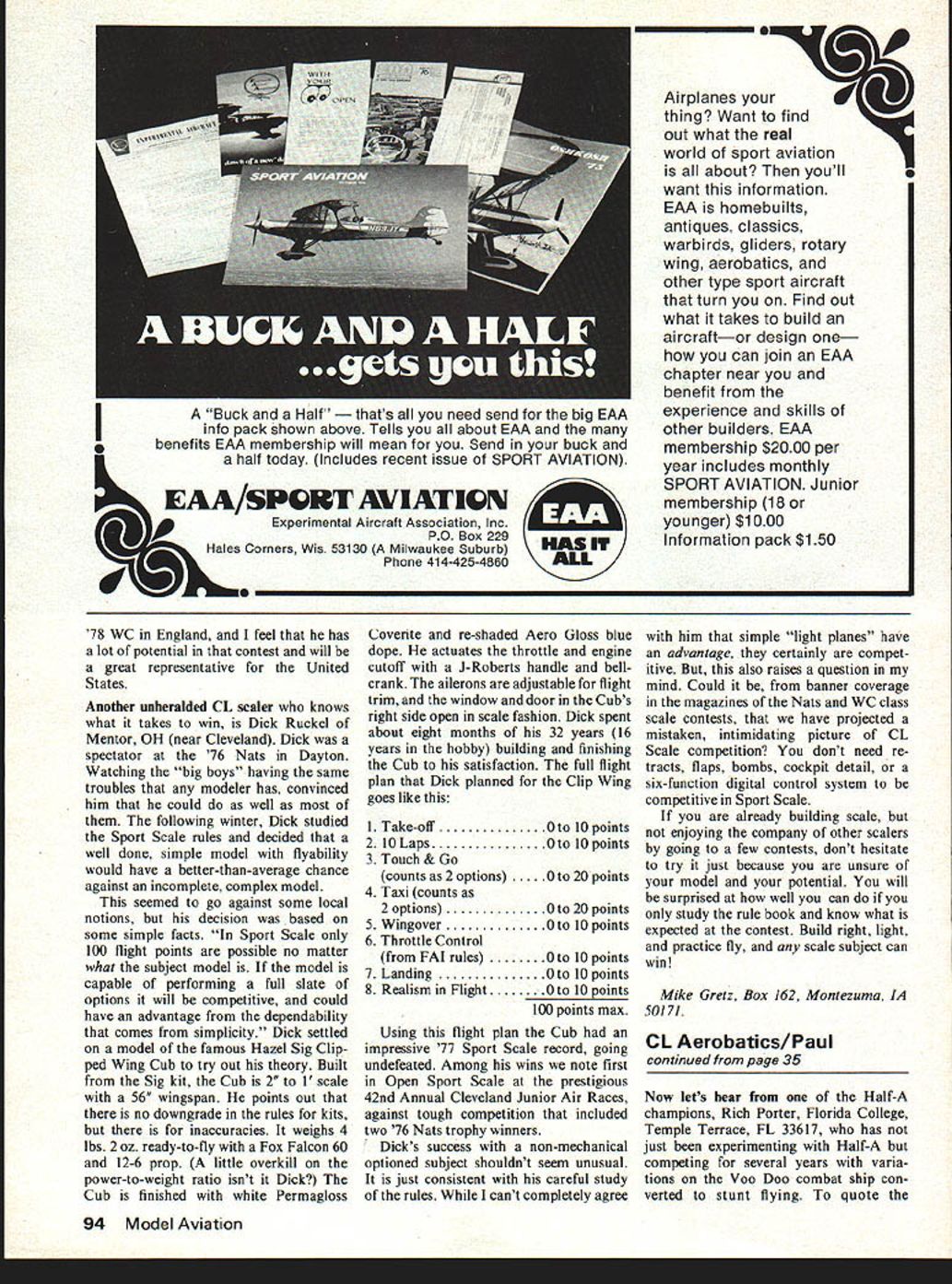
FIG. 1: Half-A Gear Blocks
The wing was already cut for landing gear blocks and Bob had installed the Lite-ply formers to hold the gear blocks. My last big stunter had removable gear, which made painting much easier, as well as allowing me to bend the gear a couple of times without that fear of breaking it loose inside the wing. I decided to see the difference in making permanent gear and removable ones for the Half-A. It came out to a total of 3.0 grams! By using two 2-56 blind mounting nuts and 2-56 screws for each gear block, I added a scant 1.5 grams to each side, and the gear is removable. See diagram one for details.
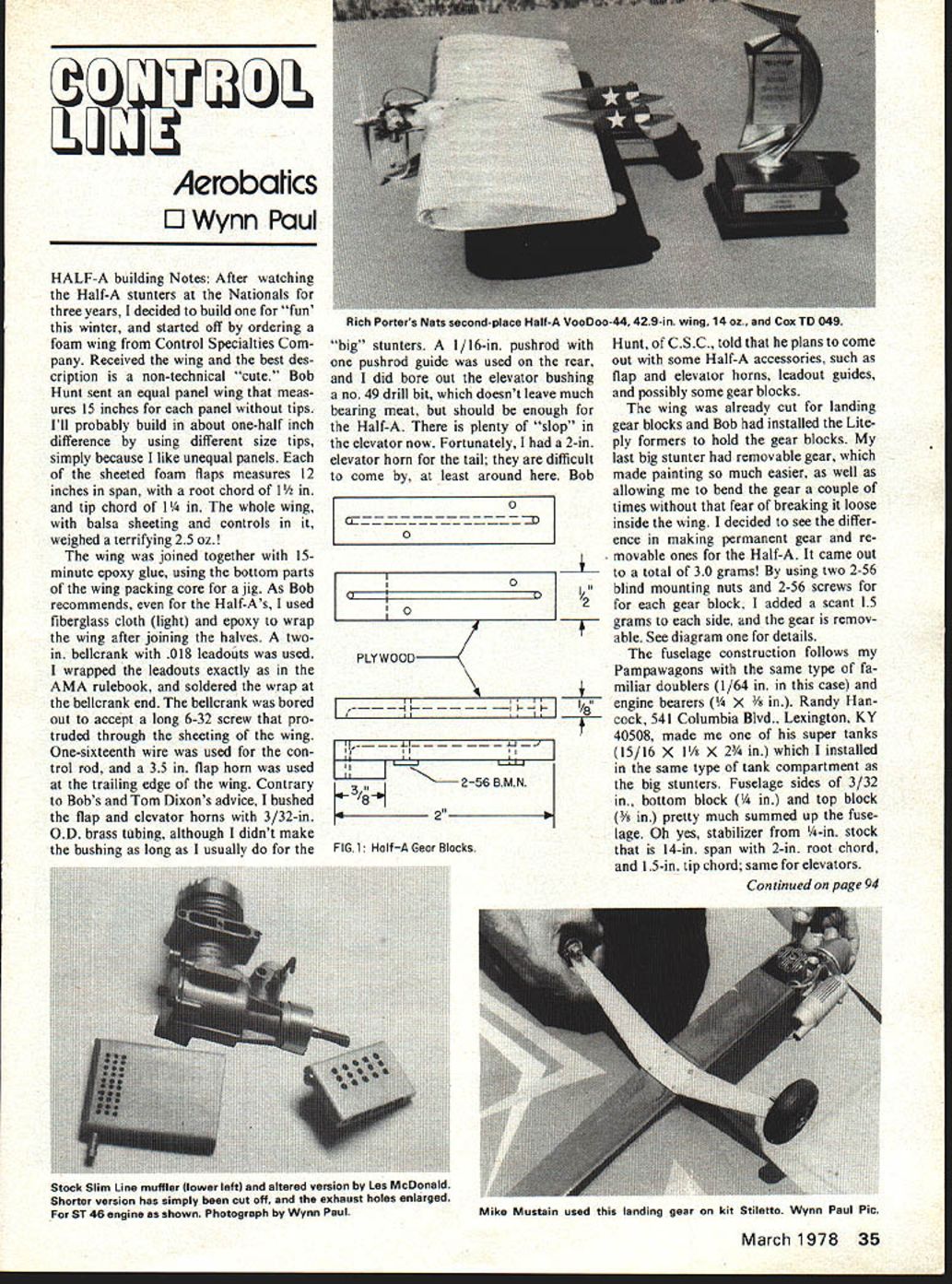
The fuselage construction follows my Pampawagon with the same type of familiar doublers (1/64 in. in this case) and engine bearers (1/4 x 3/16 in.). Randy Hancock, 541 Columbia Blvd., Lexington, KY 40508, made me one of his super tanks (15/16 x 1 1/8 x 2 3/4 in.) which I installed in the same type of tank compartment as the big stunters. Fuselage sides of 3/32 in., bottom block (1/4 in.) and top block (3/8 in.) pretty much summed up the fuselage. Oh yes, stabilizer from 1/8-in. stock that is 14-in. span with 2-in. root chord, and 1.5-in. tip chord; same for elevators. Now let's hear from one of the Half-A champions, Rich Porter, Florida College, Temple Terrace, FL 33617, who has not just been experimenting with Half-A but competing for several years with variations on the Voo Doo combat ship converted to stunt flying. To quote the unreserved Rich; "One of my main motivations for attempting to fly "simplified" Voo Doo stunters in competition has been to combat this unwholesome mystique that has kept so many potential fliers from enjoying the thrills and excitement of control line flying." Certainly, watching a couple of Rich's flights is exciting.
He states that, "200 sq. in. is just about the optimum size for top efficiency in half-A in every way. The low drag, short nose moment, and/or light wing loading (25 sq. in. per oz. or better), and relatively high speed (50-60 mph) may account for the fact that the extreme engine offset does not appear to be causing perceptible wobbling or bobbing in tight, honest 5-ft. corners (as opposed to the 20-ft. radius corners Bill Netzeband has shown most contest winners doing, as he so convincingly demonstrated to the stunt fraternity when he tried to introduce precision aerobatics into control line stunt). Remember the Humbug?"
Rich goes on, "Engine offset of 18 degrees has become pretty much standard on my 'wingie thingies.' Less than 15 degrees tends to allow line slacking, and over 20 degrees seems to cause undesirable out turning, requiring less line rake. I use a small hooked wire to pull the nylon string leadouts through the desired line rake holes. Line rake angle doesn't seem to be critical on my lightly loaded machines."
He flies the standard size Voo Doo, equipped with a tricycle landing gear, and a hopped up .049. He also has a "44" ship, which is larger size Half-A stunter patterned after the Voo Doo, but with 429 sq. in. of wing, and 42.9 in. span, weighing in at 13 oz., with tricycle gear, a factory recommended hopped up Tee Dee .049, flying on 55-ft. lines, using a 2-ounce pen bladder tank, swinging a Cox 6 x 3 competition gray prop.
Five-second laps with the "44" on 52-ft. lines; .008 lines gave him very good line tension and the ability to get through the pattern in 5.5 min. on just over 1.5 oz. of Missile Mist. Rich says, "Both the standard Voo Doo and the '44' can get 3-ft. radius loops with ease. The '44' with its large vertical fins, large swept-back wing tips, almost 100% increase in tail moment (4.29 in., vs. 2.5 in. for the Voo Doo) over the Voo Doo, appears to have a perceivable advantage in 'grooviness' over the Voo Doo, especially in turbulent air."
Rich also has something to say on lines and fuel. "Missile Mist has only about a 3-mph advantage over Cox blue label fuel, but I get consistent runs with the Fox Missile Mist as well as with the Cox fuel. Under ideal conditions 60-ft. lines have proved to be superior so far. I plan to drop down to 50 feet of .012 lines, and to use higher nitro fuel in really windy weather."
And regarding engines, "I have finally concluded that, with lots of engine offset, a side-winder Tee Dee runs significantly cooler, when the cylinder is slung in rather than out. I have known since 1965..."
Control Line: Aerobatics
that an inside hung cylinder helps to needle a tank, but only recently have I considered the cooling factor significant.
And finally, "In very calm situations the '44' can slow down to a 5-sec. lap (on 52- or 60-ft. lines) with the Tee Dee doing a rich, lazy 20 grand or less. Control and line tension are very positive, and smoothness and maneuverability are at their peak under such conditions. When the wind picks up considerably, the T.D. gets up around 21 grand or better, maneuvers are as fast as I care to fly, and rotation speed approaches a 4-second lap of 52-footers. Takeoff and landings can suffer also if the wind gets nasty, though the tricycle gear is a big help."
For his competition planes Rich uses large diameter (1 1/4 in.) but thin (5/8 in.) two-ply, cross-grain, 1/16-in. balsa wheels with small plastic fuel line tires. Rich flies clockwise, which makes his flights even more exciting as the unfamiliar direction keeps one breathless waiting for the next low pullout. Should you want to contact Rich for more information about his Half-A stunters write him at the Temple Terrace address.
Transcribed from original scans by AI. Minor OCR errors may remain.

